Coming Soon (Or More Likely Not) to an E-Reader near You – A Warning

Photo by Green Chameleon on Unsplash

So, here’s the thing: having almost certainly decided to reduce the blog to two new posts per week, I began using some of my newly acquired free time writing a new novel (I know, who knew there was an old one?) and if I’m honest, I like the way it is going; it amuses me.  The problem is that this book is a follow-up to the previous one which, I now realise I have yet to do anything with.  I have long-since grown tired of attempting to find publishers or agents who are willing even to pass a cursory eye over the kind of stuff I write – I believe that the genre of humorous fiction officially died with Tom Sharpe – and I have no desire to trek back along that road of summary rejection one more time.  I am much too old to go in for self-publicity – my sell-by date passed years ago.  I will, I suppose, eventually rouse myself to publish on Kindle and subsequently forget all about it whilst I settle fully into writing episode two.  It is a total waste of time I know, but it beats sitting in front of the telly every night with a packet of Garibaldis and a tartan blanket, dribbling gently into a mug of milky tea.

It will come as no surprise to any of you who have made a habit of reading my witterings to learn that this presents a whole new avenue for me to explore.  I understand that the manuscript will require re-formatting, which given that I have the IT skills of an over-sugared amoeba might just prove to be a little bit of a challenge for me.  I think I will enjoy creating a cover – although Lord knows how – but I worry that all of the assorted housekeeping associated with preparing the old stuff may mean that writing the new stuff might find itself shuffled into the scarily distant future and I am not happy with that.  (It is important, I feel to make the distinction here between the future [a very long time indeed] and my future [not].)  I have no great desire to leave behind a written legacy of unread treasures, and my yearning for a life filled with sex, drugs and rock ‘n’ roll has long been superseded by a desire for woollen socks and Arctic Rolls.  Never-the-less, my mind struggles with the imperative of getting the boring stuff out of the way in order that the fun bit can make some kind of sense so, perversely, book two continues to trundle on its way – by turns amusing and frustrating me – whilst book one lurks, unre-formatted, in its computer folder, having been read by no more than half a dozen press-ganged souls or, dependent upon what software has covertly wormed its way onto my pc, several million people in China and Russia.  The brief enthusiasm for getting it out there evaporated quicker than a fireside whisky once the writing had been done.

Book One is called ‘Clean’ – a tale populated with characters totally devoid of any redeeming features, from which none emerge with any kind of credit: let’s call it ultra-realism –  and Book Two – which features the same cast of unreformed ne’er-do-wells – is currently entitled ‘Clean Break’, so you can probably understand the need for book one to be read before book two, but I know that I am unlikely to attend to the practicalities of this because well, if I’m honest, I’m bloody useless and the writing of the second story is sucking me in like quicksand whilst the realities of doing something about story one weigh down on me like a hip-flask full of whisky at a Methodist wedding.    Perhaps I can format this new book so that it is written in an appropriate manner for Kindle, but I would do so in the certain knowledge that by the time I have stirred myself into reformatting book one, the criteria will almost certainly have changed, and anyway, if I like the way that book two eventually sloshes to its conclusion, I will already be half-way through the first draft of episode three (possibly ‘Clean Away’, ‘Clean Slate’ or, depending on my mood ‘Fifty things you Never Knew About Microbes’) by then.  It is the way I work.

The point is (oh yes, there is one) that I originally decided to reduce my bloggy output by one third with the intention of giving myself some extra time in which to decorate the new house, but as the move keeps getting kicked by the solicitors ever further into the long grass, the book has filled the time vacuum and will, when the paint brush is finally pushed into my sweating palm, be clogging up the ever expanding spaces between neurons.  Getting book one ‘out there’ may well prove to be even more tiresome than ‘two coats of white across six ceilings’ and book two will find itself with nowhere to go, at which point a return to three posts per week will almost certainly follow.  Just don’t say I didn’t warn you…

Frankie & Benny #12 – Coronary

“…Benny, my old friend, how are you feeling?”
“I have been better Francis, I must admit, I have been better.”
“You’re looking better than you were… when you came in, you know.”
“Well that will be, old chum, because I am no longer having a bloody heart attack.  It will be because I no longer have a fifteen stone paramedic tap dancing on my chest.”
“He saved you life Benny.”
“I know, and I’m obliged, I just wish he could have done it without breaking all my bloody ribs.  I don’t wish to sound ungrateful here, but couldn’t he see that I’m an old man?”
“Well at least you’re not a corpse my friend.  It didn’t look good back there.”
“I know.  I wonder what brought it on?”
“The heart attack?”
“No Frankie, I mean the French Peasant Uprising of 1358… of course the heart attack.”
“Well, you were on your second pie of the day.”
“Is that enough to bring on a heart attack?”
“I don’t know.  Some of those pies have been in the warmer so long they could cause Bubonic Plague for all I know.  I suppose the specialist will tell you.”
“Is that the woman in the pink trainers?”
“Could be, why?”
“She said with my diet and alcohol intake it’s a miracle I didn’t die years ago.”
“A tad harsh.  What did you say?”
“I said that when I was younger, my diet was considered ideal.”
“And?”
“She said that when I was younger, smoking was considered good for the lungs, sugar was good for the teeth and rickets was for sissies.  She said I should wake up and smell the roses.  She said I should change my diet, get more exercise and drink less.”
“And you said?”
“Is there any chance of a heart transplant instead?  A twenty year-old, teetotal heart should keep me going for years.”
“And she said?”
“‘Hearts are precious things, Mr Anderson.  We don’t waste them on old timers like you.  Just try to look after the one you’ve got.’  She said that if I behaved myself I could have years left in me yet.”
“So are you going to do that then?  Are you going to behave?  I mean, you’re a pain in the arse and all, but I don’t know what I’d do without you.”
“Maybe I could restrict my pasty intake a bit.  I’m nearly eighty Frankie, I’m too old to change now.  Nobody lives forever do they?”
“Indeed they do not my elderly friend, indeed they do not.”
“Besides, you need to think about it too.  I’m not that much older than you, you know.”
“Three years Benny, three years.  It doesn’t seem much at our age, but when we were at school…”
“We were in the same year at school.”
“I think you were held back.”
“I bloody well was not!  We started school together on the same day.  You always tell people that you’re three years younger than me, but you’re not.  What year were you born?”
“1945.”
“And I was born in 1944.”
“So you are at least one year older than me.”
“I was born in December and you were born in January: it’s barely a month.  Where do you get three years from?”
“You were always old for you age.”
“I was more sensible than you.”
Three years more sensible.”
“Yes, well now I’ve had a heart attack for my pains and you’ve had…”
“…to sit in that corridor for two days without a change of pants.  I’ve had a permanent wedgie for the last twenty four hours.”
“You sat out there for forty eight hours?”
“Of course I did.  You’re my oldest friend Benny, besides, you had my front door key in your trouser pocket and they wouldn’t let me search for it.  I asked the nurse if she would have a bit of a rifle through your kecks and she said that there wasn’t sufficient hand sanitizer in the hospital for her to risk that.  She said that if she got five minutes she would set fire to them and rake through the ashes when they’d gone out.”
“They were clean on!”
“Mm, but they weren’t clean off, as it were.”
“…I can’t even remember what happened.”
“You remember years ago when we went to the cinema and Ursula Andress came out of the sea in a bikini?  Well your face kind of went like it did back then and you gurgled.”
“Gurgled?”
“Yes.  Well you were two parts of the way through a pie at the time, so I didn’t think much of it until you fell of the stool.  To be honest, I wouldn’t even have thought too much about that if it hadn’t been so early in the night.”
“So you phoned an ambulance?”
“Well, I phoned them, yes, but they didn’t come.  Apparently the paramedics remember the last time they got called out to The Travellers so they refused to come again without police protection.”
“And the police?”
“They, Benny my friend, also remembered the last time they got called to the estate.  They wanted the army calling out.”
“So how did I get to the hospital then?”
“I couldn’t leave you on the floor, could I?”
“You carried me?”
“Are you mad?  I’m no spring chicken myself you know, and let’s be honest, you take a bit more lifting than you used to… I pushed you round in a wheelbarrow.  It’s a wonder I didn’t have a heart attack myself.”
“People let you push me round here on your own?  Nobody offered to help?”
“Most of them thought you were pished to be fair, although I must admit that if the Bible were being written that night, it would contain the Parable of the Totally Indifferent Samaritan.”
“How long did it take you?”
“About twenty minutes, but I did nip into the offie for a scratchcard on the way.”
“You left me dying in a wheelbarrow while you bought a scratchcard?”
“I got one for you as well.”
“Oh well…”
“You didn’t win mind.”
“You scratched my scratchcard?”
“Well I wasn’t sure that you’d… you know.  You kept moaning ‘Don’t let me die Frankie.  I’m not ready to die…’  You’ve always been a bit of a moaner.”
“Frankie, I was in a wheelbarrow… dying.”
“I didn’t know you were dying.  I thought it was wind.”
“They’ve fitted stents!”
“Oh well, that’s good then.  So are you all better now?”
“I’m going to be ok I think.  I just have to be careful.  The specialist said I shouldn’t drink anymore.”
“Any more?  Was she talking volume?”
“I presume so.”
“So a small glass is preferable to a large one?”
“That is what I assumed, yes.”
“And she never mentioned Wagon Wheels?”
“Not by name, no.”
“Good, because I’ve got a hip flask and Wagon Wheels in my bag.  Come on now, sit up Benny, we’ll drink to your health my friend.  Cheers…”

For your information, ‘the offie’ is the Off-Licence: a shop for the out-sales of alcohol and Wagon Wheels are large chocolate covered mallow-filled biscuits.

If you like these two old boys, you can find previous conversations at
Frankie & Benny #1
Frankie & Benny #2 – Goodbyes
Frankie & Benny #3 – The Night Before
Frankie & Benny #4 – The Birthday
Frankie & Benny #5 – Trick or Treat
Frankie & Benny #6 – Christmas
Frankie & Benny #7 – The Cold
Frankie & Benny #8 – Barry
Frankie & Benny #9 – Vaccinations
Frankie & Benny #10 – Anniversary
Frankie & Benny #11 – Dunking

A Little Post about Blogging – How Things Work

It’s an odd way of going on I know, but occasionally I write something that I really want to like, but for one reason or another (alright, usually for one reason only: it is rubbish) I just can’t.  With most sub-standard posts – and there are many – a swift click on the ‘delete’ button, the single most used key on my keyboard, is al that it takes to rid my mind of them.  A coffee or (if there is a ‘Y’ in the day) a whisky and a chocolate bar and I am ready to go again.  Like all ailing software, my brain is washed of all detritus by a simple reboot (unless it has a virus, in which case it becomes fully engaged in feeling sorry for itself, at which point all scheduled tasks are put on hold and 111 is added to speed-dial).  Every now and then these pieces just fall onto the page, blithely unusable, but refusing resolutely to vacate the synapses, clogging the gap between neurons with something that pops into my consciousness, like Sandra Bullock, whenever I let my guard down:  I have to deal with it.

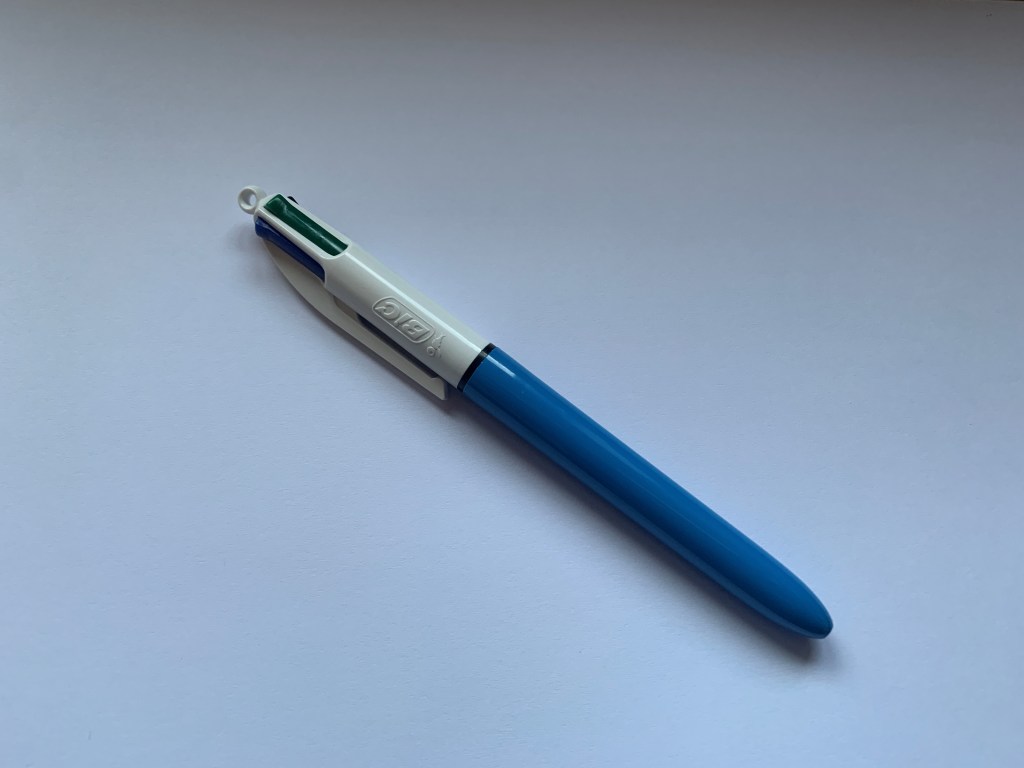
I do so by printing what I have and leaving it where it cannot be ignored.  I lay my little 4-colour Bic biro (the single greatest invention of the second millennia) across the paper, ready primed on green, while I try to pretend that it doesn’t matter to me, at which point I decide (obviously) that actually it really does, and try to massage the words into some kind of shape (generally an amorphous blob) crossing out, moving, re-writing, adding, subtracting, adding again until it is impossible to make any sense of it, at which point I transcribe the whole sorry lot back onto the computer, print it up again and click down the red refill on the pen.  (This whole process is intensified by a factor of approximately one million if I am attempting to write ‘a poem’, in which case I can spend up to three weeks fretting over a single word – usually the name of a biscuit – from a stanza that will almost certainly be completely deleted just as soon as I find another rhyme for ‘spanner’.)

By this time the post will most certainly have moved some distance from its original form: it may well have evolved a new ending which requires an entirely revised introduction and, perhaps, a mid-section that does not rely quite so heavily on the reader’s knowledge of Fourteenth Century Ship Building.  It will no longer be funny, but the syntax will be less familiar to scholars of the Rosetta Stone.  Red pen follows the same ‘add, subtract, move and rephrase’ routine as green, but in an altogether more ‘modern’ way: any jokes that remain are underlined and scrutinized in order to remove all possibility of causing offence and, on the basis that there is always someone desperate to be affronted, subsequently drained of all life and humour.  Following a red re-writing – which can, by the way, take several weeks and three ethics committees to complete and deplete a pen refill by anything up to an inch – the now tattered document will read like an instructional briefing at the local morgue and could only be made less interesting if read aloud by Alan Titmarch.  Transcribing the mess back onto the computer is like tip-toeing through a darkened room, the floor of which is strewn with Lego mousetraps, but eventually – in the brief moment that it agrees to connect to the network – the printer whirrs into life and the pen clicks onto blue…

It is generally about this time that I realise that I actually preferred the original version, but that I no longer have a copy of it due to my habit of shredding everything I do after I have despoiled both sides of the paper, the majority of which comprises the ‘b’-sides of official communications, red bills and ‘letters to self’.  By this time, reading through the piece is like being forced to listen to a euphonium concerto after accidentally scrubbing ‘Stairway to Heaven’: it is like discovering that your copy of The Complete Works of Shakespeare was actually written by Dan Brown.  I will often attempt to rewrite passages that I have long-forgotten and cross out everything that does not easily slip into my chosen category of ‘humour’ in order that I do not find myself being sued by someone who has read every word I have ever written but has never laughed once – especially given the deplorable condition of my grammar and capitalization bordering on the cavalier (Cavalier?).

Blue re-writes can involve much soul-searching, but more regularly feature something red which tastes as though it may have been strained through a docker’s sock and some kind of dry-roasted peanut induced mania.  Another new beginning or ending may have been appended, making – like a Russian history lesson – a nonsense of everything that lies between.  Blue edits are overlaid on green and red computer versions and a final reprint allows me to throw the kind of jokes that killed the humour periodical at it – in black ink, because favouritism is never a good thing.  (Perhaps now is a good time to reveal that I have four of these 4-colour Bics on the go at any one time and use them in strict rotation – or would, if only I could work out which is which.)  Having exhausted all four inks there is, after all, very little left for me to do to improve a post which will almost certainly find itself gathering binary dust in the depths of my Documents File for the rest of its natural life, except that it is, after all, one of those posts and I need it close at hand in case I ever find a different colour to write it in and having just read it through again, well, it’s really not so bad now I come to think of it…

A Little Fiction – The Trouble with Meeting Any Tom, Dick or Harry

There is, apparently, an epidemic of loneliness amongst the middle-aged and elderly.  Opportunities to meet other single people in an ‘organic’ manner are vastly reduced as we get older and for some people, many of whom may have been in a stable relationship for many years, the whole business of meeting new people can be a bridge too far.  It is with some surprise, therefore, that I learn that Speed Dating, the most synthetic and pressurised mode of social intercourse that humankind has yet devised, has, for an increasing proportion of ageing singletons, become the preferred manner of meeting people and, perhaps, finding a partner.  I tried to imagine how this might work…

DING!

Mary: …Are you alright?

Tom: Yes, it’s these chairs.  What’s the point of the arm rests?  It’s a bugger of a job to get into them without popping the front of your shirt out of your trousers – not ideal when you’re trying to make an impression; especially when you’ve not really had time to change your vest since last Sunday’s gravy incident – also, could put your hip out; twist too far trying to get your knees under these tables…

Mary: Right… well… I see.  Yes.  Well, I’m told that the best thing to do, because we’re obviously time-limited, is to get the personal details out of the way first, so, I’m Mary, I’m a retired teacher.  I like walking on the beach in the early morning.  I love music and books – clichéd I know, but true – and I’m allergic to cats.  You?

Tom: I’m… ooh, excuse me.  I had beans for lunch.  Always do that to me, beans, still, better out than in eh?

Mary: Well… I suppose…

Tom: Tom.  I spend my time in the pub mainly.  Don’t have many friends, that’s why I’m here: thought that I might be able to get a bit of… well, you know, woman of the world and all that.  Teacher.  Don’t just learn about such things, if you catch my drift, eh…

Mary: Er… well, I don’t really…  Oh, there’s the bell.

Tom: Bell?

Mary: Yes, the bell.  Time to move on I think.

Tom: I didn’t hear a bell.

Mary: Really.  I definitely heard the bell.

Tom: Nobody’s moving.

Mary: I am…

DING!

Mary: Hello.

Dick: Hello.

Mary: How are you?

Dick: I’m ok, thank you.

Mary: I’m Mary.

Dick: Dick.

Mary: And this is?

Dick: Ah, this is my mother, bless her.  Can’t leave her at home on her own – don’t want her setting fire to the beds again, do I hey mum?  Always bring her along to these things, don’t I?  Yes, gives her a bit of a day out… doesn’t it mum?

Mary: So… you do this regularly then?

Dick: Oh yes, every week.  We get a nice cup of tea – although it could do with a bit more milk if I’m honest – and a biscuit, and mum gets to meet all of my new lady friends, don’t you mum?

Mary: Lady friends?

Dick: Oh yes.  Like to check people out, don’t you mum?  Spends hours when we get home going through people’s Facebook accounts.  I think it’s so important that older people have a hobby, don’t you?  Do you have a Facebook page?

Mary: Oh, there’s the bell.

Dick: No, we have another two minutes and fifty-two seconds yet.  Must have been somebody’s phone.

Mary: I definitely heard ringing.  I’m sure it was the bell… Actually, I feel a little hot.  I must just go and powder my nose.  Don’t wait; I might be a while… and can I have my phone back please.  I’m not sure that I’m comfortable with your mother licking it…

DING!

Mary: Hi, I’m Mary.

Harry: Harry.

Mary: Hello Harry.  Look, I hope you don’t mind me asking, but do you do this sort of thing often, only I…

Harry: No.  No.  This is my first time.  It’s been a couple of years now since my wife died and I…

Mary: Oh, thank God!

Harry: Sorry?

Mary: No, not thank God that your wife has died… obviously.  It’s so sad, I…  It’s just that you’re the first person I’ve met here who actually appears to be sane.

Harry: Oh, I see…  I’m sorry, I’m not very good at this…

Mary: No, it’s fine.  It’s my first time too.  Although my wife hasn’t died.  Well, husband… probably.  That is, I have never had either, so they couldn’t have… died… at all… How old was she?  No, you don’t have to answer that.  I don’t know why I…  Look, just so that you know, if I’d had anyone that might have died, then it would be a husband and I haven’t.  I had a partner, but he isn’t dead, unfortunately.  He’s in Tunbridge Wells with his wife.  I made him choose, you see – so he did.

Harry: I’m sorry…

Mary: No, don’t be.  I’m over him.  I’m better off without him.  I… oh bugger, now I’ve made my lip bleed again.

Harry: I think you bit it.

Mary: Yes, yes, I know, thank you very much.  It’s just something I do when I… It’s just something I do.  So, you say your wife has been dead for two years now…

Harry: Yes

Mary: How do I know I can believe you?

Harry: I’m sorry, I…

Mary: How do I know you haven’t got her tied to a chair somewhere?  How do I know she’s not waiting back at home for you with a freshly opened bottle of Chardonnay and a packet of those wrinkly little black olives?  How do I know that you don’t have half a dozen children waiting for you to read them a bed time story?  I know your kind.  You’re all the same, you…

Harry: Oh, there’s the bell…

Mary: Bugger…

First published 14.09.2019

It is not unusual for me to find that things do not end quite where I originally intended them to…

Making Use of a Bedpan*

I am fascinated by words.  They have been a lifelong passion for me.  They can be manoeuvred and moulded, used in ways for which they were not necessarily intended.  It is impossible to write without them.  The best words of all are those that make people smile.  Mostly they are ‘fruity’ words, that require moistened lips and ample saliva, but they can be what my grandma used to call ‘saucy’ words, mispronunciations or even just plain old sound-alikes: so many words have the potential to be funny.

Graham Chapman told a story in his Liar’s Autobiography of a time when he was simultaneously writing multiple sit-coms, one of which was Doctor in the House (co-written with John Cleese).  Often they would be short of ideas, but they realised that the word ‘bedpan’ always got a laugh, so they used it ad lib in place of actual jokes.  It is a particularly British trait to snigger at words that we believe to be slightly ‘smutty’.  No English man can listen to an American talking about Fanny Packs without stifling a giggle simply because, over here, fanny is a colloquialism for a very slightly adjacent lady-area, and whilst we know perfectly well what you mean, you just said ‘fanny’ in front of your grandma for goodness sake!

There are ‘rude’ words that can be legitimately used in other contexts (try ‘ejaculate’) that are never-the-less almost certain to illicit a smirk from grown men who really should know better.  Never forget, most men will chuckle over perfectly normal words if they happen to catch them off-guard.  Try dropping a stray ‘breast**’ or ‘vagina’ into a conversation that is half-heard by a middle-aged man and his urge to stifle a laugh will almost kill him.

The best words, without doubt are the fruity words that are in no way ‘rude’ but sound as if they ought to be.  ‘Flange’ will always cause a most unfortunate intake of coffee into the lungs, as will ‘littoral’.  In fact almost anything that could feature in a rhyming dictionary against any part of the female ‘down there’ paraphernalia will always cause stifled laughter in the male.  It explains why male doctors always smile slightly when telling female patients they have ‘acute angina’.

Which brings me to the Queen of all comedy words: a word that it is quite literally impossible to say without smiling (try it).  ‘Moist’ can be used in a million ways but, written down, it always seems ‘naughty’; although it often has no alternative, it always sounds as if it has been chosen for effect and it is impossible to say without actually moistening your lips.  It is a full, round and juicy word that will brighten any sentence and one that it is almost impossible to take seriously: compare the effect of being told you have a ‘seeping valve’ with that of ‘moist plumbing’.

The joy of writing is always in finding the right word, rather than the correct one.  And that always makes me smile…

*I was trying to find a ‘non-funny’ synonym for ‘bedpan’ and I tried ‘commode’, ‘potty’ and ‘receptacle’ for size, before I stumbled upon ‘thunder mug’ and decided not to bother.
**The average British male has more words for ‘breasts’ than Eskimos have for snow.

A Deficit of Calories – Dinah & Shaw (14)

Photo by Janko Ferlic on Pexels.com

Dinah was a little ashamed to admit that money was no longer a concern for her, not because she had any, but because she had grown used to having none.  It had become nothing more than normal and although her middle England, middle-class upbringing meant that she always fought to pay her way she had grown accustomed to the fact that she couldn’t always do so – at least without slipping into the kind of time-scale that could accommodate the death of an entire galaxy.  Being with Shaw, she had become resigned to things being the way they were, just because that was the way they were.  It was the way that things went with Shaw – she always knew that something would turn up before disaster knocked.  Or at least before it knocked too loudly.  She billed clients for their services whenever she could: some of them paid and some of them threatened to sue, and she went through Shaw’s pockets whenever the opportunity presented itself in search of long-forgotten dog-eared cheques and any manner of tender that, in any way, could be described as legal.  At times she felt as though she was single-handedly keeping their heads above water, but she had learned that there was nothing to gain from trying to make Shaw face up to reality, to confront issues of which he was blithely unaware.  He was even more annoying when he tried to put things right.  It was a tacit agreement: she worried about paying the bills and he worried about… well, nothing really.

To be fair, he had buckled down in some respects recently and had started to take on what Dinah referred to as ‘proper cases’: investigations requested – and paid for – by people who had found their agency on Facebook without encountering the slanderous truths expressed by some of their ex-clients, but he still had a tendency to wander off – distracted by a paradox of which only he was aware – to solve instead a conundrum that nobody else knew existed.  She would have been far happier if he could have – even just once in a while – managed to solve the case he had been asked to solve by the person who was willing and able to pay them for results, but loathe that she was to admit it, she was happy – even the way things were.  She wouldn’t have changed anything much… well, she probably would have changed everything other than the strange, ramshackle, absent-minded stick of a man she had somehow hitched her cart to.  He maddened her and gladdened her by equal measure, and somehow, when she was at her lowest ebb, he always managed to come up with the goods.  Seldom the right goods, but a girl can’t have everything…

…He wandered into the office as she was half-way through putting her coat on to leave for the evening.  He was examining a stick of celery as though he had never seen one before.  “I’ve been thinking,” he said.
Dinah groaned inwardly and slumped down into her chair, forgetting the caster that Shaw had assured her he would mend, pirouetting like the plastic ballet dancer in a child’s jewellery case behind the desk.  This was never a good sign.  Shaw’s ideas seldom took heed of consequence.  She steadied herself, somewhat lopsidedly, against the desk and looked up at what the door proudly declared as her ‘parnter’.  “Go on,” she said.
“Sorry?”
“You said you were thinking.”
“Yes, I was,” he affirmed proudly.
“And?”
Shaw looked at once bemused and alarmed.  Nothing unusual there.  Even after the time he managed to accidentally shave off both his eyebrows he still managed to look perpetually shocked.  “I’m sorry, I… what do you mean ‘And?’”
“You said you were thinking,” said Dinah.  Shaw nodded.  “So what about?”
“About?”  Dinah’s turn to nod.  “Well, nothing really, I was just thinking.  At least I don’t think it was about anything.  I forget…”  He returned his attention back to the celery.  “Do you know, you use up more calories in eating celery than it contains.  The more you eat, the thinner you get.”
Dinah stood and pulled it from his hand.  “Then I don’t think it’s a good idea for you, is it?  If you get any thinner, you’ll disappear.  Why can’t you be like normal men and eat pies and chips and chocolate?”
Shaw pouted.  He would have stamped his foot if his shoes had been up to it.  “The woman downstairs gave me that!” he said.
“What woman downstairs?”
“She said she was looking for ‘Shaw and Parnter’, said she had a job for us.”
“And she gave you celery?”
“Not straight away.”
“After you accepted the case I hope.”
Shaw had the good grace to look decidedly sheepish.  “I told her we’d think about it.”
“Well,” said Dinah, “We’ve thought about it.  We’ll accept it… What is it?”
“I’ve no idea.  She never said.”
“So how were we going to think about it?”
“Good point,” conceded Shaw.  “Could we ring and ask her?”
“Yes!”  Dinah clutched her phone.  “What’s the number?”
“Ah.”
“You did get the number, didn’t you Shaw?”
“What sort of a question is that to ask of a fully grown businessman?”
“You didn’t get the number, did you?”
Shaw shook his head apologetically.  “I got distracted by the celery,” he said.  “She had bags full of it.”
“Why would you have bags full of celery?”
“That’s what I asked her.”
“And?”
“She didn’t say.  I expect she was going to make soup.  I expect she havered when Raj asked her what she wanted.  You know what it’s like if you go into Raj’s without knowing exactly what you want.”
“She got the celery from Raj?”
Shaw nodded.  “I expect she went in for an onion…”
 Dinah rushed towards the door, grabbing her coat from the chair which, exhausted with its attempts to remain upright, collapsed and died on the office floor.  “Come on,” she shouted.  “Quickly!”
Shaw looked over his shoulder as if expecting to find that Dinah was actually addressing somebody behind him.  “Me?” he asked as Dinah fled for the stairs.
“Is there anybody else?”
Shaw thought it wise to check one last time, but he was definitely alone, so reluctantly he started to follow Dinah out into the street.  This was the trouble with Dinah, he thought, all action and no time to fully think things through.  “Where are we going anyway?” he asked, when he eventually caught her, using up what little remained of his breath following his ten yard sprint.
“Raj’s,” she said.  “He’ll know who she is.  He’ll know how to get in touch with her.  We need this case Shaw – whatever it is.  We need to pay the rent , we need to pay the electricity and you need to eat something that doesn’t actually make you thinner that you already are.”
“But…” he ventured as Dinah tumbled through the jangling greengrocer’s door ahead of him.

“The lady with the celery?  Oh yes, I remember her quite clearly,” said Raj.  “Unusual for somebody to buy so much of it.  Do you know, it uses up more calories eating celery than it contains?”
“Yes.  My learned friend here as explained that to me.  Now Raj, think carefully, who is she and where does she live?”
“Not a clue,” said Raj.  “Never seen her before.  She came in here looking for you, so I told her that kind of information doesn’t come for free.”
“You made her buy celery?”
“I did her a deal.  To be honest, it was wilting a bit…  Didn’t she come to you?”
“She did, but my gangly partner here managed to let her get away.”
“Ah.”  Raj looked genuinely concerned for the about-to-be-tearful Dinah.  “Here,” he said handing her a banana that looked like it had gone twelve rounds with Tyson Fury.  “On the house.”
Speechlessly she took the banana and left the shop with a forlorn Shaw trailing behind her.  “You’re not going to cry, are you?” he asked.
“No Shaw, I am not going to cry.  I refuse to cry.  I am going to go home and drink cheap wine.  I would buy a kebab if I had any money.”
“Ah,” said Shaw.  “Is that the problem?  Here.”  He passed Dinah a roll of cash which he pulled from the inner depths of his threadbare greatcoat.
“What’s this?” she asked.
“Oh, has all my training been in vain…” he said before catching a faint flash of barely submerged anger in Dinah’s eyes.  “It’s money,” he said, seeking protection in the blandly truthful.
“How much?”
“Not a clue,” said Shaw who had quickly passed his humdrum concerns threshold.
“Well, where’s it from?” asked Dinah, already unrolling and counting the polymer bundle.
“The celery lady.  She called it ‘a retainer’.  She said she would be in tomorrow to discuss the case…”
“Why didn’t you say before we went to Raj’s?” asked Dinah taking Shaw by the hand and simultaneously tucking the cash down into the very darkest recesses of  the carrier bag that was as close as she came to a handbag these days.
“Well I…  I don’t know,” he said.  Things just…”  He thrust his hands deep into his pockets and followed Dinah up the stairs to the unlocked office.  ‘Some people,’ he thought, ‘are never happy.’
Dinah turned to him, the barest hint of hopelessness in her face.  “You will try to concentrate on the case won’t you Shaw?” she asked.
“Of course,” he said.
“Promise?”
“Promise.”
“Good,” she said.  “You know we need this.”
“Yes, I understand,” he said. 
Tension swept out of Dinah’s body.  She felt suddenly serene.  She was a jellyfish.
“There’s just one question,” said Shaw, and bones crashed back into Dinah’s frame as she prepared for the ceiling to fall in on them.
“Can I have my celery back now?…”


The Truth, the Whole Truth and Nothing but the Truth

Whenever people ask me “What should I say?” (and they do, which is odd, because I am world champion at saying exactly the wrong thing at precisely the wrong time) I always give the same answer, “Just tell the truth.”  It is so much easier than trying to manage a landscape of falsehoods, however well-intentioned they may be.  A little white lie in order to shield someone from a painful truth is all well and good, but they are none-the-less unlikely to be happy when they find out you have been lying to them.  Lies will always find you out.

I’m not suggesting that you go out of your way to be brutal with the truth – friends don’t do that – but I do know that the protection offered by a lie is transient and that the truth becomes even more painful when the ‘shield’ has faded.  Saying “Yes” when your best friend asks you, “Does my arse look big in this?” is unlikely to score you brownie points, but hiding the truth could be worse.  “It looks like a balloon!” probably doesn’t strike quite the right note – even if true –  and “Well, I’ve seen bigger,” is not necessarily any better, but if you care and you try, you will find a way. (If you are a male, you may be faced with the even knottier problem of ‘Here, do you think this is normal?’ in which instance neither ‘yes’ or ‘no’ is the correct response.)  You are mistaken if you expect me to offer any guide to what you should be saying – I have the antithesis of a silver tongue, probably pig-iron – I spend too long with my foot in my mouth to make my words easily decipherable.  When all else fails, suggest calling The Citizen’s Advice Bureau. 

My welded bond to ‘the truth’ is seldom bound to piety but is wound up instead to the simple practicalities of my own ineptitude.  I am no paragon of virtue; simply aware of my culpability as a major-league beacon of incompetence. I spend most of my life feeling as though I really ought to be apologising, but seldom sure of what about and to whom.  I am the king of obfuscation: not by intention, but by inability to consider either lying or knowingly causing distress.  If you have a secret I think I might be a bad friend.  I certainly wouldn’t ‘tell’ on purpose (actually, that is not strictly true, in certain circumstances, dependent upon the nature of the ‘secret’, I suspect that I almost certainly would) but I would also find it difficult to actually lie: secrets kind of ooze out of me, not voluntarily, but by action or reaction.  They find their way out by some kind of osmosis.  Friends and family know instinctively that I have a secret to keep and, should they suspect that they may be on the receiving end of let’s say a surprise birthday party, they keep their distance from me in the certain knowledge that it won’t be long before I accidentally reveal that I can’t look after the kids because I’m waiting in for a delivery of champagne for your… bugger, bugger, bugger!  I have been the unwitting nub of familial data breaches, on the basis of pure incompetence, more often than I would care to remember.  “Don’t tell mum, but…” is the signal for me to go to pieces.  It is far better that I am given neither bag nor cat to let out of it.  Happily, most people who know me understand that I am a lost cause and choose not to burden me, because when I let go of a ‘good’ secret, I won’t lie, I feel wretched.

A Little Fiction – OldenEye

…007 sat back in the deep, yielding burgundy leatherette swivel chair, his chin resting on the pyramid of his fingertips.  His once-steely eyes were focussed glaucously on the minister, he could see his lips moving – just – but he did not hear a word he said.  His mind was preoccupied with thoughts of how he would get out of the recliner without putting his back out.  Again.   The minister smiled benignly at the supposed indifference of his senior spy and flipped open the lid of an exquisitely inlaid wooden box.  Involuntarily, Bond’s body tensed and he was again thankful for the ‘special’ pants in which his house-keeper had dressed him.
“Cigar, James?”
With an almost deft flick of his finely manicured hand, the super-spy fiddled at his ear, knocking the miniature hearing aid to the floor, where it whistled irritably.  Bond struggled to his feet and reinserted the apparatus, back to front, so that it echoed eerily around the office.  The minister smiled again.  Obviously a little piece of Q’s genius, cunningly designed to foil concealed electronic bugs or somesuch.  “Cigar, James?” he repeated.
“No thank you,” said Bond, who had decided not to try the swivel chair again, but was standing at the corner of the minister’s desk, resting his weight on a red telephone and wheezing gently.  Having reinserted his hearing aid, Bond was able to hear the minister, whom he was saddened to hear was suffering from some sort of adenoidal problem.  “I am very aware of my responsibilities as a role model for the young.”  Advancing years had made Bond ever-more conscious of the debt he owed to the planet that he, in his prime, had saved on many occasions from nuclear destruction with little, if any, consideration to the biodegradability of the apparatus he employed.  “Now,” he said.  “What can I do for my country?”
The minister explained in great detail the nature of the latest threat posed to the free world by Ernst Blofeld and he was almost sure, at times, that Bond understood a little of what he said.   Satisfied that he had his most senior agent on the job, the minister waved him away airily and 007 left the room, finding the correct door at only the third attempt.

In the stores, Q issued the special equipment.  “Of course,” he said.  “We’ve had to garage the Aston Martin, James.  The emissions were simply unacceptable.”  Bond nodded his understanding.  He had a similar problem.  “But we’ve beefed up this electric trike for you.  Push this red button here and the booster cuts in giving you a top speed of anything up to eight miles an hour, depending on the wind; three-wheel drive will enable you to continue pursuit across all terrain – providing of course that it’s flat and surfaced; there’s an in-built MP3 player, pre-loaded with Coldplay’s greatest hits and concealed behind the seat here is one of those clever little adapters that allows you to plug your vehicle in anywhere in the world.”
Bond grinned.  “And the range?”
“Twenty miles,” said Q.  “Fifteen if you use the booster.  Should be plenty to get you to the bus stop…”
Bond signed out an e-cigarette that concealed a radio transmitter, a comb that concealed a powerful magnet, and a tube of ointment that concealed the worst of his rash, all of which he stashed away under the cleverly designed hinged seat of the trike. 

And so, as evening drew into night, James Bond trundled off into the enfolding darkness, unconcerned by the danger that lay ahead and untroubled by the gangs of youths that garlanded his route – mostly because his glasses were steamed up so that he couldn’t see them, and his hearing aid had fallen out in Penge.

…“A virgin martini please, shaken, not stirred…”  The barman looked quizzically at Bond, who would have raised an eyebrow in reply, but he was wearing contact lenses and he didn’t have any spares.  Bond moved his face very close to the barman.  “Tonic water,” he whispered.  “Slimline if possible, with ice and a slice… oh, and put one of those little umbrellas in it will you?”  He began to rifle through his purse, searching for the correct change, when a female voice behind him said “Put that on my bill, would you?”  The barman nodded and handed Bond his drink.  The woman joined Bond at the bar, hoisting herself effortlessly onto the stool.  Bond recalled his own battle to mount it with distaste.  He could still feel the bruise swelling on his shin.  The woman reached out an elegant hand.  “008,” she said.  “Pleased to meet you Mr Bond.”
“Likewise, I’m sure,” said Bond.
“Won’t you join me for dinner?” she smiled.

The meal was acceptable, although Bond would have preferred something a little more… fried, but the company was scintillating.  Memories of conquests-past flooded Bond’s mind and he found himself, almost subconsciously, taking a little pill with his dessert.  He knew that he could trust a Rennie to ensure a good night’s sleep.  008 sparkled.  Her conversation was engaging, witty, seductive.  She laughed and her laughter was like a summer breeze; bright and joyous.  He laughed and coughed up a piece of carrot the size of Sheffield.  A bubble of sauce escaped his nose.  She spoke of life and love in a way that Bond had never considered.  She spoke of Keats, Shelley and Chaucer almost as if she actually enjoyed them.  In the past, of course, he would have seduced her, but something told him that, delightful though she was, it was just conceivable that she would not welcome the amorous advances of a sexagenarian lothario with sauce down his chin and a full floret of broccoli wedged under his dentures.  Besides, she was probably more than capable of rendering him unconscious with a single chop to the throat.

Bond slept peacefully.  He knew that 008 had been sent along to shadow him in his pursuit of Blofeld, but he realised immediately that she stood a much better chance of success alone.  She was smart, she was beautiful, she was ruthless and, unlike him, she had never once mistaken the hotel ice machine for a urinal…

First published 04.03.2019

I love these little parodies.  I suppose it stems back to a boyhood full of Mad Magazines.  I will try to write some more…

At Last – The Eulogy You’ve All Been Waiting For

Photo by Pavel Danilyuk on Pexels.com

In my five years on this site I have returned to the subject of death on many occasions – in fact if you put ‘funeral’ into the search bar, you will find that it brings up virtually every post I have ever published – and I discover that in my post Part of the Process (01.05.23) I talked about the possibility of writing my own eulogy.  I don’t think I have ever done this – although I have written a large number of posts since then which, alarmingly, I cannot remember – so here it is…

Colin came into this world at the dawning of 1959 which, typically, made him far too young to enjoy the benefits of The Swinging Sixties: no sex, no drugs, just loads of suet roll.  Britain was still clambering its way out of post-war austerity and his childhood was a time of freedom and exploration, his playground a landscape of ad hoc dumps and tatterdemalion ruins, of permanently grazed knees and white dog-dirt.  Colin was (to the best of his now meagre memory) the only person in his class with ginger hair and most certainly the only person in the entire school with the forename-that-time-forgot.  Little did he know at the time that he would reach the age of one hundred and fifty years, fully sound in both mind and body.  (I put that bit in to cheer myself up.)

At school he never rose to the exalted rank of milk or window monitor, but he did fall very easily into the role of class-pain-in-the-arse.  Described by his teachers as ‘lively’ he none-the-less breezed through eleven plus exams – largely on the basis of being blithely ignorant that it was happening – and into Grammar School and an environment that left him feeling one degree south of normal for the rest of his life.  His proudest achievement during this time being his school prize for Industry and Progress or, as it was known to the teachers Thick, but tries hard.  The effort did not last, and he found it difficult to corral his brain into what it should be doing: Daydream became his default setting.

It is fair to say that everyone who ever knew him was, at some time, aware of his existence – beyond that I would not like to commit.

At the age of twenty-one he married his first love Beryl*, with whom he had two children – Gladys and Ethel* – and eventually four grandchildren – Cedric, Lilac, Anna and Viola* – all of whom are here today, weeping inconsolably and wringing their hands for all they are worth.  He has left behind a hole that cannot be filled by money – because he hasn’t left any.

Throughout his life Colin was a man of principle which meant that he seldom paid for anything that did not come with a certificate.  He was also prone to foible: his penchant for wearing hats that very clearly did not suit him, a passion for the short-lived television series El Dorado and the conviction that the world was being run by a giant lizard called Donald.  His life-long passion was music despite his possession of an ear so tin that it may well have contained baked beans.  He could not play and he could not sing, but he spent almost all of his life listening to those that could.  He also had a soft spot for those who could not, but patently thought that they could. 

Humour was his thing and he spent most of his life looking for – but seldom finding – it.  He never did really grip the distinction between funny and weird.  He was happy to think of himself as a successful husband, father and grandfather, based on his failure at pretty much everything else.  He once scored 180 in darts, but it took him twenty-seven throws.

As you are all aware, Colin died as he would have liked to have lived, covered in chocolate and whisky – it is just unfortunate that it was still in a ten-ton truck at the time.  At least it saved us the problem of spreading his ashes. 

So, if you would all now like to stand, we can all say our final ‘goodbyes’ to him before you are invited to join the family at the pub where Colin has left something behind the bar for you all – it is called the bill…

*All names have been changed in order to ensure that nobody has to endure any association with this tosh.

A Self-Guide to Putting My House in Order

Photo by cottonbro studio on Pexels.com

You know how it goes; there are certain times in your life when you feel it is important to put your house in order.  For me, these usually occur when I am hanging several miles above the ground, encased in an aluminium tube with wings, suspended in the air by God-knows-what, and the drinks trolley is not getting around to me quickly enough.  But not this time.  On this occasion my desire to get all my ducks in a row is down to the imminent house move and runs in parallel to the physical act of putting all I have and am into cardboard boxes.  These things are physical entities and yet they are no more solid than memory.  A record collection may be nothing more than a half ton of plastic, but once it has gone into a box, it becomes the story of a life.  I am not ‘packing up my troubles’, I am packing away my life.

Everything I own, everything I have packed, is nothing more than a crystallized memory.  When I unpack my records they will not have changed, only the location will have shifted. What will be different will be my awareness of the ‘connection’.  In the past, when I lifted a disc from the shelf, all I thought about was the music I was about to hear.  When I put the same album on the new shelf for the first time I will remember how, when and why I bought it, the set list from the tour and the friends I went to see it with.  Each track, each crackle and pop carries an echo of yesterday.

Obviously, not all memories are good ones so I must ask myself whether I should take this opportunity to throw out the bad ones.  Should I, like Russian, Chinese and German governments before me, expunge certain elements of my past from the narrative, leaving gaps that I am able to fill with self-aggrandisement?  Well, I’ve got plenty of age-old photographs – mostly featuring tank-tops or ill-advised facial hair – that could certainly get the chop.  I have seldom kept diaries – well, never for long – because I quickly became aware that they were little more than a terminal whinge.  They have long gone, shredding is not an option.  I have boxes full of old scripts because I am far too lazy to transcribe them all onto digital media, but I will not destroy them: not because they are of a quality that will ever see them reworked, but because they are my very own, slightly dog-eared archive of all that I was and did.  In there somewhere is every pre-computer joke I ever wrote.  Stick an infinite number of monkeys at an infinite number of typewriters and sooner or later they will come up with exactly the same stuff – only funnier.

My books have gone into boxes and they will be coming out – no book burning here – despite the fact that I have re-read them all ad nauseum before, without remembering a single word of what they said (with the notable exception of the ending).  Books don’t change, do they?  (Unless, of course, they were originally written by Enid Blyton and featured a certain jam-related ragdoll.)  I do retain the memory of when and why I first read them, and I never forget who first recommended a book to me.

And then I have my various bubble-wrapped knick-knacks (which I am guessing will be known to my French speaking readers as knack-knicks) which I surround myself with as pure memorabilia.  Beautiful objets in my opinion; yet another thing I never bother to dust in my wife’s.  When, in the fullness of a chainful of solicitors’ time, I unpack, I very much doubt that it will in any way enable me to get it all together.  In short, when I place my old life into its new surroundings, it will remain to be very much in a house of disorder…