Humdrum

Photo by Pixabay on Pexels.com

…It’s more of a trickle really.

You see, I’m trying to be quiet.  My wife is unwell and asleep in bed, so I am trying not to wake her.  This involves sitting in the kitchen, drinking coffee and watching daytime TV while I count away the hours before I go to pick the grandkids up from school – did I mention that my daughter is also unwell?  After school we have – that is to say they have, although Lord knows I could do with them – swimming lessons, carefully staggered to ensure that the gap between them is insufficient to supervise the getting dried, dressed and ready thing and the watching the swimming thing.  I flit – like an eyeball in REM sleep – between pool and changing room, partially concentrating on both, fully concentrating on neither.  I always miss the “Grandad, did you see me doing the…?” bit in the swimming pool; I always miss the underwear falling into the shower in the changing room.

It is something that drives me mad: not being able to devote my full attention to anything that I am doing.  As I get older I find it increasingly frustrating.  I will give almost anything a go, provided I can give it sufficient time and complete attention.  I have spent my whole life upcycling – except, given the results, perhaps downcycling might be more accurate: start with rubbish and, via the medium of ill-suited, damaged tools and general incompetence, end up with something even worse – much like we all do with self-assembly furniture.

Somewhere in the world there is a factory where the ‘patterns’ are created in a building whose floors slope at an angle of five degrees whilst the walls fall away at a variety of non-matching angles.  I can find no other explanation for it.  I have spent hours putting these things together with millimetric precision and a spaceship grade set-square only to find that they lurch horribly upon completion and fit the corners only where they touch.  The pre-dilled holes appear to have been added by a myopic butcher with a hand-held awl and a defective ruler.  The only way to make them match up is to put the bottom on the side and fit the shelves diagonally.

Afternoon TV, I discover, is full of property programmes, but none of them have kitchen cabinets where the unit doors are propped up on books and can only be opened after taking the hinges off.  This is not real life.  There is a serious dearth of wonky bookcases and shelves that you could ski down.  Moving around the investment opportunities (we won’t call them ‘homes) there are never doors with hinges that squeal like a frightened mouse with a megaphone, that can only be closed by kicking.  Moving from room to room here sounds like you are castrating an orchestra.  It cannot be done without waking up sick spouses… and nobody wants to do that.  The unintended consequences could be too chaotically random to contend with.  Like today’s little stream of consciousness, it could end up anywhere, although it seldom goes far.  It’s more of a trickle really…

I ride a tandem with a random
Things don’t run the way I planned them
In the humdrum… Humdrum – Peter Gabriel

The Werewolf

When I was a boy, very few people, other than the elderly and Captain Birdseye, had beards.  It was a clean-shaven world full of heavy-drinking, chain-smoking, wife-beating misogynists – I’ve seen the films – in which my own parents (and, oddly, those of everybody I knew) were clearly the exception.  The only violence ever witnessed in our house being between myself and my brother over who should have the tap-end at bath time.  We now live in a much more facially hirsute world.  Beards are the rule rather than the exception and are shaped with the kind of topiary skills formerly associated only with box-hedges and the more exotic lady-gardens.

I’m not the world’s fastest learner: it took me, I suspect, about forty years to decide that shaving was not for me.  I lived, for many of those years, with a permanently sore face: an early morning fizzog full of rivulets of blood and toilet paper; an evening face full of scabs and spots where hair had joined The Resistance and headed back into the follicle in order to avoid the razor’s edge.

I started with an ‘on-trend’ 2mm stubble which, far from making me appear young and edgy, lent me the look of someone who had been sleeping under a hedge, so I let it grow a little longer and it became ‘a beard’.  The clipper now seems to move out about a notch per year.  Give it five years and it will be set on full-on Grizzly Adams*.  Occasionally I decide to shorten it and I spend as long as it takes to grow back looking like my face has been sculpted out of plastecine by a five year old.  This spiky, white-flecked visage is what I have become.  I am officially ‘grizzled’.  Shave off the beard and the face is no longer my own.  My beard might make me look a little older, but shave it off and I look like Mr Potato Head’s fatter brother: a suet pudding with glasses.

We all grow used to the way we look in the mirror.  The morning reflection is the face we have to live with for the rest of the day.  I am perhaps fortunate in that I have never had to carry the burden of the good looking.  I have the face that Winston Churchill rejected.  Covering it up with hair seems the only rational thing to do.  I am fortunate that, by and large, women do not fall for a pretty face: if only I had GSOH or pots of money, I would be well-placed.  I always wanted to look like my own Bearded Man**, but I realise now that I look more like a geriatric Richard Stilgoe***.  There is no justice in this world (even for Richard Stilgoe.)

Anyway, as I mentioned earlier, it was not for the benefit of my looks that I called a halt to the daily ‘scraping off the uppermost layer of dermis’ regime (unless you count the fact that it stopped me looking red and angry all the time) but for the good of my health.  Being pale, my skin reacts to anything – I swear, a stinging nettle can get me from a metre distant – and there is no fun to life when you look like someone has placed a giant scoop of raspberry ripple ice cream on your neck in place of your head, but things are what they are and I’ve learned that I’m too old to go back now: the beard will die with me and everyone else will just have to learn to live with it…

*A link for anyone under the age of fifty.

** “…Tall, distinguished, white-grey hair, long, but immaculately neat, the beard full, but neatly trimmed…”

***A link for anyone too young (or too not British) to remember ‘That’s Life’.

The fact is most obits are mixed reviews
Life is a lottery
A lot of people lose
And the winners, the grinners
With mony-colored eyes
Eat all the nuggets
Then they order extra fries… The Werewolf – Paul Simon

Conversations with the Bearded Man (2) – Petrol

Photo by Janko Ferlic on Pexels.com

I was walking along some god-forsaken ‘B’ road, somewhere between the middle of nowhere and the middle of nowhere else.  The rain was falling so hard that it was bouncing back from the road surface and having another go at making me wet.  It cut through my clothes like icy spears and made its way down into my very heart and soul – and drowned them.  It had already made its way into the engine of my car which was residing, hopefully beneath several feet of extremely acid rain, in a lay-by somewhere short of the middle of nowhere, whilst I was trudging, huddled and freezing, along this unlit country road searching for somewhere which, for all I knew, quite possibly did not exist.  However low my previous lowest ebb, my present one was even lower and I was beginning to ponder the possibility of drowning by syphonic action.   It was then that I first became aware of the car that had stopped beside me.  I hadn’t heard its approach, nor had I seen its lights, yet there it was, stationary and alongside me; engine running, lights on.  I didn’t wait for an invitation to open the door.

The warmth from within billowed out and enveloped me as I lowered myself into the passenger seat and closed the door behind me.  My glasses steamed up instantly so that, with or without them, I was practically blind.  The car began to move smoothly away as I tried to wipe away the condensation from my spectacle lenses on a sodden jacket that just made the problem worse.  The heat made me feel a little light-headed and the music from the stereo seemed to increase in volume as the car accelerated.
“Persephone,” I said.
“You really do know your Wishbone,” said a voice that I vaguely recollected.

Now, I’ve never been one for putting two and two together and coming up with five, but suddenly I was into double figures.  I went through my pockets, frantically trying to find something dry with which to restore my eyesight.  I felt an arm reach across me and I’m ashamed to admit that I flinched.  The glove compartment dropped open in front of me.  “There’s a box of tissues in there,” he said.  I fumbled around, expecting to come across a gun or a knife or… I don’t know what I expected to come across, but all I actually found was a box of tissues.  “I keep the gun under the seat,” he said.

I was suddenly profoundly uneasy.  I knew from the tone of his voice that what he had said was nothing more than a joke, a light-hearted remark, but it was as if he knew exactly what I had been thinking.  I needed to see him properly.  I pulled out a tissue and wiped the lenses unnecessarily hard.  It crossed my mind that if I continued it might alter the prescription.  I put them back on.  It was him.  A slightly blurry him, but him none-the-less.  Tall, distinguished, white-grey hair, long, but immaculately neat, the beard full, but neatly trimmed.  He looked like an anorexic God, in jeans and a checked shirt. 
“Where are you heading?” he asked.
“To find someone who can mend my car.  It’s broken down, about two miles back I think, probably more by now.  I know it’s in a lay-by, near some trees…  That’s not going to help is it?” I looked through the windscreen at the rain-sodden trees hanging limply to either side of us as far as the eye could see.  “I’ll have to come back this way in the morning, in the light, when it’s stopped raining.  I’m sure I’ll find it then, as long as no-one’s set fire to it.”
“Don’t suppose it would burn in this,” he said.
“No, I guess not.  Well then, I suppose I’ll have to find somewhere to spend the night.  Can you drop me at the next town?”
“Of course,” he said and we lapsed into silence, both entranced by the swish of the wipers on the rain-spattered windscreen and the sound of the tyres on the road.  “I don’t suppose you know where the next town is, do you?” he asked.
“Don’t you?”
“No, I was just out for a drive really, when the rain started falling and I saw you walking.  I never really pay too much attention to where I’m going.  I just sort of know when I get there.  Where were you going?”
“I’m not sure, I just sort of drove.  I was in a temper, I suppose.  I needed to cool down.  It’s something I do; I just get in the car and go.  I think I was driving for quite a long time, I’m not sure, the car just sort of stopped really.  All the lights came on and it stopped.”
“Like you’d run out of petrol?”
“Exactly.”   Light dawned somewhere in the declining grey ooze behind my eyes. “I ran out of petrol.  Stupid, stupid.  Why didn’t I check the fuel?  I…”  The car began to slow.  “Why are you stopping?” I asked.
“I think we’ve arrived,” he said.
Puzzled, I looked around.  The rain had eased, but everything else was as it had been for miles.  Trees, trees and more trees.  And a lay-by.  And my car…
“Erm, thanks,” I said.  “I really… That is how…?”
“It’s good that you’ve cooled down,” he said.  “But I think your family might be wondering where you are.”
“I don’t have one,” I said, instantly aware that I sounded really pathetic, “but you’re right, I ought to be getting home.”
“There’s petrol in the boot,” he said.
I eased myself from the seat and went round to the back of the car.  I wasn’t surprised to see the petrol can, alone in the centre of an otherwise empty boot.  I carried it quickly to my car; the rain had eased, but it was still cold and wetting.   I heard his car begin to pull away behind me.  I wasn’t surprised.  I think I had expected it. 
“Hang on,” I yelled.  “Your petrol can.”
His window opened “Don’t worry,” he said “I’ll get it next time I see you…”

First published 25.07.20 under the title “A Little Fiction – A Further Excerpt from a Different Novel”

Perfect

I have no idea what put this photo at the top of the page – I blame AI.

I decided that I should compose a list of all the things I would most like to be.  In the process, I had to consider all of the things I would most like not to be, and this person turned out to be a whole lot easier to define…

I do not want to be the person:

  • …who walks into a newly decorated room and says, “You’ve missed a bit.”  These are the people who spot the single mis-placed comma in a ten thousand word document; who notice that the left channel of your stereo is playing through the right speaker; who write to Points of View*.  These are the people who cannot see the magnificent forest for the single less than splendid elder.  Who cannot forgive imperfection in anything or anyone (else).
  • …who has “forgotten more than you will ever know.”  What is the point in that?  Knowledge is a great thing, but not when you’ve forgotten it.
  • …whose phone always does something yours does not.  Who says “Give it here, I’ll show you.  I can’t believe you don’t know how to do it,” and then does it without showing you.  Who smirks while they’re doing it…
  • …who always knows best.  Who is not prepared to even listen to your point of view because, obviously, it can’t be right as it doesn’t concur with their own.
  • …who always knows a quicker way than the SatNav.  If there is no SatNav, they will wait until you are completely lost before saying, “Well, I wouldn’t have gone that way in the first place.”  Who has a car and a driving licence, but never drives.
  • …who does exactly what he is told when the party host says, “Make yourself at home.”
  • …who orders the most expensive thing on the menu simply because somebody else is paying.  “Well, I was thinking about a fish finger sandwich, but I suppose I could squeeze in a little Chateau Briand.  I’ll share your wine – you can buy a second bottle if we need it.  Pudding?  Oh, it would be rude not to…”
  • …who always takes the kerbside seat on the bus.
  • …who has been everywhere you really want to go – and didn’t like it.
  • …who has met all of your heroes – and didn’t like them.
  • …who never admits to knowing anything in case it means having to do something.  “Sorry, it’s been so long… one forgets so quickly… I think you might need someone with a stronger wrist.”
  • …who always sits in front of me at the theatre.  He is very tall and the back of his neck is ugly.
  • …who always makes an entrance.
  • …who has a smile on his lips, but a cash register in his eyes.
  • …who never sings duets.
  • …who never sings at all unless he is certain somebody is listening.
  • …who has to be the judge.
  • …who has to be perfect…

Don’t forget to win first place
Don’t forget to keep that smile on your face… Perfect – Alanis Morrisette (Morrisette/Ballard)

*A UK TV programme to which people write in order to complain about TV programmes.

Some Days Are Better Than Others

Like, I imagine, most of you, I have days when I cannot write a single word, and I also have days when I write thousands (some of which are usable).  I have days when I can write three or four posts which, weirdly, often need very little editing before use.  I eventually publish them all as they fill in for the weeks in which I spend many days picking over the remains of a single article, looking for jokes, agonizing over syntax, trying not to sound too much like an AI Serbo-Croat translation tool.  I have no idea why this happens.  I can find no logic to it.  Sometimes the darkest days guide me to the lightest posts.  Sometimes my most devil-may-care days* lead me to the most angst-filled offerings which I often shelf for a while before I try to pick the darkness out of them with a coloured pen, although usually the initial mood manages to prevail.

In my days of yore, when people paid me for what I wrote and printed it on unsustainable paper, it mattered.  Satire was happily encouraged, but soul-searching was not.  I could be as mean as I liked about other people, but not myself.

Cut and paste is Bill Gates’ Prozac for the written word: a means of dripping sunshine into a rainy day.  I will often remove more of ‘the guts’ of a piece than a drunken surgeon and have, very occasionally, attempted a complete cut-and-shut job with two otherwise unsalvageable pieces, but more often than not these little bolt-necked creations end up in a folder set aside specifically for articles I cannot save (although I’m not above plundering them for the odd joke now and then – there are occasional doodies in there.)

Perhaps, at this point, I should make it clear that I am no tortured soul.  I have grown to accept what I have and what I am, and to be happy with it.  Like everybody else I sometimes get overwhelmed by The News, but generally I look at the world around me and I’m very happy to still be a part of it.

I try not to blog about blogging too often – I enjoy being taken away from the day-to-day by the bloggers I read and I’d like to do the same for them – without dumping them back on the beach from which they swam.  Singers often sing songs about writing songs, but writers writing about the hardships of writing – well, it’s not a good look is it?  I suppose my own ‘style’ of two-finger typing could conceivably lead to a blister and, after sixty years I do have a slightly deformed pen-finger­, but I’ve never broken a limb or saved a life.  All in all, nothing to write home about.  No typewriter tales to tell.  Other than the time I accidentally inhaled too much Tippex, I’ve never really had any incident linked directly to writing.  I’ve screamed at the laptop from time to time, usually in frustration, but never in pain and almost always on a ‘no-blog day’, when I write very few words and publish even less.  And you wouldn’t want to hear about that…

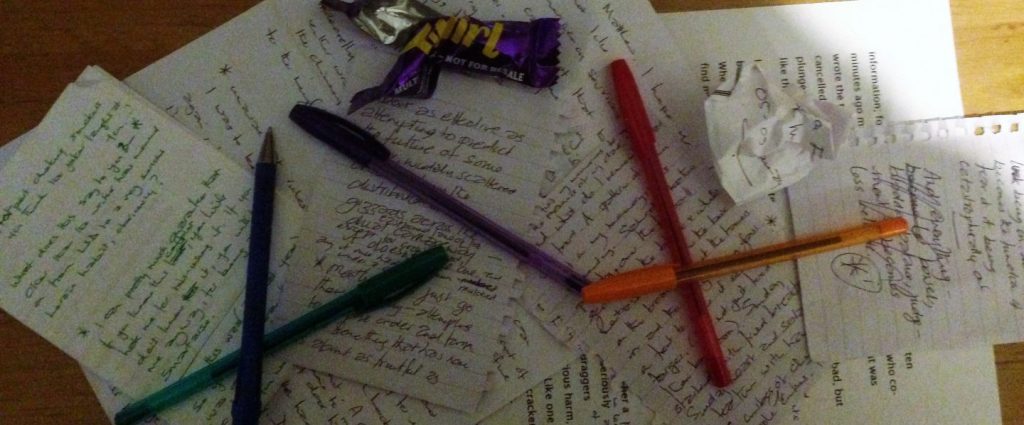
N.B. This blog was brought to you via the medium of a cheap lilac gel-pen with occasional red and green contributions.  You’re welcome…

*On the Universal Scale of Devil-may-careness, about a three.

Some days are honest some days are not
Some days you’re thankful for what you’ve got…  Some Days Are Better Than Others – U2

Remember a Day

I relate this little tale from my past simply because it has just occurred to me that for so many reasons none of it could happen today…

I should, perhaps, begin by setting the scene.  The first thing I should tell you is that I come from a loving and caring family: there was no negligence here other than my own.  Secondly, it was the mid-1960’s – a world that I now realise is hundreds of years removed from the one that we now inhabit. 

Anyway, it’s Sunday morning, I am with my dad at my nana’s house, a five minute walk away from our own.  We were tending the family vegetable patch.  My mum was at home with my younger brother, and my nana* (who I adored like no other) was inside her post-war ‘pre-fab’ bungalow, cooking my grandad’s Sunday Lunch**.  My grandad was terminally ill – a combination of the side effects of a working life spent laying asphalt and World War II service – and there was a conscious effort to keep mega-bouncy me at some distance from him, which resulted in me slightly fearing a man who, I later discovered, was very far from fearsome.  As dinnertime approached, dad went to the pub – as working class men did on Sundays – leaving me in the care of my nana.  I chose not to stay indoors while she cooked, but to ‘play’ in the garden, and what I chose to play with was the garden fork…

We, perhaps, do not need to linger too long on methodology, other than to report that I duly managed to impale myself with said fork.  I don’t recall pain, but it didn’t take much, even for a six year-old to work out that this was not good.  What to do about it, however, proved a knottier problem.  I did not want to upset my nan and I most certainly did not want her to interrupt the preparation of grandad’s dinner; I could not hobble home – it was much too far with a fork sticking out of my foot, and I couldn’t get the bloody thing out – I had no idea what to do.  Then fate, as it has a habit of doing for a child, intervened in the shape of a double-decker bus.

The bus stop was just through the gate – easy limping distance – and I knew it stopped near the hospital.  Obvious.  The bus driver was a little taken-aback when I asked to be taken to A&E, but he took me even though I had no bus fare.  I don’t recall if he asked me why I was on my own – to be fair, he might have done, I really don’t remember – but he took me none-the-less.

The nurses – I was aware only of nurses and not doctors – removed my boot and the fork, cleaned and stitched me and prepared to send me home when my real problems began.  I couldn’t go home on the bus and I certainly couldn’t walk – not even with a mucky old fork to use as a crutch – but I had no way of contacting anyone as I had no idea of any telephone numbers (nor if anyone even had a phone).  I was given orange squash.  The police would have to be called!

As luck would have it, the local police constable (yes, we had one of those back then) was on the look-out for me having been contacted by my frantic nana and, having given me the ‘you will get a proper what-for when I tell your dad what has happened’ lecture, sat me on the saddle of his pushbike and wheeled me home.  I don’t remember any of the familial fall-out – although I’m sure there must have been plenty – but I do recall that it was the subject of much mirth at family gatherings for years to come and, in the end, no great harm was done: my foot healed (there is barely a scar some sixty years later) and my wellies – I guess – were replaced.  Nobody found themselves under Police investigation, nobody – other than me – found themselves in trouble, nobody was any the worse for it and we all, within reason, lived happily ever after… although I’m pretty sure that I now know why I hate gardening quite so much…

*In our family grandmas are known as ‘nana’, great grandmas as ‘grandma’ and granddads as ‘grandad’.  It is just the way it is.

**Sorry, I started to forget myself – that is, of course, Sunday Dinner, the main meal of the day which, on Sunday, was always in the middle of the day before ‘tea’ in the late afternoon, which featured pork pie, cubes of cheese and salad.

Remember a day before today
A day when you were young
Free to play along with time
Evening never comes…  Remember a Day – Pink Floyd (Wright)

Conversations with the Bearded Man (1) – The Lights

Photo by Janko Ferlic on Pexels.com

The first time I saw him he was peering under the bonnet of a car, pulling at wires and whistling “Blowin’ Free”.
“Wishbone Ash,” I said.
“You know them?” he asked.  He neither looked my way, nor ceased his wire pulling.  I took a couple of steps backwards to stand alongside him.  “Every note,” I said.
He lifted his head from his work and peered at me.  He had a smudge of oil across the bridge of his nose that I wanted to wipe away.  He didn’t speak.  I fidgeted, unnerved by the silence.  I looked down at the engine.  “You got a problem?” I asked.
“Just looking for something,” he said.
“Anything I might know?”
“I think there’s a sensor.”
“What kind of sensor?”
He straightened his back and looked at me properly for the first time, swatting his hand across his face, aiming for something that as far as I could see, wasn’t there.  And then he leaned back under the bonnet and recommenced his wire pulling, but I noticed that he’d shifted over a little, just enough to allow me to stoop down at his side.  I peered inside.
“The lights,” he said finally.
“The lights?”
“The lights.  They know when I’m coming.  They turn red… always.”
I stared at the engine, uncertain whether he was serious.  He could have been psychotic, or neurotic, one of them, I’m never sure.  He turned towards me, his face now only inches from my own.  I realised he wore spectacles and it struck me as strange that I hadn’t noticed them before.  Underneath his beard his face was tanned, not overly, but he had a weatherworn skin that actively defied any attempt to age him.  There was something, I don’t quite know what, but there was something in his eyes.  Was he mocking me?  I felt uneasy and I realised that he hadn’t blinked.  I don’t know why I noticed that.  Why should I notice that?  He turned back to the engine and pulled enthusiastically at a wire that might just have been very important.
“I don’t know too much about cars,” I said, “but I don’t think you want to go pulling too many of those.”
He grinned, suddenly and fleetingly and I wondered whether I had imagined it.
“Don’t worry,” he said, “I know I’ll never find it, but it’s important that they think I’m looking.”
He shook his head in a theatrical way and eased himself upright.  I followed and he closed the bonnet.
“I don’t drive as much as I used to.  Don’t seem to have much of a place to go these days.”  We lapsed into silence again.
“Well,” he said, wiping his hands on his trousers.
“Yes,” I said.  “Well…”
He held out his hand and I shook it.  “Better be going, I suppose,” he said.
“You have oil on your nose.”  I pointed and he wiped across his face with his sleeve.  The oil spread further, the stain became paler. 
“OK?” he said.
“OK.”
I continued on my way and he wandered off across the road ahead, when a thought struck me.
“Your car,” I shouted after him.
“My car?”
“Your car, you haven’t locked it.”
I could see the amusement bubbling across his face as he slowly turned away.  “Don’t worry,” he said.  “It’s not my car.”

First Published 17.09.19 under the title “A Little Fiction – New Book (Title Unknown) – Introduction”

Conversations with the Bearded Man (10) – The White Light

Photo by Janko Ferlic on Pexels.com

…There was no dimly lit corridor, no feeling of warmth, no welcoming arms, no smiling friends and strangers.  There were none of those things.  There was nothingness.  Complete and bottomless, utter nothingness.  Like the space behind a Barista’s eyes when you ask for a milky tea.  No sight, no sound, no sensation…  And yet I was able to comprehend this nothingness; to understand the nature of the void of which I had become part.  Cast into a world of non-existence, I sensed myself as part of a far greater non-being: somehow able to recognise the gossamer frail grip I held on existence even though I knew that I had no influence over it.  Yet if I understood the depths of nothing, if I felt the fear and the thrill of the utter unknown, if I felt anything at all, then I could not be dead.  As a child my mother always threatened me with a fate worse than death and I thought, ‘name one’.  What could be worse than non-existence?  Well, if this was death, then it – at least what I had seen of it so far – was not so bad, although I have to admit, not being dead still felt like much the better option.

The strangest sensation was of not being anywhere: it was not like a Waiting Room or even like the long tiled corridor I had heard people talk about, it was just nowhere: an ethereal Milton Keynes.  I was surrounded by a bright white light, but I wasn’t actually there.  Was I actually part of it?  No, that couldn’t be so – it couldn’t seem so bright to me if I was part of it.  And I know that my life hadn’t flashed in front of my eyes.  It hadn’t even wandered listlessly by.  Unless, of course, it had and it had been so boring that it hadn’t even held my own attention. 

I tried to concentrate on the moment.  I wanted to know what had brought me here, even if I didn’t know where ‘here’ was.  I think that even without any solid recollection I had a pretty firm idea of what I was like: bad diet, too much alcohol, too little exercise – all of the above seemed to fit into my own impression of me, so I guessed that I must be having a heart attack.  Or a stroke I suppose.  Or perhaps I wasn’t waiting for death at all.  What if this was the life that lay ahead of me?  Could I be in a coma?  What if this is all that I would have – me – and no outside stimuli for the rest of my days: my whole existence the kind of dream you get after too much sauce on your kebab?  I could feel my chest tighten at the thought and I decided that, all in all, given the choices available to me, I was prepared to let myself go – and then I thought of Sara…

“…Don’t worry,” said the voice inside my head.  “She’ll manage perfectly well without you.”  As a hypothesis, I realised that it was almost certainly factual, but I wished that I could have been a little less candid with myself, if I’m honest.  “She’ll be totally lost without you,” might have been completely untrue, but it was a sentiment I could have thrown my weight behind, if I actually had any weight to throw.  Even in such a state of grace I could not depend on me.  “I’m just not ready to die,” was all that I could sense myself saying…
“Actually, I don’t think you are dying,” continued the voice that, contrary to all expectations, seemed to be coming from outside of me.  “If it helps, I don’t think you’re having a heart attack at all.”
I was, for some reason of which I was not certain, enraged to hear my instincts so summarily dismissed.  “Oh yes,” I could feel bile rising inside of me, “and what makes you so sure?”
“Well, I don’t think they’d just let you die would they?  You would feel them, don’t you think?  I’m sure that somebody would be punching your chest…”  Mentally I tried to assemble a list of all the people that might like to punch me, even under these circumstances, and it was regrettably long.  “…Someone would be giving you the kiss of life…”  Again, a small, rational portion of my mind tried to assemble a roll of all the possible suspects, but this one was very much shorter.  “…At worst, I’m sure there’d be a boy scout of some kind with a pen knife…”
“A boy scout?”
“Well, they’re taught to ‘be prepared’ aren’t they?  I’m sure I’ve heard something about them being taught how to cut your chest open and massage your heart.  No… someone would be trying to do something wouldn’t they; you’d feel them… rummaging about.  The paramedics would be here.”  I had my doubts, but I felt it best to keep them to myself.  Perhaps a uniformed youth in search of a CPR badge really was my best hope, but I couldn’t help but rail against the injustice of it all.
“I don’t want some snotty adolescent hacking at my chest with a bloody Swiss Army knife!”
“No, I don’t suppose you do.  If I’m honest, I can’t help but wonder if anyone is actually that prepared… I wonder if now would be a good time for you to review some alternative scenarios.”  The voice, obviously not my own, was calm and gently questioning.
“It’s you, isn’t it?” I said, or thought, I’m not sure.  “It’s Lorelei.”
“Yes, it’s me,” he said, sounding ever-so-slightly hurt, like it should have been obvious.  It should.
“What are you doing here?”  I sensed that if I opened my eyes I would see his face… Could I open my eyes?  I decided not to try.
“Well, more to the point,” he said, his voice as soothing as Vaseline on a graze “what are you doing here?”
“Well, I thought I was having a heart attack, but you seem very intent on persuading me otherwise.”
“No not really,” he said.  “I completely agree that you thought you were having a heart attack, I just think that that was what brought on the panic attack.”
“Panic attack?”
“Mmm, yes, I think that you’re probably having a panic attack.”
“But I’ve never had a panic attack in my life.”
“No, and that’s probably why you’re panicking.”
“So if I’m not dying, why can I see the white light?”
“I think it’s probably because you’re in the dentist’s chair.”
“Oh God, no.  Please tell me that I’m not having some kind of episode at the dentist’s.  Please let me be having a proper heart attack – like a man.”
“I’m sorry, I can’t do that.”
“Oh my… you’re not even really there, are you?”
“Well, it depends on what you mean by ‘really there’.”
“I mean really there.”
“Ah.  No then, I suppose not.  I mean, I’m here now, but when you open your eyes, I won’t be.”
“I don’t want to open my eyes.”
“I think you probably have to…”
“…Am I speaking out aloud here?”
“A bit, yes, I think you are.”
“They won’t believe that I’m rehearsing for a play will they?”
“I think it’s unlikely.”
“What the hell should I do?”
“Do you think you can sit up and rinse?”
“Yes.”
“I’d probably do that then…”

Like Frankie & Benny, I am very attached to these characters, but I thought that their story had probably reached a conclusion when the idea for this little episode popped into my head whilst I was sitting in the dentist’s waiting room…

The Divine Art of Being

Photo by Wendelin Jacober on Pexels.com

I seldom tackle The Big Subjects on this blog: I really don’t feel at all equipped to do so – there is nothing I can add to the discussion – never-the-less, my world is currently in the midst of one of those periods where the man with the scythe is back from vacation and going flat out to impress his employer.  Death is surrounding me.  My contemporaries are falling off the wheel with the alacrity of a three-legged hamster.  Either The Grim Reaper is getting better at his job or we’re forgetting that the whole point of life is to keep him out of it for as long as possible.

Nobody, but nobody, wants to think about dying, and the closer that you get to it, the less you want it on your mind.  The inevitability of it is oppressive and the only way to cope with it is to wipe it from your mind.  Deal with the day you are in, ignore the day you might not make: it will get along perfectly well without you.  Mortality is a concept that can only be fully understood by the immortal.  As a mortal, you deal with it by pretending that it does not exist: you create an afterlife, you invent reincarnation, you imagine ghosts… There is a kind of logic to the planet as a media on which we can all leave a mark.  We can all leave an echo.  Perhaps we do leave some kind of fingerprint after we have gone.  The battle is to not let death define you.  It would be so easy to spend the closing decades of your life running away from something that is inescapable.  We all die.  I’m not suggesting that you ignore it, just that you stick your tongue out and tell it that you’re not interested right now…

Personally I would be happy to put it off for as long as possible, but I do know people who have given up everything they enjoy in life in order to prolong it and I’m not sure that I could face what might well begin to feel like eternity without coffee, chocolate and whisky.  My loved ones are my life.  My grandchildren bring me more joy than I can begin to express.  The ability to get around and enjoy life out in the world is one that I treasure.  The thrill of seeing spring’s first snowdrop, first butterfly, first nest-building bird is undiminished by age.  Who could fail to find the spirits lifted by a field full of spring-legged lambs?  Life has to be about life.

So, I try to eat sensibly, I try to drink responsibly, I swim, I go to the gym, I plod through my 10,000 steps a day (unless, of course, it’s too hot, too cold, too wet, too windy or the armchair is too sticky) I embrace life in every way that I can.  I avoid politics like the plague (no-one will ever have their opinion changed by a valid argument) and politicians like the plague dogs they unquestionably are.  It is my aim to evade death by thinking about it as little as is humanly possible.  I can’t deny death, but I can try to refuse it immediate access.  I might be surrounded by it, but I will make like Michael Caine in Zulu, and everyone knows that the last thing that Death wants is a Zulu spear up the backside…

You stepped out into nothing, you didn’t fear a fall
You did it with your eyes closed, you didn’t care at all
And when I’m not here like the ending of this play
You can tell them in all righteousness I’m the one that got away… The Divine Art of Being – Lonely Robot (John Mitchell)

Green Manalishi

It is one of those diamond-bright April mornings: T-shirt weather in the Sun, Arctic in the shade.  This afternoon the wind is expected to pick up, rain is likely to drift in and turn to hail.  Thunderstorms are predicted.  This is spring in the UK.  However you are dressed when you leave home, you will spend some of the day too hot, some too cold and always you will get wet.  No amount of pre-planning will keep you dry.

We live on a little green dot on the map within which England is wet, Wales is wetter, Northern Ireland is wetter still and Scotland is probably the wettest place in the entire world.  This whole nation radiates out from London in concentric bands of damp.  By the time you reach the Scottish Highlands, the men have all abandoned trousers on the grounds that they are always wet from the knees down, and taken to wearing plaid skirts.  (The sporran is nothing more than a vestigial mould growth.)

I, myself, live in a part of the country that appears to function as the nation’s sump.  For most of us at this time of year, gardening boils down to washing the duckboards, but the time is coming when everything outside the window turns green – particularly on the inside of the shed.  The general rule is, if it isn’t rotting from the root up, it will need cutting back.  If it needs cutting back, it will injure you.

Secateurs are the instrumentum diei for spring gardening.  You will find them, rusted, at the back of the garden shed in April and, with the regular application of WD40, you will be able to operate them by mid-May, at which time you will be able to remove branches up to the thickness of your thumb (and, for the unwary, your actual thumb.)  If you do not actually excise your digit, you will trap it.  The fastest growing item in the springtime garden is always the blood-blister… except for the lawn.

This is the time of the year when the front lawn will have grown by the time you have pushed the mower round from the back. Dandelions and daisies lengthen quicker than a schoolboy’s legs (although, unlike schoolboys, if you chop them off they will just grow back at double speed.)  You have two choices with a lawn: keep it long and full of weeds, or keep it short and full of mud.  In real life, lawn mowers have only two settings: ‘light trim’ and ‘scalp’.  ‘Light trim’ achieves nothing except letting the midges out to play, whilst ‘scalp’ lifts the lawn out in giant clods and spits them into your shoe.  As most lawns provide a half-inch covering of vegetation for a six inch layer of aggregate, this will be launched through your windows, greenhouse and lower legs.  If you want to fill in the resulting ‘craters’ with grass, you will need to fill them first with a blend of finely sifted compost and sand dusted with seed and fertilizer, and water at least twice daily.  Alternatively, if you want to fill them with weeds, just turn your back on them for five minutes.

Most importantly, do not worry: in April, moonless, crystal-clear nights can be very dark and when that happens, your garden will look Just as good as everybody else’s…

Now when the day goes to sleep
And the full moon looks
The night is so black that the darkness cooks
Don’t you come creeping around
Making me do things I don’t wanna do… Green Manalishi – Fleetwood Mac (Green)