The Search for a British Super-Hero


GB Superhero
OK, I know that Superman is not an Avenger, but he is a Super-hero, right?

As the very occasional visitor to the Avengers Universe that I am, you must excuse me if I have got this wrong, but I believe that there are very few, if any, British Super-Heroes protecting that troubled world, and that knowledge has spurred me to question ‘Why?’ Is there something about being British that precludes us from entrance into the hallowed realms of Superherodom? What, exactly, is stopping us from saving the world?

Well, for a start, in these politically uncertain times, there is the imperative that we use the full, politically correct title for our sceptred isles and Captain United Kingdom of Great Britain and Northern Ireland does not trip easily off the tongue. In any case, we would tend to go for the even more specific: the obvious question for any potential Captain UK being ‘North or South?’ Captain No I Get Dizzy When I Stray Outside of London would not cut the mustard. Nor would a northern superhero serve any great purpose if the endangered folk of the planet were ‘Nowt but soft, spoiled southerners’. We are of one nation, but a hundred different regions, none of which particularly care for the others. I suppose that we would have to go for a team of Captain Regional UKs – all a little bit shambolic and slightly home-made: a slight afterthought – like the regional news programme on the BBC. (I cannot stop myself harking back to an episode of The Goodies in the 1970’s that centred around the Lancashire martial art of ‘Ecky-Thump’, in which black puddings were utilised as super-weapons. Perhaps not as effective as Thor’s hammer, but a whole lot more entertaining.)

If we were to have a super-personification of the nation’s true identity, around which we could all coalesce, it would be General Heroic Failure; The Terribly Apologetic Hulk; The Iron Man that comes with a can-opener just in case. We would take to Wolverine only if he could be taught to ‘fetch’ and ‘beg’. And as for British Wonder Woman – my word, where do I even start? She would be criticised for her hair, her costume, her physique. She would be asked if she didn’t think that she could make better use of her time by being at home cooking tea for Wonder Husband. She would spend so much time explaining that ‘No, I am not just the wife of Wonder Man’ that she would have little time left for fighting baddies – especially if the ironing still needed doing…

We’ve all played the game – ‘what would be your super-power?’ (That last sentence started out very differently, but ending a sentence with a preposition is something with which I will not put, so… Super-Pedant for me then. ) Would you be super strong, have super hearing, be invisible, be able to detect the faintest whiff of political bullshit with the merest twitch of the nostril? My Super Power would be to make people ‘get on’ – not necessarily to agree, just to tolerate one another: not to fall out over things that really should not matter between two rational adults – that would do the job. I would be Peaceful Co-Existence Man. My ‘uniform’ would be my treasured snake skin boots (simply because Jimmy Page had a pair and he’s the closest thing to a super being that I have ever managed to see in the flesh) my Ziggy Stardust T-shirt (for similar reasons) and my grey felt Fedora thinking hat, as it would serve its purpose in both sun and rain, and is an ideal receptacle for salted peanuts. I would, of course, wear jeans, because I’m that age quite frankly. I would probably have to buy a pair of Union Jack socks – which wouldn’t be seen under the boots. (Unless, of course, I was called upon to do a love scene – because everybody in Hollywood knows that British men always keep their socks on – actually, I’ve just read that through and you might choose to close your mind to it. I know I would.) Of course, none of the above would be the defining reason for my exclusion from any prospective ‘Avengers – Déjà vu (Again)’. That would be my flat-vowelled northern accent, which would mean that I would either have to be sub-titled, or my character would have to be accompanied at all times by Super Signer – all in all, not the greatest of innovations if Dr Evil does not know the Makaton for ‘all out thermo nuclear war’, or the twin Suns of Gallifrey had temporarily blinded him to the translation of my ultimatum*. Even Benedict Cumberbatch (Dr Strange) only got the gig because he pretended to be American and his accent didn’t set off car alarms.

Anyway, until Hollywood decides that it need some more down-to-earth superheroes – like the person that can conjure up a cup of tea and a supportive shoulder in the direst of circumstance; like super-neighbour, super-teacher, super-nurse – we’re probably better off leaving it all to somebody else anyway. What possible use has love and compassion in saving the world?


*I realise that plenty of people will find the inaccuracies contained within this sentence more provocative than the dreadful irony of the ironing gag  – what can I say?


So, yesterday I watched a program about the Apollo 9 moon landings.  If you wanted a hero, there were three strapped to that rocket.  And then I remembered that is 50 years ago today since the release of this:

This is Major Tom to Ground Control
I’m stepping through the door
And I’m floating in a most peculiar way
And the stars look very different today

Space Oddity – Bowie

Facing the Music

efit

In my ‘real life’ I work in a shop and virtually every day I face the agony of somebody saying to me “Do you remember me?” The answer, almost always, is “No”. I have a terrible problem in recognising faces. Even when the face has not changed, I have huge difficulty remembering to whom it belongs. Given a face that I last saw in childhood, I am completely at sea. As I see people often enough, their features do begin to seep in – I remember my children for instance – but it does take a while. I have lost count of the number of times that I have gone through an entire conversation with an acquaintance without once realising that the person I was talking to was not the person I thought I was talking to, but that they were too polite to say.

There are ways around it; there are strategies I can use, but they require an awful lot of effort to maintain, and I can’t do that all the time, for everyone. My problem seems to lie in the recognition of facial features – I am about as reliable as the Facial Recognition software used by the police. Knowing that somebody has, for instance, a big nose, does not help me unless that person just happens to be called Rose, then I remember them. It’s called mnemonics I think. It doesn’t have to be a facial feature that I focus on; it can be a trait, a habit, even something that somebody else has said: anything that I can put a name to, that is recollectable and that I can immediately associate with that person. If you wear glasses and I recognise you, don’t ever change them or we’ll have to start all over again. Many of these mnemonics are not kind; they rely on personal irregularity in order to be memorable. They are often not nice – I’m not proud of that – but they work and, quite frankly, you will never know about it anyway Twitchy… I’m sorry, Mr. Ritchie.

I find the whole thing intensely irritating and weird. I remember the faces of friends and family, obviously. I struggle with people I haven’t seen in a while, people I only meet occasionally or people I have only just met. The most annoying aspect is that I don’t always recognise the people that I really should, yet, for some unfathomable reason, there are some people that I can recognise for no reason at all. My ability to recognise a face bears no relation to my desire to recall it. Often it’s the faces that I really don’t want to recognise that lodge themselves first. And I am fully aware that people might think that I am just being an arse; that I can’t be bothered to recognise them, or even worse that I am being obtuse and, for whatever reason, I am just pretending that I don’t recognise them. I’m not. The only thing that I can tell you for sure is that if I don’t recognise your face it is not because I don’t want to. It could, however, be because you don’t have a big nose.

By way of natural compensation, I suppose, I am very good with voices, inane facts and I can often spot a tune before the first note has finished. I might not remember your face, but sing me a song and I’ll name the tune in a flash…

Every single ray leaves a little trace
There’s a blind man smiling, the sun on his face
Maybe what we don’t have we don’t need anyway…
Available Light (W. Porter) Willy Porter

A Little Fiction – The Custodian of Time

blur clock clock face close up

The Custodian of Time sat, open-legged on the heavily brocaded settle, smoothing the creases from his satin pyjama trousers and picking the loose threads from the cushion on which he rested his arm. His movements were leisurely, but his eyes skipped around the room and he spoke as if time was of the very essence, which, of course, for its Custodian, it was.
“I suppose he wants more does he; they all do?” The words jettisoned from his mouth without warning or prevarication, in a way that would have caused his attendant to leap from his skin – if only he had some.
The acolyte was, in fact, a small ectoplasmic fog, slightly purple in colour – lilac possibly – and nervous to the point of dissipation. It was his/her’s (we’ll assume her for ease) very first day on duty and her first time alone in the presence of the Custodian. She had been told, “Pass on the request. Wait for the reply. Leave.” Simple. She hadn’t been led to expect a question. She hoped it was rhetorical.
“Well?” said the Custodian. Obviously it was not.
The attendant’s stress-level passed critical. She was aware that she was starting to precipitate. She coughed nervously (as only a lilac ectoplasmic cloud can). “Erm… that is… well… I think so. Actually no, not really. No. It’s more of an assurance he’s after I think, not more time, just an assurance that he won’t get less.”
“Less than what?”
“Well, less than he expects, I think.”
The Custodian picked at his teeth with the corner of the written request (parts 2 and 3). His eyes betrayed no clue to the activity that whirred behind them. Eventually, with a sigh, he removed the paper from his mouth, flicked an errant sesame seed from it, before smoothing it out across his lap.
“He understands, does he, that what I give to one I must take from another?”
“I don’t know,” said the blob, emboldened by the hesitation he detected in the Custodian. “I don’t think that he wants more anyway. He just, as I understand it, would like an assurance. He was led to believe, from birth, that he could expect to live to one hundred years of age, and he just wants to be assured that that is what he will get. He doesn’t smoke, he’s a moderate drinker, fit and well. He just wants some certainty.”
“Has he told you what he plans to do with this certainty?”
“I’m sorry, I…” The gossamer orb was in full-fluster once again.
“When he knows that after Wednesday he no longer has anything to lose…”
“Wednesday?”
“Wednesday? Did I say ‘Wednesday’? Just a slip of the tongue – probably. Not at all the kind of assurance he was looking for, huh? Tell him ‘Carpe Diem’ baby; tell him ‘Seize the day’. Tell him only one person knows what time has in store for him and, for every good reason, he is keeping that knowledge to himself.”
“But, what if he wants to do good things?”
“Then nobody’s stopping him,” said the Custodian and, with a wave of his podgy little fingers, he dismissed the cloud, which hesitantly turned (I think) to go.
“Come on,” barked the Custodian impatiently. “Tempus Fugit, baby. Get a move on. Time waits for no amorphous entity.” And with an audible ‘Pop!’ the attendant disappeared.
“Wednesday,” chuckled the Custodian. “Wednesday. I’m such a wag… Now, where’s the cloud with my supper?”

A Little Fiction – You’ve Got A Geriatric Friend In Me

A Little Fiction – Winnie-the-Pooh and a Head Full of Kapok

A Little Fiction – OldenEye

A Little Fiction – The Later Cases of Sherlock Holmes: The Mystifying Instance of the Absent Footwear.

A Wingful of Eyes*

wingful of eyes

It’s amazing how often you have to go back to the beginning in order to find the end.

More often than not I begin to write with no clear concept of where I’m going. About half way through I begin to get some kind of clue of what I am trying to say and, by the time I begin to understand the point towards which I am painfully inching, I find that it has been there right from the start.

When you write, whatever you write, there are only three places you can be: the past, the present or the future. The past is ok, but it requires such a lot of research. Everything is checkable. Everything is verifiable. Everything is refutable. Even if the past is only used as a backcloth, it has to be correct. There will always be someone to tell you if it is not. The way I write, I tend to focus whatever concentration I can muster onto the voices rattling around inside my head. These internal conversations lead to everything else and when they take wing, it is a little too easy for me to take my eye off the factual ball. I don’t want to know that he couldn’t have switched the kettle on as electric kettles had not been invented at that date or she couldn’t have hidden the samovar in her knickers as no-one wore them then: the concentration necessary to get the background right would mean that I would have no chance of keeping up with the narrative popping around inside my skull. I would become the poor man’s AJP Taylor – and, for my money, one of those is quite enough. That doesn’t mean it can’t be done. If you want to read what can be done by gloriously mixing together fact and fiction (both your own and that of others) have a gander at ‘W.G.Grace’s Last Case’ by the magnificent William Rushton and understand why I avoid even the slimmest chance of comparison with him like the plague.

The present, I find, is such a difficult tense to write in. The grammatical hoops through which one has to jump, chew you up (I know, I know, but these hoops can chew) and spit you out. Most fiction written in the here-and-now is actually written in the past tense (as, intriguingly is most fiction set in the future) because it makes things so much easier. The present is, however, a great place to write because it needs relatively little research – unless the taxman is reading, when it needs loads. I know what happens if I switch the kettle on – it blows the fuse because I never remember to put any water in it; I know what happens if I get on the number 9 bus – I arrive two hours later than planned, on the other side of town to my destination, with a fungal infection I most certainly did not have on departure. There are few constraints to setting your work in the present, for a start, most of us have absolutely no idea of what is actually going on, so we have no factual basis for saying ‘Hang on a minute, that would never happen’, and therefore opportunities to tamper with reality (or something similar to it) are almost limitless. You cannot deny that Donald trump is currently President of the United States of America, but I defy you to find any good, solid proof that he is not an alien lizard.

Push hard enough against the present and you will fetch up against the future. It waits in store for all of us: we are all heading towards the self-same exit door, but we will not all reach it at the same time. But (and this, I have just decided, is my point) what we do all gain with age is the belief that we can see how things are going – that having seen where they have been, we are somehow more able to understand what lies ahead. In that, we are, most of us, sadly deluded. Just take a glance at Brexit (sorry): whichever way it ends up going, whatever the eventual outcome, vast swathes of us will have been proven wrong in our prophecies of doom or in our visions of a golden tomorrow. That’s just the way it is. Few of us can assemble our experiences of today and somehow use them to accurately predict the shape of tomorrow. There are, of course, exceptions. ‘Nineteen Eighty-Four’ for instance, was written in the past, predicting a future that, for much of the world is now the present. The world is full of Big Brothers, China alone (it would seem) has a million Room 101’s. However, for every prediction of thoughtcrime we have one of a world ruled by mutant frogs. The thing about the future, it seems to me, is that it is actually just the past dressed up in a different way. The uniform has altered, but the righteousness of incontestable ‘truth’ remains unhindered. There will always be those that ‘do’; there will always be those who control those that ‘do’, and there will always be those that ‘do’ those that control those that ‘do’.

Maybe the ability to predict the future relies simply on the ability to observe the past and to understand just how, exactly, it evolved into the present. Change the names, throw in a pacifying drug, a constantly wittering radio companion, an overarching discipline, a war-mongering despot, a gullible proletariat, a never-ending war, a totalitarian regime and Presto! Ladies and Gentlemen, I give you the future. As I say, it’s amazing how often you have to go back to the beginning in order to find the end.

There is a feeling we all know
Something happened long ago
When you remember who you were
Makes you what you are today
*‘Wingful Of Eyes’ – Gong (M. Howlett)

The Initial Laceration is the Innermost

finger

I have been self-harming for forty years now – although I think that most people would probably call it gardening. After a day in the garden I have generally accumulated enough injuries to make me of more use to an aspiring Accident & Emergency doctor than the average full-colour text book. If you want to find an example of any one of the myriad ways in which a buffoon can injure himself in the garden, just look me over, you will find it… somewhere. Today, after a day spent digging and building, in addition to the normal array of bumps and bruises, pulls and twists, aches and pains with which I am afflicted, I have a plaster on the end of my finger. It covers an area where a small chunk of finger used to be – where it actually is now, I have no idea. It is not, in fact, unusual for me to leave parts of me dangling from thorn, spike or metal implement during the course of a day’s gardening. There is barely a plant in my garden that doesn’t have a minute piece of me suspended from it somewhere.

The damage I have suffered is, however, not my point (such as it is). The point of my witter today actually revolves around the plaster. You see, in the past, there would not have been one there. What was the worst that could happen? It would not heal properly; it would become sore; it would ooze a little; I might go septic. I would squeeze it, wash it and it would heal. Not so today. Today it might not heal properly; it might become sore; it might ooze a little; it might be sepsis. I might die. I have grown used to my injuries changing their names. When I drop a brick on my shin, I no longer have a bruise; I have a contusion. When I scrape my elbow along the wall, I no longer have a graze; I have an abrasion. When I pierce myself with any one of the dozens of lethal implements to which my garden shed is home, I do not get stitches; I get sutures. And with each change in name comes an incremental growth in seriousness. One word closer to death.

Hence my little cut, sore and swollen that it is, has been treated to a dose of Tea Tree Oil and is currently encased in a plaster, which means that a) I currently smell like a hospital ward no longer does and b) I cannot pick anything (e.g. a £1 coin) up if it is laying flat on the table. It is irksome. Now, I know what you’re going to say and you’re quite right, I could use the other hand, but you miscalculate my direction of drift (aimless drifting, of course, being my forte). You see, what I’m struggling to understand is how my very minor gardening injury has suddenly become a death-threat and, even worse, how it has made me £1 worse off for as long as my right hand is otherwise engaged.

My wife says that I should wear gardening gloves and, whilst I must concede that a stout gauntlet would probably forestall many of the piercings and slashing to which my mortal flesh is prone, I still would not be able to pick up the coin. Furthermore, over four decades of horticultural flagellation I have grown used to the kind of damage that I can inflict upon myself – even if the names have changed, the harm remains the same – but with gloves, I am faced with a whole new range of possibilities: who knows what manner of glove-related injuries are possible. So, although suggestions are always welcomed and good advice is always taken, on this occasion I will stick with the lacerations I know and I will continue to harm myself in all the old, familiar ways.


‘A scar is what happens when the world is made of flesh’ – Leonard Cohen


What To Do With A Freshly Cricked Neck

bowl of sliced broccoli

I cricked my neck this morning. I’m not sure how. Could have been putting my boots on. These sort of things happen as I get older. Any muscle I have that is not already in an advanced state of atrophy, is ready to pop out from where it belongs at a moment’s notice. If it’s not weak or damaged, then it gets cramp. It’s just one of those things that you learn to live with. Like broccoli. Whatever their primary purpose in your youth, the primary purpose of muscles as you get older is to ache. They appear to have no other function. Nature’s way of telling you that the cork is well and truly out of the bottle.

Of course, a cricked neck is somehow quite unlike any other physical pain: it is the stealth bomber of bodily discomfort. You are blissfully unaware of its presence until, without thinking, you turn around and… too late, it’s got you… Like a well-directed rubber band in the darkness of a cinema, there is no way of even telling where it came from. Like the house guests who have lingered just a little too long, there is no way of telling when it might go. There can be no more exciting moment than that at which you realise that your crick has disappeared – just as suddenly as it appeared – but none quite so disappointing as when it returns the very next time you turn around.

I once suffered a whiplash injury. It was like a crick in the neck with knobs on. Big knobs. This was a crick that somehow belted down my back and into my legs without warning. A crick that meant that I felt absolutely fine until, quite suddenly, I wished that somebody could remove my head from my shoulders – very quickly. A flash of pain that was so intense it physically convulsed me, often provoking laughter from those around me who did not know what was happening. Laughter, I always find, is infectious, but boy does it rattle the whiplash. The doctor put me in a neck brace that made me laugh every time I caught sight of it. Laugh, wince, laugh, wince, it was torture. I can’t explain if you’ve never had it. If you have, you’ll be wincing now.

Anyway, this is not whiplash, this is a common-or-garden crick in the neck, and I have no real idea how I got it. The trick is to move slowly, never turn quickly and, for some reason I can never quite fathom, hold one arm across the chest. As I daren’t look down or around, I keep clipping my ankles on immovable objects. I flinch, the pain flashes down my neck, I wince, I catch sight of myself, I laugh, I wince… I’m getting a bit fed up with it all to be quite honest. Pretty soon I will take to my bed with a small nightcap and the firm resolve to wear shoes instead of boots in the morning…

Everything You Never Wanted To Know About Old Age

Old

So… searching the internet for I-know-not-what, I stumbled across a Google entry for a page simply titled ‘Old Age’, by Dr Marian Koshland, which piqued my curiosity and, like a fool I opened it. This is what I learned…

Old Age, apparently, is broken into three stages: young old (55-65 years), middle old (66-85 years) and old old (85+) and I must admit that knowing that I have already been old (albeit young old) for five years came as something of a shock. Alarmed I immediately checked my wardrobe (well, straight after I’d checked my pulse – I still had one, so that was good) and I have to confirm the sad fact, I am old. My clothes are either old old, or new, but still old. My jeans are not ripped, my ‘T’ shirts are not frayed, my suits are shiny (although in an overworn way, not in a fashionable way).  I have woollen cardigans. At my bedside I have an alarm clock, a glass of orange squash (I can’t drink the chemical brew they call tap water without masking the flavour) and a jar of Vick’s Vapo-Rub…

According to Dr Koshland, the effects of Old Age are sub-divided into four categories: Physical, Cognitive, Emotional and Social

Physical:
Bones become more brittle and joints become less flexible – much like attitudes. Much like my knees, opinions become fixed – and prone to sudden inflamation.
Almost everyone over the age of 55 will need glasses at least part of the time. Unfortunately, I have needed glasses since a motorbike accident in my teens when I met a tree face on. The tree did not yield. My face did. I count myself lucky that my neck did not. I am aware that my eyesight is deteriorating by the day. Either that, or somebody is moving the TV further away whilst I am not looking; somebody is smearing the newspaper with Vaseline. Perhaps even more alarming than the general deterioration in the clarity of my vision, is my inability to see in the dark. My house shines like a beacon during the hours of darkness: I cannot find the toilet without a spotlight; I cannot find the light switch without the lights on.
Sense of touch starts to decline. Sensitivity to pain is reduced. I have no sense of touch during the winter months when my fingers are permanently encased in woollen gloves. During the summer, I am generally out in the garden damaging myself with one lethal garden implement or another. I can only imagine that reduced sensitivity to pain waits around the corner for me. It certainly does not appear to be a feature of my current age. A hang-nail can drive me crazy. A splinter may drive me to drink. A thorn under my nail may drive me over the edge.
Older people are more prone to chronic disease. Blimey. The common cold is chronic enough for me, without developing anything that is actually life-affecting. My last visit to the doctor featured the sentence ‘Cholesterol’s OK, blood pressure’s fine, you don’t have diabetes – yet’; as if I was just awaiting its arrival. In response, I have cut down my chocolate intake. I can now take minutes to finish a Mars bar.

Cognitive:
Functions such as memory begin to decline – at different rates for different individuals. In my case, that started at about fifteen years of age. I used to have a boss who said ‘Remember, I have forgotten more than you will ever know.’ I have never – would never – use that line, but it could easily be at least partially true in my case. I’ve definitely forgotten loads, but I can’t honestly remember how much I might have known in the first place. It is possible to slow down this decline – in specific areas rather than general cognition. Memory training, for instance, can be beneficial, but only if you can remember where you left the cards. Fortunately, ‘reasoning’ as it applies to everyday life is unaffected by normal ageing, so I can remain quietly confident that I will not be tempted into politics in my dotage. It has been shown that physical exercise can protect brain function and I have gone for this in a big way. I have bought some socks that are at least a size too small so that I really have to pull them on. Without fail, regardless of where I am, my phone is somewhere else, so I constantly have to circle the house in search of it. I then have to re-circle the house in search of my glasses so that I can read it. I deliberately leave the TV remote just out of reach – which, in practice, means that I have been watching Channel Four for the last three months.

Emotional Development:
• As we age, apparently, we learn to accommodate the changes in our physical selves and become more focussed on pursuing meaningful goals rather than attempting to expand our horizons. Well, you can say what you wish, but I am just that far away from my goal of eating six cream eggs in six minutes and if that’s not horizon expanding, I don’t know what is. Positive attitude is incredibly important. Apparently those with a positive attitude ‘live on average 7.5 years longer’. Presumably the opposite also applies: each night I sit down to watch the news and I can feel the life draining out of me. If you really want to put your positive attitude to the test, read the unexpurgated Wikipedia page for Old Age and digest all of the grisly details it contains. If you remain positive, then you deserve your extra 7.5 years – although I’m not certain that you’ll want them.

Social:
• Finally, it would seem that as we get older our social networks shrink – eventually centring just around partners and family. This change, asserts Dr Koshland, reflects the emotional development associated with old age. Ah well, as long as it’s not just because all of our friends are dying eh…

You can live to be 100 if you give up all the things that make you want to live to be 100 – Woody Allen

My Unceasing Battle With Pratchett’s Californians.

block

My mind is in a sling – again! The plaster-cast is not yet ready to be removed. My imagination is tied in a malaise from which it can find no exit. My brain, filled as it currently is with grinding mundanities, has called in all available resources and completely shut down the tiny, sparkly bit (I’ve seen the TV animations) that controls creativity. The great steeplechase of life has pitched yet another hurdle in my path and I am currently waiting for the bloke to turn up with the step ladder.

When I began this little enterprise, I did so with the intention of publishing once a week. This became twice and eventually thrice. It suits me and, it accommodates the time that I would otherwise use less fruitfully. (At this point I pause for a while to consider the phrase ‘less fruitfully’, and quickly lose faith in the concept. We will say ‘less productively’.) I don’t lack ideas (except, perhaps, good ones) – in any case, if you’ve been reading me for any time you will, I am sure, have come to the conclusion that this blog does not rely on ‘the big idea’ to function. More often it relies upon the tiny gripe; the sudden understanding of a concept that the rest of the world has understood since the dawn of time; an itch that, without your participation, I would be unable to scratch.

Every now and then the routine day-to-day, augmented by the annoying, but ultimately surmountable obstacles that life is apt to chuck, fills such space as is available in my head and completely gums up the works. It’s an annoying happenstance, but common enough to not normally warrant mention – unless the annoying happenstance is all I’ve got to talk about.

I am not, I know, unique in this mental torpor. Anyone that has ever put pen to paper or finger to keyboard knows it. Normally, a period of writing inconsequential tosh (approximately forty years in my case) and a short spell in the thinking hat will shake me out of it. The WD40 of a single malt may be required when the cogs are more substantially seized. But today that is not enough.

To cut a long story wosname, short, the point towards which I have been laboriously working – like a disgraced Samurai snail – is this: as I am patently not alone in addressing this impasse, I must, likewise, be in very substantive company when it comes to groping around, searching for a solution. In much the same way that we all have a favourite method of tackling a hangover (mine features fried egg and coca cola) we must each have our own methods of plunging the plughole of creativity. On the basis that I am pretty much up for trying anything of which I am capable (probably not LSD, despite what it did for The Beatles) I would love to know what you do to lubricate the works. How do you – pardon my presumption – get the juices flowing again? I have been becalmed upon this sea for a couple of days now, my thoughts (such as they were) lost in The Bermuda Triangle of inspiration, adrift on a sea that offers only unfathomable depths. My usual methods have not, on this occasion, offered any forward thrust.

I would be massively grateful for any suggestions you are able to make. I need strong magic now that the enchantment has gone from my thinking hat. Help me now, or we could be back here again in no time…

‘There’s no such thing as writer’s block. That was invented by people in California who couldn’t write.’ – Terry Pratchett

There Is No Means of Testing This Hypothesis, but the Fact Remains That the Dog Has Three Ears.

There is no means... (2)

Please, do not worry. No animals were harmed in the writing of this blog. There was no animal experimentation. No canine extremities were grafted where they did not rightfully belong. No canidaen genetics (whatever that might mean) were in any way modified.  “So what then,” you might well ask “Is this all about?” And I will answer “I really do not know.” You see, when I awoke this morning, there at my bedside lay a tiny scrap of feint lined paper, and upon it, not neatly written exactly, but certainly not illegible, I had written ‘His effete resistance was futile – the monkey, after all, knew its own way home’. The pen was there, the handwriting was my own. It’s not exactly an unusual thing. It happens often enough, although I seldom recall getting out of bed. I do not recall getting pen and paper and I have absolutely no idea what I was thinking when I wrote it down.

Anyway, I left the paper with my laptop, in case it ever came back to me (to date, it has not) but before I left the room I found another piece of paper, roughly folded and nestling on the other side of the desk, filled with several such epigrams – none of which I remember writing, none of which I fully understand. The handwriting, whilst undoubtedly my own, takes several forms from neurotically neat and precise to psychotically drunk and barely legible. I seem to have used a range of pens and, occasionally, a pencil when, I can only presume, I did not feel able to trust myself with a ball-point. I appear to have deliberately kept it with a view to making use of it at some time, but I have no idea how that might happen.

Top of the list is: ‘“Sometimes” said the man in the red plastic nose, “I forget what it means to be funny.”’ I can almost see the sense in that, but I have no idea why I wrote it down or what I intended to do with it. ‘Either I have consumed mind expanding drugs, or this hat is too tight’ is a little bit Woody Allen, but I think it rather points to the fact that I might have partaken of an ill-advised chunk of late-night blue-cheddar or similar because a little further down the page, in the same pen and with my handwriting in the same state of undress, I have written ‘We no longer share our lives: we co-exist – like Dhobi’s Itch and Anthrax’. It was obviously a maudlin night because further still down the page, in a hand that slants in all directions, as though written aboard the Kon Tiki during a force ten hurricane, I have written ‘Life ebbed away from him; unidirectional, double-speed; all tick, no tock…’ And finally, no less disconcerting because it is written in red pen – an implement I do not appear to possess – I have written ‘There is no means of testing this hypothesis, but the fact remains that the dog has three ears’. And if you think that I might have an explanation to offer, I’m sorry, but I don’t…

A Little Fiction – You’ve Got A Geriatric Friend In Me

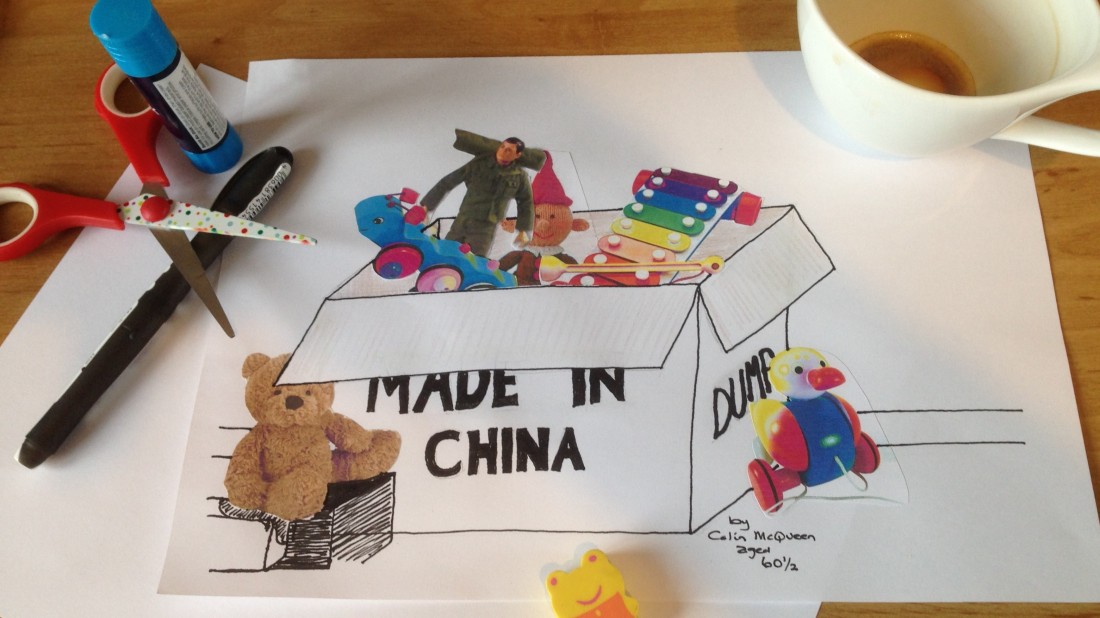
Toys

Toy Story 4 – general release (UK) 21st June.

“So, where we going this time?” asked Action Man. “Loft, car-boot or play school?”
“It says ‘Dump’ on the box,’ said the small knitted Elf as it scrambled back through the lid that was being held open by the ageing soldier. The one-time man of action looked startled (although the Elf was not able to see this as the military mannequin’s head had been reinserted backwards at a party some years ago and he had never been able to turn it back around since) but his voice remained steady.
“Dump?” he said. “Are you sure?”
“Certain,” said the Elf who had started to unfurl slowly as he hauled himself back over the lip of the box and was currently pulling on a severed leg that hovered some six inches below him.
“Nothing else,” the soldier persisted.
“It says ‘Made in China – Do Not Stack’ but I don’t think that’s relevant.”
In the silence that followed, Xylophone began a doleful rendition of The Funeral March, but had to stop when he reached his missing note.
The plastic infantryman stroked the ragged transfer scar on his cheek, popping his arm out of the shoulder joint as he did so, leaving it to hang dejectedly in the sleeve of his combat jacket.
“Would you like me to put that back for you?” said Elf.
“No point,” said the commando, sitting down heavily on a Jack-in-the-box, his reversed face being pressed tight against the cardboard wall.
“It might just be a mistake,” said Elf, tugging hard on a strand of wool in his attempt to retrieve his fast unravelling leg. “It might just be an old box that they’ve used for something else before.”
“Yes, like the last time they took all the old toys to the dump.”
“I suppose it had to come,” said a tag-along duck, whose tag-along ducklings had long since become detached and fledged. “We’re none of us what we were.”
“It’s alright for you,” said the Elf bitterly. “You’ve got rid of your kids, but you’re pretty much sound yourself.”
“And retro,” said the Clitter Clatter Caterpillar. “People don’t mind you having a wheel loose when you’re wood. Can just screw you a new one on. Doesn’t even matter if it leaves you waddling, being a duck and all. Doesn’t even matter if you abandoned your children.”
“They were cut from me,” shrieked the duck. “By that ginger girl from next door. Nothing I could do. She tied ‘em to the back of her Wibbly Wobbly Dog and wheeled them back home with her. I never heard from them again…” Her voice trailed away as only a wooden duck’s voice can…
“Yers, well, just saying,” said the Caterpillar. “It’s alright for you; you’re salvageable. Nail on a new wheel, quick lick of paint, some yummy mummy will pay twice the going rate with delight because you limp. Some of us,” he continued, surprised by his own sourness. “Some of us lose a wheel and it’s the end of the road. Clitter more than clatter and it’s a future full of yoghurt for me.”
“Once upon a t… Once upon a t… Once upon a t…” said the talking book from the bottom of the box.
“His battery leaked,” said Duck, quietly slipping the button to ‘mute’. “He doesn’t know whether he’s coming or going these days. I’m not sure he even knows the stories he’s meant to tell.”
“Well, if you want my opinion,” said a large, green, five-legged spider. “He’s the lucky one. Take his batteries out and he won’t have a clue what’s going on.”
“What does happen down at the dump?” asked Elf, who had by now given up on rescuing his leg and was slowly unpicking the features from his face.
“No-one knows,” said Action Man. “No-one has ever come back to tell the tale.”
In the silence that followed an inflatable frog sighed gently and his back leg deflated.
Caterpillar began a frantic search for his missing wheel, even though he knew that it had been eaten by the dog some months before.
“Looking back…” began Action Man.
“Which is all you can do,” interrupted a voice from the bottom of the box.
“Who said that?” demanded the soldier, leaping to his feet.
“It was me,” hissed a rubber snake from his position wound around Threadbare Ted’s head where he was held in place with a rubber band. “I wouldn’t want you to accuse me of speaking behind your back – although, of course, it is all that you can do…”
In the depths of the box somebody sniggered briefly. If the Taiwanese moulding had allowed, Action Man would have gnawed his lip. “Looking back,” he continued. “We have all had some good times.”
“Speak for yourself,” said the spider, who had found himself hidden in more knicker drawers than he cared to remember.
“Ok,” replied AM. “Maybe we are not, any of us, what we once were. Age has affected us all, but we still have value.” His voice swelled even as his detached arm slid slowly from his battle dress. “We still have much to offer.”
“He’s right,” said Xylophone. “I can still bang out a good tune, providing there are no G’s in it.”
“We all have to adapt,” said Caterpillar, wedging a small Lego wheel in to the space from where his own wheel had disappeared. He smiled triumphantly. The wheel fell off, as did one of his little spring antennae. The silence that followed was profound. All of the toys looked at themselves in quiet contemplation, suddenly aware that they were somehow less than they had once been: less clean, less functional, less complete, less use… Caterpillar stepped back, as only a many-wheeled caterpillar can, catching Talking Book’s switch as he fell. “We’re doomed,” he whispered. “Doomed.”
“… and they all lived happily ever after,” said Talking Book. “… and they all lived happily ever after…”

A Little Fiction – Winnie-the-Pooh and a Head Full of Kapok

A Little Fiction – OldenEye

A Little Fiction – The Later Cases of Sherlock Holmes: The Mystifying Instance of the Absent Footwear.