The Writer’s Circle #11 – Ulysses

“…You cannot deny that it’s a masterpiece.”
“I can and I do.  It is impenetrable, pretentious claptrap.  The only people that ever claim to have enjoyed it are those who have never actually tried to read it.”
It had been several weeks since James Joyce’s opus had last been the topic of debate at the Writer’s Circle, but once again Frankie found himself at odds with Penny – whose poet’s heart had been stirred by the lyricism even though, truth be told, she understood barely a word of it, and Deidre – who had read it on holiday in ‘The Lakes’ once a year for as long as she could remember, on one memorable occasion making it as far as the first couple of pages of chapter seven.
“It’s a wonder to me,” continued Frankie, “that he could drink so heavily whilst obviously having his head so firmly up his own arse.”  Like Deidre, Frankie had also attempted to read the book annually for decades, although never with the expectation of finishing it.  It was just something he did.  Like walking on glass, it was only possible to find satisfaction when it was over.  Frankie was always happy when he’d finished it.  ‘Finished’ as in given up, that is – definitely not as in getting anywhere near the end of the bloody thing.  He had no intention of ever making it to the end.  It was like any other method of self-flagellation: you had to know when to stop.

For Penny it had been a literary rite of passage, a trial of intellect, and she had made it all the way through from start to finish – although, as Frankie was often at pains to point out, it would have made just as much sense if she’d read it from finish to start – and she loved it.  She bathed in the sound of it, the rhythm of it, the feel of it without any sense of knowing what on earth was going on.  And having achieved the feat she, sensibly, made no attempt to ever repeat it.  She realised that the sheer incomprehensibility of it would start to irk with a second reading.  If reading 1 had left her fulfilled although mystified, she felt sure that reading 2 would leave her feeling somehow inadequate – and she didn’t need a book to do that to her.  Unlike Frankie, who knew condescending twaddle when he saw it, she still believed that the meaning was there, waiting for her to find it, one day.  Although, as it was a timeless masterpiece, she decided that there was no hurry.

Louise Child, cast her eyes to the smoke-yellowed ceiling; she liked Penny, but tonight she wanted to strangle her. The writer of Modern Thrillers and one of the most obviously ‘educated’ members of the circle, seldom took part in these conversations, but today’s topic had roused something in her: a ghost from the past.  She was haunted by the memory of her High School English tutor, an unlovely and unloved man, who had coerced her into reading both ‘Ulysses’ and ‘Finnegan’s Wake’ because it would be good for her.  “They’re not on the curriculum, Sir,” she had whined, but he was insistent: he knew that Louise was going to ‘be something’ and, a man of great vanity, despite his penchant for tweedy suits and bushy sideburns, he wanted to be the man that she eventually credited with her awakening.
“It will help your development as a reader,” he’d assured her.  “It will open your mind.”  He was wrong.  It had merely bored her out of it.  She had decided to go on to study ‘English Novels’ simply because even a lifetime of ‘Far From the Madding Crowd’ was preferable to ever having to consider Joyce again.  She wanted everyone to know what she thought of the blessed thing so, she seized a moment of silence and leapt headlong into it.
“Ulysses is a pantomime,” she declared with uncharacteristic conviction.  “A fairy tale.  It’s a charade.  It means nothing.  It was simply a means of getting people prepared for what was to follow: throwing words at the page and seeing what stuck.  It’s a child’s pasta collage dressed up as fine art.  It is Brian Sewell discussing roadkill, simply because the badger was struck by Damien Hirst.  It’s being too vain to care what people really think, only what they say they think…”  She stopped, suddenly aware that she was centre of attention.  It was not a position she chose to occupy.

Penny sensed her discomfort, but she also felt affronted by the strength of her opinions, so she abandoned any attempt to intervene.  As usual, she regretted her decision almost immediately, but felt, none-the-less, completely constrained by it.  To everyone’s surprise, including his own, it was Billy who first leapt to Louise’s defence.  “I’ve never read it,” he said.  “But I know exactly what she means.  It’s like being expected to like Shakespeare, but you can’t, because you know it’s nonsense.  Some brilliant one-liners, a few clever epigrams and what?  There is no plot.  Go and see it in the theatre and you get the director’s plot: you get what he or she thinks Shakespeare was banging on about, but try and work it out for yourself, just from the text and, be honest, your guess is as good as anybody else’s.  What’s the point in buying a book if you’ve got to make the plot up yourself?  Well, that’s what I think anyway…”
He looked around the Circle and, for once, he did not sense the hostility his contributions usually managed to engender.  Even Phil managed a slight nod in his direction.
“And it’s just so bloody long,” said Frankie.  “Like War & Peace.”
“Have you ever read War & Peace?” asked Phil.
“No I haven’t, it’s too bloody long.”  Laughter filled the room.  It happened from time to time and it always annoyed Deidre, who would really have quite liked a world without it.
“Are you seriously suggesting that all long novels are bad?”
“Not necessarily,” answered Frankie.  “Although I would rather like you to name me a good one.”
“What about Middlemarch?”
“Have you read it?”
“Well I…”
“No, I thought not.  Watched the TV series I expect.”
“You could count the ‘Lord of the Rings’ as a single book,” ventured Billy.
“Indeed you could,” admitted Frankie.  “It is, after all, profoundly dull without the benefit of CGI.”
Deidre glanced at her watch and decided it was probably time to call an end to the evening’s meeting.  “I think, Mr Collins, that you are probably being deliberately obtuse.  Perhaps we should call it a day and bid one another farewell for now, before anyone can be offended.”
The Circle began, haphazardly, to rise and disband.
“Ah,” said Frankie, a triumphant grin spreading from ear to ear.  “‘Think you’re escaping and run into yourself.’”
“I have no idea what you mean by that,” sighed Deidre.
“Nor do I,” said Frankie.  “It’s codswallop.”
“He’s right,” offered Louise as she struggled her arm into the sleeve of her overcoat “and, as we are leaving, I would also ask you all to remember, ‘Longest way round is the shortest way home.”  She smiled at Frankie, who beamed back at her.  “Pure codswallop…”

This [Ulysses] is obviously the wave of the future, I’m glad I’m dying of tuberculosis.  Katherine Mansfield

‘The Writer’s Circle #1 – Penny’s Poem’ is here.
‘The Writer’s Circle #10 – Phil’s Baby’ is here.
The Writer’s Circle #12 – Seriously Unfunny’ is here.
The Running Man on Stopping

I thought that I might stop the running diary: it has a very patchy readership – although that, in itself, is not unusual.  Day by day, post by post, the (lack of) quality within my blog remains more or less constant, yet the readership goes up and down in a manner that I just cannot fathom.  There have been occasions when I have published a post only because I have nothing else.  It has often been a toss-up as to whether to go for ‘no post’ or something I feel to be substandard.  I always go for ‘substandard’ – it’s been many years since I have felt comfortable in falling back on ‘My homework is in the dog’ – so I use what I have got, and therein lies my problem.  The posts that I do not believe to be good enough often get lots of reads and lots of likes and I am always left wondering why?  Perhaps I should write badly all the time.  (Oh come on now.  That’s below the belt!)  Nobody who writes is ever fully content with what they have written, but I have from time to time published a post that I have been largely happy with and often, those are the posts that go down the toilet quickest.  I clearly do not write for me.

Not being my own audience is my biggest problem.

I have realised that the more I ‘polish’ a post, the less it is liked.  I use my own voice most of the time now and that seems to work the best.  (I wonder what I sound like to you?  I can hear me.  I sound like a camp history teacher.  Is that how you hear me?  Hearing myself on audio or video playback makes me cringe and laugh at the same time – unfortunately, normally in the wrong order.  It’s hard to know what you sound like to other people, isn’t it?  It’s like colour.  We both know that grass is green, but do we both see the same colour?  Is my green red and your green blue?  My brother is colour-blind and I really struggle to understand it.  If he really can’t tell the difference between blue and green, why doesn’t he keep falling off cliffs?)  I wrote a series of ten-minute monologues a little while ago about a fictional village which were perfect for podcast so, to see how they sounded, I recorded a couple.  Oh dear.  Imagine Alan Bennett’s more monotone sister.  I cannot believe the sound that comes out of my mouth.  It’s the aural equivalent of watching wallpaper being stripped.  It’s like chillies in honey – whatever you are looking for, it is all there, just definitely not like you want it.

I know, also, that with blogging there is a knack to getting the title right.  Asking questions is apparently a sure way to get readers.  My whole life is a question.  I do not need readers, I need answers.  Perhaps if I just add a question mark to the end of each title my readership might go up (it can’t go down).  There must be a way of fashioning Categories and Tags to pull people in.  I should learn it, but…  I enjoy the writing.  I would like to have more readers – my wife finds it hard to understand why I devote so much time to writing this drivel for the weekly consumption of ten regular readers and four hundred algorithms.  It’s just what I do.  It is what keeps me sane.  Wibble. 

This morning I received bad news upon bad news and then I went for a run.  I realised that running is now also what I do to keep myself sane.  This running diary should, by my own ‘rules’ stop with the end of ‘Lockdown’, and I fear that it might, like Only Fools and Horses, perhaps run on just a little too long if I’m not careful.  For now, as I continue to run even as Lockdown measures begin to ease (no turning back – you heard Boris say so) the running diary will continue, but it will have less to do with running than what is rattling around inside my head as I run, and when that little voice ceases prattling on, then the diary won’t be all that stops…

Today’s thought of the day:  Colin’s First Rule of Decorating – the brush you need is always the brush you don’t have.

The Return of the Running Track of the Day: Jimmy Hendrix – Red House.

My first sad trundle into running started with ‘Couch to 5k’ – here.
Last week’s running farago ‘The Running Man On the Go’ is here.

Zoo #27 – Penguin

Dinner-suited penguins come
In many shapes and sizes.
Are they birds, or are they fish,
Or Masters of Disguises?

A slip back into the original short, sweet and silly plan of nonsense rhymes.  I think I read somewhere – that normally means I have (unwittingly) made it up – that penguins are the world’s favourite creature, above the giant panda, the sloth and the koala.  I guess it is because, even when faced with issues of life and death (whenever they are visible to us, e.g. on land) they are slightly comic.  The way that they move just makes us smile.  Who doesn’t find it endearing?  But also, I think, we all see something incredibly inspiring about penguins.  Emperor Penguin females, for instance, lay their eggs and then go off to gather the food, without which the babies would not survive.  Dad, meanwhile, gives up his entire existence to the protection of his egg in order that it might hatch and survive until the mother’s return.  During this time every member of the raft (I just had to look that up) is totally reliant upon every other member for body heat and protection from the bitter wind and cold.  Their stoicism is incredibly noble (and gives rise to what is actually a much better collective noun for penguins – the huddle).  I think, perhaps, we see in penguin society an aspiration for the human race: not the eating of regurgitated raw fish, of course, nor the fact that between them they do not appear to have sufficient sense to come in out of the cold, but the recognition that in order to thrive they all rely on one another; that every individual has a role to play; that they all need to protect and to be protected.  A lesson for humankind…

Well that, of course, and the fact that they all look like Charlie Chaplin in a tuxedo…

A Blue Ballpoint Pen

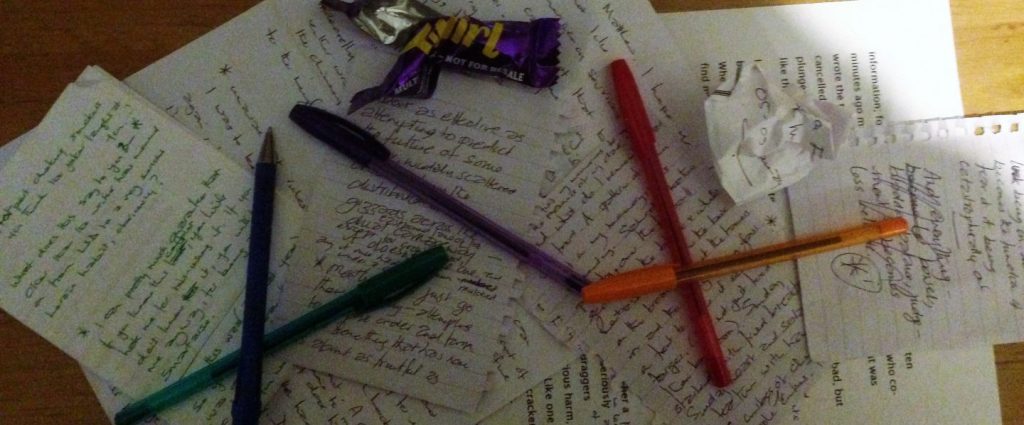
Having not written a usable word for more than a week now, I have decided upon drastic methods to get things going.  Not only have I changed my pen, I have also changed the colour of my ink.  I know what you’re thinking and, yes, you’re right, I am a man without fear.  If pushed into a corner by the Gods of Not Being Able to Tie Down a Single Amusing Thought, I will resort to any method of turning things around.  I have faced down the devil, twisted his nose and flicked the lobe of his ear.  If he thinks that he can make what is currently flitting around between my ears any more sterile than it already is well, he’s welcome to give it a go.  It could only spice up my day.  I have grown tired of staring at a blank sheet of paper.

Yes, I did say paper and yes, I have tried staring at a blank laptop screen instead – it didn’t help: it just reminded me that I need my eyes testing.  I have tried lined foolscap, plain A4.  I have tried both folded into four.  I am probably responsible for putting more shit on paper than the inventor of Andrex.  I currently have a bin full of the stuff.  It is folded in many ways, although some of it is just crumpled up in an almost avant-garde fashion.  (Out of interest, I have just popped ‘avant-garde’ into a French to English translator and it apparently translates as ‘avant-garde’.)  I am the Jackson Pollock of the wastepaper basket.  I am the idiot son of the man who never made it past a yellow belt in Origami.  I am currently writing in a school exercise book.  I cannot throw the pages away because if I rip them out, another – uncontaminated by my nonsense – falls out at the back.  I cannot bear to throw away undesecrated paper.

So, new pen it is: radical I know, but you are looking at a man who once drank red wine with fish.  Of course, switching to a blue does not come close to the sheer excitement of pushing down the little levers on one of the 6 variously coloured refills housed within a single pen that people of my age always got for Christmas, but it does make a change from black.  As it is, I usually flit between black and red biros.  I have black roller-balls, but I really don’t trust them.  They are fickle.  I use green pens for correcting.  Green is the colour of second thoughts.  Starting to write with a green pen means that I don’t even trust what is in my head – which gives me an insight into what other people think of me, and I don’t particularly enjoy it.  It’s like looking into the house through your own window – something you only ever really do when you are locked out.  I write, floridly, in fountain pen occasionally – but these pieces very rarely get transcribed into zero’s and ones.  I seem to whine a little too well in India ink.  Fountain Pen Me is a character that I rarely allow out in public.

I suppose that the man I would most like you to see when you look at what I write is exemplified by the mug full of pencils that sits on the desk in front of me.  They are bright yellow, of uniform length, and each capped with a rubber* to one end.  Sadly, upon close inspection you will find that only one or two of them are sharpened.  Most are blunt and unusable.  In fact, as much as I would like to emulate Hemingway, Steinbeck and Capote in writing in pencil, neatly rubbing out rather than scrawling over mistakes, I can’t.  I tend to carry crumpled paperwork around with me during the course of the day and, by evening, pencil scrawlings become indecipherable: a homogenous**, pale grey smudge – too much like my real life.

So, today I am writing in blue ballpoint – simply because I found a hitherto unused pen in a drawer and thought that I would give it a go – and an exercise book that I bought some years ago for my Open University course and never used, (My Uni notes were written in pencil, but were all contained in the margins of the rainbow highlighted text books) so I’m confident that I will eventually find something to tell you.  I’m just not sure what yet…

*Probably ‘eraser’ to those of you with an education.
**This is correct in English but both reads and sounds odd.  In American English ‘an homogenous’, which sounds much better to my own sadly uneducated ears.

The Writer’s Circle #10 – Phil’s Baby

Well, as the whole of the evening’s session resulted from a stupid, slack-mouthed, off-the-cuff suggestion made by Phil, he felt obliged to make the first contribution.  “Perhaps,” he had said a couple of weeks ago, “we should all have a go at writing in one another’s genre.  It will help us to understand…”  He could recall exactly how his voice had trailed away as he realised that everybody else actually saw this as a good idea.  He had meant it to stir up disagreement: something to spice up the last few minutes of a drab meeting, but it had been met with universal approval.  Deidre had drawn up a list on the spot, they had all chosen a random number and Phil had chosen ‘Play’; the knot in the pit of his stomach tightening immediately with the realisation that Billy would become his main critic.  Anyway, the die was cast so, despite the attraction of wanting to hear what Penny would make of the ‘Horror’ ticket she had drawn, Phil offered to go first – it was, after all, his baby.  Such was the general enthusiasm that they all agreed to make it a monthly diversion and gave Phil two weeks to make his ‘pitch’.  Two weeks can pass so quickly…

“Right,” Phil started, sounding very much more at ease than he felt.  He had worked very hard on this.  He actually thought he was onto something, but that was the last thing he wanted any of the others to know – especially Billy.  He had pages of dialogue at home: he couldn’t quiet the voices in his head; they kept him awake at night.  He felt that what he had was good, but it was much too close to him to let the others hear much of it yet.  He pulled half a dozen neatly typed, but deliberately ‘distressed’ sheets of foolscap from his pocket.  “This is what I’ve got…  It’s probably not very good,” he continued in a voice that even Terry recognised as insincere.     “The scene is simple: a single park bench facing the audience.  The setting is a graveyard and the cast is three old men discussing life and death, and the inconsequential nature of everything between the start of one and the end of the other.  It will be wordy, because there is no action and each of the characters each have monologues to deliver to the audience through the progress of the conversation.  I guess it would make them tough roles to learn – but it would be very cheap to stage.”  He paused for a moment expecting to hear Billy’s voice questioning whether it would be ‘real’, but it never came.  ‘Give him a little more rope…’ was what was dancing around Billy’s brain.

Silence can be good, but, in truth, it seldom is.  Phil decided it would be the right course of action to fill it. 

“OK,” he continued.  “It starts like this…

(As the lights come up on stage a three seat bench is centre stage facing the audience.  Behind the bench, his hands resting on it’s back, stands Frank)

FRANK                       It never seems quite right – a funeral on a sunny day.  You’re looking for gloom aren’t you?  Cold.  A chance to wear one of those long black coats like they do on the telly.  A bit of rain would be good; a swirling wind perhaps.  Maybe you could hold a big black umbrella over the grieving widow’s head.  Lift your collar.  Watch the rain drops collect on the coffin lid…  Funerals should all be in the winter.  Everybody should die in the winter, when the weather is right for funerals.  Not like today.  The world should be a drab place on the day that you’re buried, like one of those old newsreel films of the miners leaving the pits after a day’s shift; young men trudging off to fight in the war; the same men, now old men, trudging back, empty-eyed, from the war – the world should be monochrome on the day that you’re buried: dank and dark and cold for everybody else, like it is for you…

But look at this.  Bright sunshine.  Nobody wants to be buried in bright sunshine.  Unseasonally warm the weather man said.  Spring flowers pushing through the grass.  A world alive with daffodils and discarded ice-cream wrappers; confetti from yesterday’s wedding; birds singing in the trees, fighting and mating, scrabbling round in the newly-dug graves, searching for worms in the freshly turned soil.  You should go away little bird, come back in a couple of years when the worms are big and fat.  They say that we share 99 per cent of our DNA with worms.  It’s no surprise, is it?  I wonder what the other one percent is?  God perhaps.  Do we all contain one percent of the almighty?  Like the one percent of pork in a pork sausage – are we all God?  Is that what the Church means when it says that God is in us all?  God is all around us?  We are all minutely God?

(He walks around the bench and sits in the centre)

I read once that when bodies are exhumed, they find evidence that most of them were not actually dead when they were buried.   All those people asking to be interred with their precious possessions, when really they’d have been better off with a Black & Decker or a Walkie Talkie.  You’d at least want a neat little flat screen telly in the coffin lid.  Or a torch and a good book.  Imagine waking up and expecting a little bit of comfort in your plush silk lining only to find your stingy bloody kids had buried you in a cardboard box.  Eco-friendly.  Laid to rest like a Shredded Wheat.  I suppose, ultimately, we’re all recyclable aren’t we…

(He takes a piece of paper out of his jacket pocket and looks at it briefly)

One side of A5, that’s what your life boils down to isn’t it?  One side of A5.  Two prayers, a hymn and a eulogy from a vicar who can’t even remember your name.

(He folds the paper and puts it back in his jacket)

Sometimes you do have to wonder if you’re at the right funeral.  The person that they’re all talking about, it’s never the person you knew.  Nobody ever mentions that he stole from the tea fund; dropped old buttons in the charity collection; fed all fifty seven of the gerbil’s offspring to next-door’s boa constrictor…  Always the friend you could rely upon – always the rock in everybody else’s storm.

Everybody who ever died was a wonderful parent: I wonder what happens to all the crap ones.  Maybe they never die.  Maybe they live forever.  Strange thing to have as the key to immortality – ‘Are you a bad parent?  Yes?  Then don’t bother taking out life insurance, you’re here forever baby…’  You wouldn’t even have to worry about what the kids might say about you at your funeral : no-one would ever know that you’d never read them a bedside story; that you’d never sat with them when they were ill; that you never put actual English currency into their piggy banks on their birthdays.  You’re never going to die – you’ll never have a funeral – you don’t even have to worry about the ancient photographs of you with long hair and a kipper-tie being passed around the wake.

I wonder why people have such a compulsion to embarrass you after you’ve died.  ‘Look, here’s a picture of him with a really stupid haircut.  And here’s one when he had that really silly ginger moustache, do you remember that?  Ooh and look, he’d had far too much to drink on this one.  Wasn’t he funny?  Such a shame he’s dead.  Do you want another sherry?’…

Well, that’s all I’ve got really.  I know I’ll never make a playwright…”  He folded up his papers and forced them back into his top pocket.  “But it has made me think

about how these things are plotted.  I’m sure Billy will have a few pointers for me.”

As one, the Circle turned to Billy, who even now was toying with his own draw: ‘Detective Novel’.  “Right, well,” he gathered himself.  “Very good – for a non-playwright – although I can see many pitfalls ‘construction-wise’ and I think what we really need to ask ourselves is, ‘Is it real?’”

“Or is it a play?” asked Frankie.

Phil grinned broadly.  As far as he was concerned, the reaction had already been worth the effort and, truth be told, what had set off in his head as a means of laughing at Billy had become a project that he was now determined to pursue.  Meanwhile, the heated discussion he had hoped for had started, although Billy, whose thoughts were now fully occupied elsewhere – how would it be possible to kill someone without ever being caught – was strangely quiet…

‘The Writer’s Circle #1 – Penny’s Poem’ is here.
‘The Writer’s Circle #9 – The New Chapter’ is here.
‘The Writer’s Circle #11 – Ulysses’ is here.

The Running Man on the Go

Gradually, I have started to run a little further.  Metre by metre I eke out my runs.  I have no intention of joining James in attempting to run a half marathon – whatever the time-scale.  I am quite close enough to the grave already.  Nor do I have any intention of ever taking part in any kind of organised run.  I run a little, and I know how boring I can be about it.  Imagine an hour spent with people that run a lot.  Or possibly two hours in my case.  Also, the thought of the toilet arrangements haunts me.  I’m ok when I’m at home and close to a lavatory that I am familiar with at the start and at the end of a run, but just imagine travelling any distance before a run and then joining a queue to use the portaloo!  I am no stranger to the portaloo.  I have queued for many hours to gain access to these reverse Tardis of hell.  Nothing inside is anything like as big as it should be.  It’s impossible to be inside one without touching something.  Whichever way you turn, something pokes you in the back.  Can you ever be fully sure that the lock is on?  Who could possibly wee in those circumstances?  Well, not me.  Usually I wait for what I imagine is a reasonable amount of time: enough to have a (theoretical) wee, but not long enough to give the impression that I have had to deal with even more pressing problems involving – gulp – sitting down in there, before I wash my hands and leave – walking straight to the back of a different queue and hoping for better luck next time.  I am not good with public amenities.

Imagine having to use one (and I most surely would) before setting off for a run.  I would almost certainly have to loiter at the back of the field at the start so that I could nip back to the loos after everybody had gone (and there is little worse in this world than being the last person to use a portaloo).  As my chances of subsequently catching anybody would then be very slim indeed, it would turn into a wholly ignominious run for me; lurching over the finishing line long after the last of the Zimmers, such self-esteem as I could muster trailing behind me like a two-legged dog.  It’s really not an option.

So, what I am trying to do is to slowly lengthen my runs up to 10k.  I don’t know if I will see it through.   I don’t really know why I have decided to do it.  Another little challenge I suppose.  Having attained some kind of comfort over the last six months with my thrice-weekly 5k (occasionally 6k if I’m feeling good or there are chores to be done) it would be very easy to settle into that routine.  I think I need to unsettle myself a little.  I will push it on.  10k is a far-off target that I would like to reach over the summer, in the balmy evenings.  It is quite a long way.  At the pace that I run, it will take quite a long time to get there and I know what that means, but I live in the countryside; wherever I go it will take me past trees and hedges.  You don’t have to be a contortionist to wee behind a hedge, and I’ve never had to queue for a tree…

The previous episode of the Running Man Saga ‘… On The Path’ is here.
The next episode of the Running Man Shenanigans ‘…on Stopping’ is here.
The very first time I ventured out to begin the ‘Couch to 5k’ nonsense is here.

Zoo #26 – Pangolin

I write these little rhymes in batches simply because when I start one, the opening couplet to another unfailingly pops into my head – annoyingly distracting me from the original which can then take some time to finish.  (Limited space in my brain, only room for one rhyme at a time in there.)  Originally I thought that I might do a dozen, but it has stretched now to 26* – half a year’s worth – so I thought that I might go for the full year.  Who knows, by the time I get there, fifty-two may well be the number of animals in the world that have not yet made it onto the WWF Red List.  I have to remind myself from time to time that these rhymes are not meant to be ‘clever’ they are meant to be silly.  I’m not really made for ‘clever’.  My attempts at ‘clever’ usually emerge as ‘pompous’, so by and large I leave that to other people.  Childish is much more my cup of tea.  On a scale of Stephen Fry to Charlie Cairoli, I come in somewhere adjacent to the Chuckle Brothers.  Pomposity appears to me to be the domain of the politician.  I would never make a politician.  I do not have the necessary conviction that I know best and I have a face that even my grandchildren cannot take seriously, but if I do sound like a bit of a dick from time to time, I rely on you to tell me.  If I sound like a dick all of the time, then I apologise, but would suggest that you and I are probably not suited as companions going forward.

I know just what a panda is,
I know the panther too.
The parrot is well known to me,
I’ve seen one in the zoo.

We all know how a penguin looks
And pigs are nothing new,
But what a pangolin is like
I haven’t got a clue.

It could be that it’s tangerine,
It could be that it’s blue…
I thought I’d try and draw one
And this is what I drew.

It isn’t great – I know that’s true,
I’m sure it could be neater,
But have you ever tried to draw
A shy, scaly anteater?

Be fair – at least mine had an ant!

Could Have Been Worse

Photo by Dids on Pexels.com

The three most scary words my wife ever utters?  ‘…I’ve been thinking…’  Three little words that translate as, “You are about to be coerced into something – possibly electrical, certainly difficult, probably dangerous to the uninitiated, and definitely something that you will find right at the very top of your ‘Things I really don’t want to be doing’ list” – a catalogue of all the tasks for which I am uniquely ill-equipped.  I am fully aware that it would be considered churlish to respond to “I only want you to paint one wall” in any negative way, whilst being similarly well-acquainted with the fact that one wall will inevitably lead to all walls, all curtains, all carpets, all doors and all electrical fittings.  It is, of course, quite illogical that I should kick-back against what I am assured will be “a two-minute job” even though I carry the certain knowledge that it will escalate into something that will consume at least six months of my life and involve God-knows how many trips to A&E, not to mention innumerable three-figure invoices from the qualified tradesmen we are forced to employ in order to ‘put it right again.’

The room that is currently chalked up for the lick of paint is the hall/stairs and landing combo and it fills my heart with dread.  It has 9 doors and two windows – so I can, at least, take comfort from the fact that I am not being asked to wallpaper – as well as a virtually inaccessible stair-head which I can only reach from an improvised scaffold made from 3 ladders, part of an old kitchen cabinet door and several rolls of gaffer tape (“So, you might as well do the ceilings whilst you’re up there.”)  I will fall – of this you can be certain – the only question is whether I will land on the stairs and stop where I land, or whether I will barrel-roll to the bottom in order to be in exactly the right position to receive the ‘scaffold’ as it follows me in my downward trajectory.

It has been a few hours now since the coat of paint was first mentioned and the discussion has already passed through paint shades, new sockets and switches, new door furniture and new light fittings.  It will eventually encompass new carpets and flooring after I hit the deck with a five litre can of emulsion in hand.  The total rewire the house will need after I have fused the entire National Grid will, of course, be something we should have thought about anyway – not to mention the complete redecoration that will have to follow.  And so it goes…

I have grown used to the exponential growth in the magnitude of disaster that pursues me in any practical task: a kind of incremental plunge into the abyss.  There are many contributory factors that have a role to play in the remorseless collapse into pain and chaos; the universal one being me: the tool on the end of the tool.  I am a gift to authors who can spare only a single word in describing a character’s (in)competence in all things: inept.  From all manner of human interaction through to hammering a nail in without hitting a thumb, pipe or wire: inept.  Like a cockle* in a rockpool, I yo-yo wildly between out of my depth and beached, despite the instinctual knowledge that the tide is always coming: closed tight when I should be open, gaping when the seagulls arrive.

Now, I realise that this magnitude of whining does not make me sound like the world’s most enticing man.  I’m sure that I must have some redeeming features (Please God, let me have some redeeming features!) but none of them appear to be based anywhere within the scope of ‘practical’ for any mildly proficient person.

I feel as though I should list some of my positive attributes: I am honest, loyal and affectionate (and all of the above without being a dog).  I think that I am reasonable company – when I’m not decorating – and I’m a wiz in a pub-quiz. (I sense that I’m beginning to lose you.)  I laugh easily and I find joy in the smallest of things.  I am always in possession of chocolate and wine.  I figure that by constantly fearing the worst I, by and large, preclude the possibility of reality slumping below my expectations – so that, generally, I am relatively satisfied with the way in which things turn out.  I think that ‘Could have been worse’ may well be my epitaph.

Anyway, I have already placed myself in the hands of the Gods and assembled my scaffold and minced the length of the plank of wood that I have laid across it.  It is just long enough and it bends under my weight only slightly, so it should be ok if I keep to the ends.  I have moved the telephone table from the foot of the stairs because it does not look ideally suited to fall-breaking (although, ironically, it does appear to be supremely well assembled in order to facilitate leg breaking) and given full consideration to how I intend to fill the holes I have made in the wall when the scaffolding is down (I am considering the possibility of lengthening two of the four legs on a kitchen chair so that I can balance it on the stairs and, if necessary pile books on top in order to achieve the required altitude).  I’m quite proud of that plan – and we all know where pride comes…

A man, he’s like a rusty wheel
On a rusty cart
He sings his song as he rattles along
And then he falls apart…
We’ll sing Hallelujah – Richard Thompson

*I think that this might, to many of you, be ‘clam’ but, be honest, cockle is definitely funnier.

The Writer’s Circle #9 – The New Chapter

Elizabeth Walton knew that time spent in regret and recrimination was always wasted.  It achieved nothing positive.  It merely deepened disillusionment – and bitterness was so ageing.  She had been lucky enough to spend twenty years of her life with the man that she loved, and she was grateful for that.  It had been a happy marriage; not blissful, but normally happy.  There had been times when she wished him dead and times when he had wished the same for her, but there had also been times when she felt truly contented – and those were the times that she chose to remember.  She remembered the day he had died – had been killed – of course, but not with any detail.  She remembered it as one remembers a taste or a smell.  The loss was a sensation to which there was no detail.  It was emptiness.  It is not possible to recall emptiness, only to experience it, and emptiness is what she experienced, day after day until one morning, several months after he husband’s death, Elizabeth awoke with the realisation that she had experienced quite enough of it and so she packed it carefully away – she had to know that it was still there if ever she needed it – and closed the cover on it, like a precious flower pressed between the pages of a favourite book, never forgotten, but seldom recalled.

Joining the Writer’s circle was the first conscious move that Elizabeth had made towards opening a new chapter in her life; she felt it apposite.  She had seen the leaflet in the library and, despite never having written a word in her life, she went along at the first opportunity, because she knew that if she left it to the second, it would never come.  In the event, it had been a very easy introduction.  A local history writer – a professor from the local university with a bad wig and, from the look of it, only one good shirt – had agreed to read them a short section from his new book, so apart from introducing herself briefly she had little to do for the first hour.  When the professor had finished his reading to polite applause on the hour mark, Deidre had suggested that it would be a convenient time to take ‘tea’ and everybody went down into the bar below.  She noticed that most of the group drank happily together whilst two men – whom she later got to know as Billy and Terry – tended to hang around the fringes, unwilling or unable to properly join in.  It didn’t take her long to realise that backs bridled whenever they came close enough to join in the conversation.  She also was aware of the smartly dressed man with the boxer’s brow who stood alone, occasionally shooting his cuffs, and constantly looking over his shoulder.  She felt that he did not belong.  Fortunately she retained sufficient intuition not to approach him – although she was intrigued by the bulge on his ankle. 

She’d had two gins – the first of which was bought by a man who introduced himself as Phil and said that he was pleased to see ‘new blood’ in the group.  The second she bought for herself and had to finish somewhat hurriedly when Phil told her that they were not allowed to take the drinks upstairs with them when they returned to the Circle.  Thus it was that, when she was asked to better introduce herself to the group, she did so fully and, briefly, tearfully.  She was a little ashamed of herself but, if she was honest, it felt liberating to be able to unburden herself in such a way in front of strangers – like taking her bra off in a restaurant.  (It was only the once, you understand, and she’d put her blouse back on before she came out of the ladies.  She’d only done it to see if her husband would notice.  He didn’t, but the waiter who found the bra under her chair did.)  Anyway, it was done; there was no way of turning back.  In her mind she had decided that it didn’t matter because she would never return here, but then everybody had been so nice about it, not condescending, just nice.  Phil and Frankie had made her laugh, Penny had offered her a tissue and Louise had passed her a little mirror saying, ‘You might like to take a little glance in there,’ which was very nice of her because nobody likes snot trails do they?

Anyway, long story short and all of that, the rest of the session really became just a little bit of a chat, mostly about books: they asked what kind of books she read, which authors she enjoyed, all the kinds of things that she’d anticipated and rehearsed and then Deidre asked her what kind of books she wrote.  Elizabeth had been prepared to obfuscate a little on this point – not really wanting to own up to getting little further than a shopping list – but the question was so direct and the manner in which it was asked allowed so little room for equivocation that Elizabeth panicked.  She closed her eyes and visualised the library shelves.  “Family saga,” she said.  “Oh good,” said Deidre, “We haven’t got one of those,” and the die was cast.  It seemed to satisfy everyone.  Well, almost everyone.
“What are you working on at the moment?” asked Penny.
“Well…” she looked at Penny and smiled.  Penny seemed very nice really and Elizabeth was sure that she would grow to like her, if she could just get over the current urge to strangle her.
“Maybe you could read for us sometime.”
“That would be nice,” said Elizabeth, painfully aware that ‘nice’ was a word she was going to have to try and eradicate from her vocabulary if she stood any chance of perpetuating the fiction of herself as an author that she was in the process of creating.  “It’s all a little bit fragmented at the moment, but I’m sure in a week or two…”
“That would be lovely,” said Penny, genuinely pleased.  “To hear something new.  Lovely.”
“Well, I’m really not sure how good it will be,” said Elizabeth, realising that if she was to come back again she would, almost certainly have to write something – and that was the second positive thing she did since opening the new chapter…

‘The Writer’s Circle #1 – Penny’s Poem’ is here.
‘The Writer’s Circle #8 – Ovinaphobia’ is here.
‘The Writer’s Circle #10 – Phil’s Baby’ is here.

The Running Man on the Path

I would choose, if it was safe, to run on the roads rather than the paths.  The paths around here are very much the second choice for running.  For a start they would appear never to have recovered from being bombed in the war: it would be uncharitable to call the craters that litter them ‘potholes’ – I think ‘fox-holes’ would be more appropriate: they are wide enough to defy hurdling and deep enough to conceal ancient Japanese soldiers who still do not know that the war is over.  Dodging them pretty much doubles the distance of a run.  Then, where there are no potholes, there are drives.  For some reason this village specialises in driveways that merge with the road via something with sides that appear to have fallen off a rift valley.  Those that do not treat you to an up and down of about six feet over a car’s width, indulge you, instead, in a headlong dive either into the road or somebody’s garden, as the whim takes them.  After a ‘path run’ my knees feel like they have just done ten minutes on a bouncy castle with my grandkids – the most strenuous exercise known to man.  And finally, of course, the paths have dog walkers…

I know, I know, I have been here before, but really!  What is it all about?  Normally if I am running in the road, providing I stick to the gutter – that’s quite enough of that, thank you – approaching cars ease out a little to give me room.  I always acknowledge them.  Everyone is happy.  If I am on the path and have to pass anyone – a novelty for someone who runs at a speed somewhat short of walking pace – I move into the road if I can, or cross to the other side.  None of this is possible when the rain means that the road is as slippery as a greased eel.  I stick to the path and gauge my speed, the best I can, to pass walkers at a convenient point, causing both of us the minimum inconvenience and allowing the maximum distance.  Now, I am a walker too.  I do realise that walkers do not want a shagged-out senior citizen panting all over them at close quarters.  It’s easily sorted.  We all move a little and everyone is happy.  Normally pleasantries are exchanged and the world carries on turning.  Unless the walkers are attached by a leash to a dog, in which case the path becomes a kingdom to be defended.  None shall pass.  A laird whose territory extends exactly to the end of the pooch’s lead.

Most of what passes for rational thought when I am running, is expended on where I should be in order to cause the minimum inconvenience to other path and road users: on plotting a path that keeps everybody as safe as possible and, if possible, avoids the necessity for a trip to A&E with my leg in a makeshift splint, cunningly fashioned from pieces of the larchlap fence I have just crashed through.  A walker, on seeing a runner approaching, will normally move to one side, the runner to the other and it is very easy to manufacture a point of crossing that coincides with a driveway.  Two metres is an easy distance to gauge: imagine falling over; would you crack your head on the path or on the other person’s toe-cap?  A walker with a dog, however, will glare and stop, with great deliberation, between driveways before moving to the very centre of the path, giving you the simple choice: go ‘dog-side’ and risk a trip through somebody’s hedge, or go ‘idiot-side’ and risk a high-wire act along the kerb whilst they glare at you and defy you to breathe their air.  With the road out of bounds, the ‘full stop’ is the only way out, whilst they walk by at their leisure, snorting gently from the nose.  I was actually asked today whether I was ‘allowed to be doing that’.  ‘Lockdown,’ apparently, ‘is not over yet.’  I was about four hundred yards from home.  I did not recognise my interrogators – who were even more ancient than me – but I’m guessing they were probably not from the village, that they drove here to walk the pooch – doubtless because they have run out of places to dump their plastic wrapped bundles of faeces closer to home.

I could have stopped to argue, but, to be quite frank, it’s such a battle to gain momentum that, once I’ve got it, I don’t want to let it go.  I could have said something caustic en passant, but I’m not certain that my breathing was up to it; I could have given them a withering look, but I fear they may have thought I was having a stroke, so I settled for a cheery ‘And a good morning to you too.’  They didn’t see the irony.  I must be slipping.

The whole running saga started here with ‘Couch to 5k’
Last week’s bulletin ‘The Running Man on Reasons to be Cheerful’ is here.
The next Running Man bulletin ‘…On the Go’ is here.