Never wave an ice cream cornet In the presence of a hornet, If they want to taste the thing They possess a fearsome sting.
And, unlike the Bumble Bee, Are very much less mannerly: Always happy to inject Their poison where you least expect.
If you’re walking round the zoo And you somehow find that you Are trapped between the beast and sugar, Swat the stripy little bugger.
So, science tells us that every creature has carved for itself an evolutionary niche: every creature has a role to play. Tell me, please, what is the role of a hornet? Other than being even more belligerent and bloody-minded than a wasp, what does it do? It seems to have developed as a consequence of some entomological arms race: more likely to sting than a bee, more painful than a wasp, bigger than them both; it is the China of the insect world and every bit as unreliable. If you avoid being attacked by it, it will probably find a toddler to attack instead.
PS I do sometimes have readers in China. No more I guess…
Having ‘retired’ at the beginning of the year I, like the majority of our benighted nation, have spent the last few weeks at home, doing things that I have been putting off for months, but in two weeks time I start my new, part-time job and, having worked full-time without a break for the last forty plus years I suddenly find the prospect quite daunting. I was adamant that I was not going to return to ‘pressure’ situations and my new employer assures me that this will not be the case. There will be no pressure in what I do – except that there will be a thousand new things to learn, and it occurs to me that it is a long time since I last did that. Am I still capable of learning, not an odd thing – how to peel an onion without crying, for instance; how to pull my socks up without putting my back out – but many, many new things, all at the same time? I am seriously concerned about it.
Have you ever stopped to think what you have learned recently? ‘Every day’s a schoolday’ is my mantra. I love to learn. I learn new things – all of them useless – every day, but I learn maybe one new thing at a time, not dozens, and I am increasingly aware that my brain is now operating a ‘One in, one out’ policy. Every time I learn how to set an electrical gadget, I forget the name of one of the grandkids. I look at those grandchildren and I realise how much they learn each and every day. They have brains like sponges, I fear mine is probably more like a pickled walnut: the content just as unpalatable. Pickled walnuts are soaked in vinegar, and we all know what that does to conkers. (I have only once eaten a pickled walnut*. It tasted like pickled coke**. I could not think of a single sane reason why I would ever want to repeat the experience.) Will I be capable of learning even the rudimentals – which key goes where, which button rings the till, which button sets the alarm off – let alone the more complicated stuff: whose turn is it to make the tea, who has milk, who has sugar? My brain is very good at what it does – at least that’s what it tells me – but how will it be at doing what, to date, it has not done before?
I wonder if I should somehow test it, maybe force it into doing a Sudoku, learning the chords to ‘Stairway to Heaven’ on a ukulele, making sense of the gas bill. I’m good at quizzes, but I always have been, I need a new mental challenge. How much of a stretch would it be for me to sit through an entire episode of ‘Eastenders’ without searching for something more interesting to do, e.g. researching how to pickle a walnut? I can only hope that my need to understand everything that I find puzzling is a good thing, that it shows that I am still curious, and not that I am stupid. Everything is a puzzle to me, but I know that curiosity does not necessarily equate to intelligence – I have looked it up. I am curious about how the universe works, but I do not understand any of the workings of it. Forget The Big Bang, I do not understand how come all of the planets do not just sink down to the bottom. (Also, come to think of it, where is the bottom? If there is no up and down in space, how on earth do you avoid spilling your gin?)
I still find the same things amazing now, as I did as a child: a butterfly, a snowflake, the way that animals find their way home from the other side of the world, the way that paint always drips in exactly the one place you don’t want it to. I have stopped trying to understand politics, but that is only because I have grown to realise that there is nothing to understand. It would all be so much easier if I could choose what to forget every time I manage to remember something new: the name of my next door neighbours, ‘In’ – the atomic weight of plutonium, ‘Out’; the names of the people I will shortly be working with, ‘In’ – the nicknames of the people I went to school with – ‘Out’; anything even vaguely important, ‘In’ – the kind of pedantic crap my mind is full of (‘aitch’ not ‘haitch’, ‘may I’ not ‘can I’, ten thousand incorrect uses for the apostrophe, ‘we were’ not ‘we was’) ‘Out’. It’s the knowing what to let go of, that’s the problem. I‘m sure there’s a place in my brain that is set aside for making such decisions – I’ve just got to clear out the junk so that I can reach it.
*Just for the record, I have never eaten a pickled conker – that way lies madness. **The stuff you put in furnaces, not the stuff that makes your teeth drop out and your manly chest drop to just below waist-level.
“I wrote this for a magazine. I thought it was funny. They returned it to me. They didn’t think it was funny. They thought that it was a GCSE essay that I’d sent to them by mistake. Anyway, as I wrote it, I thought that I might read it to you all before I feed it to the shredder.” Frankie began, solemn-faced, to read from the sheaf of papers he held in his hand.
“‘In common with most nations (and some sunglasses), the UK is seriously polarised. At one end of our society there is a sub-set of the poor and disadvantaged who believe that all of their woes have arisen as a result of the actions (or inactions) of ‘the rich’; at the other end a sub-set of the rich and privileged who really do believe that those without wealth are that way simply because they are workshy; that those without education are that way simply because they are stupid; that those who choose to eat their meals in McDonald’s do so simply because they are too lazy to get the 4×4 out of the garage and nip round to the wine bar. Both views, although palpably flawed, are none-the-less deeply entrenched into the British class psyche. It is an obvious, if not particularly edifying fact, that when things get stacked-up – as societies are apt to do – something always winds up at the bottom – like Grimsby. Whilst the vast majority of us occupy the middle ground between two extremes – ineffectively dangling our balls over either side of the fence, grumbling under our breath like a disenfranchised Social Democrat about the behaviour and attitudes of those both ‘above’ and ‘below’ us – it is the rift between these two ‘poles’ of society that drives all comedy. The stooge in all comedic confrontations will be either an upper-class twit or an ill-educated lout. We feel empowered to laugh at them both because we are neither.
Our comfortable little Larnaca poolside sunbed in the ‘green zone’ between the two sides engaged in the class war is the place from where we can look in any direction and see something ludicrous. We are the sane centre of an insane universe and the idiots either side of us can’t even see it. We see that the rich are wrong to deride the poor and the poor are wrong to censure the rich, but we do not see that the one thing that unites the two is the contempt with which they view those of us in the middle. Neither one nor the other, neither twixt nor tween, neither Abbott nor Costello: we are an homogenous gloop, like vichyssoise, and there’s nothing funny about that.
Comedy is always painful for someone. I have been to many comedy gigs that were excruciating. (The problem with a bad joke is that you don’t know it’s bad until it drops onto your foot.) All jokes are battles: all punchlines are the moment when Indiana Jones shoots the giant swordsman in Raiders of the Lost Ark. The skill of the comedian is in telling you something you already know, whilst allowing you to think that they thought of it first. How many times have you watched a mammoth James Bond fight whilst thinking ‘Why doesn’t he just shoot him’? Some degree of foreknowledge from the audience is vital. Imagine a comedian with no audience (perhaps Jimmy Carr). If I fall over in a forest and nobody is there to see it, is it still funny? (Answer: only to my wife.)
In the United Kingdom, we can add to this caustic little brew the fact that the four home nations actually have very little time for one another (we are perpetually either preparing for divorce or engaged in the kind of dalliance that will almost certainly lead to one) and – except for when any one of us has an Olympic champion – we’d actually far sooner be United with anybody else other than our closest neighbours (excluding the French, obviously). All the jokes I knew as a boy featured an Englishman (smart), a Scotsman (tight) and an Irishman (stupid): there was seldom a Welshman in my proto-teenage repertoire as I was not familiar with any comedic Welsh stereotype other than a fat man singing loudly at daffodils. The English man – always a man: misogyny would have been a really good Olympic event for us back then – always top of the pile as far as we were concerned, but bottom for everybody else. For us the stiff upper lip, for everybody else an iron rod up the arse. The characteristics we most valued, being the most reviled by everybody else. Charming eccentricities are all well and good, providing that you don’t expect everybody else to share them. Ok, so we have the best sense of humour in the world, so why does nobody else get it? Perhaps they just need educating. (Many deride the French sense of humour, but they forget Marcel Marceau – or a single word he said – some say the Germans have no sense of humour, but they forget… actually, they don’t forget, perhaps that’s the problem.) Hating the English is the only thing that actually unites the rest of our Queendom (and, at times, the world). English plutocrats, looking down our noses at our feckless Celtic cousins: a class war of nations. We are the butt of their jokes as they are ours. A fun day out at the circular butt-kicking convention.
And God forbid that anyone is knowingly droll or amusing: that is just not how it is done. English characters do not wise-crack, they pratfall. Basil Fawlty was a clown, Del Trotter was a clown, David Brent was a clown: if they’d have been witty, they’d have been smart-arses and we wouldn’t have liked them at all. Funny is accidental, stupid, absent, but never intentional. Witty is annoying. It is difficult to think of a single successful sit-com character who ever ‘made’ jokes, rather than being the butt of them: an unwitting victim of circumstance. Most successful comedians stress their own fallibilities rather than those of others. Frailty becomes their strength. ‘Making fun of’ is seldom funny. Mocking political satire merely turns the ‘enemy’ into the ‘victim’. Even with a target as broad as our own Boris, it is difficult to score points without appearing mean. Nobody likes a bully, and the desire to be liked is the common thread that joins all comedians. The class clown is traditionally the shy boy/girl who has no friends until they discover that putting a drawing pin on the teacher’s chair will buy them a class full of them – as long as they find something equally funny to do the next day. It is like being court jester to a medieval king: ‘make me laugh my head off or I’ll laugh yours off’. ‘You’ve got to give it to him though, that’s a bloody hilarious pig’s bladder he’s waving.’ Has any sane person ever laughed at a circus clown? ‘So, your car fell apart, well so did mine sunshine, and nobody laughed then either.’ The biggest prize for those with no friends is the friendship of those with many. The biggest prize for those with many is the ability to thwart the aspirations of those with none. Money does buy friends, and also the ability to have no need for them. Those that have do not need, and those that need do not have, and whilst we may well be the only ones to see it, the joke, none-the-less, is always on us.’”
He winked.
“I really have no idea why Woman’s Own would not accept it…”
The actual ‘running part’ of my day takes about forty minutes; the rest of the run takes considerably longer. Firstly, I have to convince myself that I am actually going to do it. This involves first going through all of the reasons why I should not do it: a definite twinge in the middle toe; a parcel delivery expected any time in the next few days; the possibility that it might rain; the possibility that it might not rain; a recently discovered re-run of the Phil Silvers Show on some obscure channel that I may never find again, and the necessity to gauge the current bladder status. It all takes time.
Eventually, decision made, I start to get ready: take a drink; empty bladder; bind up knees; don running tights, vest, shorts, ‘T’ shirt. Empty bladder. Put on running shoes – always double-bowed. Empty bladder. Pop in Bluetooth headphones, grumble on for ten minutes (approx) whilst sorting out ‘connection error’ and set up GPS tracking. Empty bladder. Open door in order to assess need for hat and gloves. Put on hat and gloves in certain knowledge that I will regret it within five minutes. Exit, closing door behind me. Open door. Empty bladder. Exit again. The routine is pretty much invariable, as is the realisation that despite the knowledge that it is all habit, I will regret not visiting the loo one last time at precisely the same time as I begin to regret the woolly head-covering.
I’m told that there is a close link between the pressing need for micturition and running. Why? Well, nobody’s ever told me that. I suppose it is the same link as that which lurks behind the curtain coming up at the theatre or the first chord booming around the concert venue. However recently I last went for a wee, it was always just too long ago. Some years ago, some friends and I went to a concert in a small, ‘intimate’ venue which meant that, for most of the evening, the artist* could see the audience. When the mid-session interval came around, one of my friends who was clearly almost as desperate for ‘the gents’ as he was to escape ridicule, leapt over two tiers of seats and ran down the corridor shouting, ‘Emergency. Emergency. Coming through!’ The already assembled ‘toilet queue’ parted like The Red Sea at the behest of Moses and deferentially let him through. Back then, I collapsed into the kind of laughter that sends well-meaning souls rushing for the defibrillator. Today I feel his pain.
On my eventual return from running I generally have a decision to make over whether it is worth retracing my steps in order to find the glove I have somehow contrived to drop at some point along my journey. Generally I decide that I will find it dangling from somebody’s hedge when I repeat the journey in a couple of days time, so I leave it where it is and, pausing for nothing more than twenty minutes to remove the triple-knot from my trainer laces where the double-bow used to be, head straight to the shower before the flies have the chance to settle. Thus the forty minutes of exercise generally eats about an hour and a half from my day – which is the perfect reason not to run if I’ve only got an hour in which to do it.
*Roy Harper, whose song ‘When An Old Cricketer Leaves the Crease’ is one of my ‘funeral songs’. This may, or may not be relevant.
Today’s episode was brought to you by a break from procrastination and a red Wilco ballpoint pen. Today’s top running tune was ‘There’s No Way Out Of Here’ by David Gilmour. Today’s Thought for the Day: If Einstein was correct, a stitch in time would require a very big bobbin indeed.
Built like tower cranes on feet And rendered pink by what they eat, Thank the lord that politicians Do not provide them with nutrition. (Because nobody wants a shit-coloured flamingo).
Come on, everybody knows the joke about ‘you are what you eat’, but flamingos, at least to some extent, really are. Everybody loves a flamingo don’t they? Well no, not me. Have you seen those beady little eyes? They may be pink – and nothing pink is ever bad – but surely the knowledge that they only get to be pink by eating certain algae and shrimps gives some pause for thought. What colour would they be otherwise? Would they still be cute if they were brown? Why, evolution being what it is, do they not eat stripy algae so that they are disguised in the reeds? There must be some natural advantage to being pink. Maybe it’s a visual warning to all predators: I taste just like one of those god-awful pink wafers that you always get in a biscuit selection, and nobody wants to eat one of those…
If only to illustrate a point made last week (In ‘A Blue Ballpoint Pen’ – here.) I reproduce a piece for you today that was originally written with fountain pen on completely unsuitable paper. I have transcribed it best I can, bearing in mind that one side of the paper appears to be much more absorbent than the other, with the effect that part of the original draft appears as though written on kitchen towel and, whilst I am never completely certain of my intentions in retrospect, it is even more difficult to understand an original document that appears to contain words such as ‘miuct’, ‘fouruain’ and ‘squrrox’, but I’ll give it a go…
…I went for a walk this morning to find that The Gas Board have descended on our street. There are perhaps a dozen white vans parked along the road, each one of them meticulously placed across every driveway that contains a car. Empty driveways are left unmolested. It appears to be a game that all the drivers play. Dropped into this white Transit car park, we also have variously hued diggers, lorries and more lengths of plastic fencing than Aintree racecourse. There is also something hanging around that appears to suck – water, I presume – from the holes that are being excavated at various points along the pathway and it appears to require the attentions of at least eight men to do it. It is either not very good at what it does, or so good that it pulls in an audience. I cannot tell you the answer: the plastic-barrier maze that has been set up to keep the public at sufficient distance to protect them from danger, means that total concentration is required in order to remain upright. An injudicious glance off-piste may well result in a ignominious headlong plummet towards a gasman’s ankles and the possibility of a humiliating struggle back towards the upright via a hand-up from a giggling high-viz workman. I am used to embarrassment, but I have my limits.
Today, my walk took me just around the corner to the post box where I discovered that the little notice on the box states that the collection time is five minutes ago. Always five minutes ago. Ah well, this is Royal Mail: what difference can twenty-four hours make? I posted and walked on.
Spring is in full bloom now: the world is filled with yellow and violet. Blossom is filling the trees and the birds are trapped in the strangely heroic struggle to prioritise mating over feeding. Sparrows fight and blackbirds begin, what for some, will be a very short season of kamikaze diving in front of speeding cars. Cats lurk, permanently mid-prowl, waiting for some errant feathered soul to flutter their way. The animated ‘shooing’ necessary to move them on is tempered by the caution necessary to ensure that they do not flee across the road and into the path of a giant gloop sucker.
People talk in the streets these days. Picking a way through the small knots of socially distanced chatterers is like a slalom ski run. (I think. I have never skied – strange word: never looks right – I have neither the knees nor the balance to do it. I don’t like being cold. I do not enjoy time spent in the company of fiercely middle-class couples bent on making me aware of how difficult it is to employ a decent home-help these days. I do not like gluhwein.) By and large, other than one or two young mums with prams, the talkers are overwhelmingly elderly. Maybe everybody else is working from home, wired into the laptop, the kettle and the Hob-Nobs. They should get out of the house. They need to listen to the birds and see the flowers: they need to meet other people. Homework should come with in-built Not-Spending-the-Entire-Day-Sitting-at-the Kitchen-Table-Staring-Hollow-Eyed-at-the-Laptop breaks.
I have never really had to work from home, although I do an awful lot of working at home. My wife considers it the only really valid reason for my continued existence. I cannot but imagine how difficult it must be to fit in home-working with home working. How do you squeeze ‘Homes Under the Hammer’ into the routine? Do the tea breaks run concurrently? I have always had a job which paid the bills, but I have always written – what I consider my proper work. My weekday routine has been unchanged for years: carry out my day’s employment and then ‘work’ through the hours between eat and sleep. I have worked right through the night many, many times, in the certain knowledge that any ideas that lurk in my head ‘right now’ will have evaporated by the morning, leaving only an uncertain stain where inspiration used to be. I am not Douglas Adams. The ‘wooshing’ noise of a passing deadline is, for me, not one to be enjoyed, but the sound of an opportunity being missed: another clanging ‘Might-Have-Been’ to be added to my CV. The worse thing about my deadlines these days is that they are all self-imposed. Nobody is any longer in any hurry to receive anything from me. I still try to write something worthwhile every day, but I am no longer driven to twelve hour sessions and the brandy bottle when I cannot. And when I just cannot think of the punchline, I take a walk to clear my head – there is joy in having nothing much to think about…
“…You cannot deny that it’s a masterpiece.” “I can and I do. It is impenetrable, pretentious claptrap. The only people that ever claim to have enjoyed it are those who have never actually tried to read it.” It had been several weeks since James Joyce’s opus had last been the topic of debate at the Writer’s Circle, but once again Frankie found himself at odds with Penny – whose poet’s heart had been stirred by the lyricism even though, truth be told, she understood barely a word of it, and Deidre – who had read it on holiday in ‘The Lakes’ once a year for as long as she could remember, on one memorable occasion making it as far as the first couple of pages of chapter seven. “It’s a wonder to me,” continued Frankie, “that he could drink so heavily whilst obviously having his head so firmly up his own arse.” Like Deidre, Frankie had also attempted to read the book annually for decades, although never with the expectation of finishing it. It was just something he did. Like walking on glass, it was only possible to find satisfaction when it was over. Frankie was always happy when he’d finished it. ‘Finished’ as in given up, that is – definitely not as in getting anywhere near the end of the bloody thing. He had no intention of ever making it to the end. It was like any other method of self-flagellation: you had to know when to stop.
For Penny it had been a literary rite of passage, a trial of intellect, and she had made it all the way through from start to finish – although, as Frankie was often at pains to point out, it would have made just as much sense if she’d read it from finish to start – and she loved it. She bathed in the sound of it, the rhythm of it, the feel of it without any sense of knowing what on earth was going on. And having achieved the feat she, sensibly, made no attempt to ever repeat it. She realised that the sheer incomprehensibility of it would start to irk with a second reading. If reading 1 had left her fulfilled although mystified, she felt sure that reading 2 would leave her feeling somehow inadequate – and she didn’t need a book to do that to her. Unlike Frankie, who knew condescending twaddle when he saw it, she still believed that the meaning was there, waiting for her to find it, one day. Although, as it was a timeless masterpiece, she decided that there was no hurry.
Louise Child, cast her eyes to the smoke-yellowed ceiling; she liked Penny, but tonight she wanted to strangle her. The writer of Modern Thrillers and one of the most obviously ‘educated’ members of the circle, seldom took part in these conversations, but today’s topic had roused something in her: a ghost from the past. She was haunted by the memory of her High School English tutor, an unlovely and unloved man, who had coerced her into reading both ‘Ulysses’ and ‘Finnegan’s Wake’ because it would be good for her. “They’re not on the curriculum, Sir,” she had whined, but he was insistent: he knew that Louise was going to ‘be something’ and, a man of great vanity, despite his penchant for tweedy suits and bushy sideburns, he wanted to be the man that she eventually credited with her awakening. “It will help your development as a reader,” he’d assured her. “It will open your mind.” He was wrong. It had merely bored her out of it. She had decided to go on to study ‘English Novels’ simply because even a lifetime of ‘Far From the Madding Crowd’ was preferable to ever having to consider Joyce again. She wanted everyone to know what she thought of the blessed thing so, she seized a moment of silence and leapt headlong into it. “Ulysses is a pantomime,” she declared with uncharacteristic conviction. “A fairy tale. It’s a charade. It means nothing. It was simply a means of getting people prepared for what was to follow: throwing words at the page and seeing what stuck. It’s a child’s pasta collage dressed up as fine art. It is Brian Sewell discussing roadkill, simply because the badger was struck by Damien Hirst. It’s being too vain to care what people really think, only what they say they think…” She stopped, suddenly aware that she was centre of attention. It was not a position she chose to occupy.
Penny sensed her discomfort, but she also felt affronted by the strength of her opinions, so she abandoned any attempt to intervene. As usual, she regretted her decision almost immediately, but felt, none-the-less, completely constrained by it. To everyone’s surprise, including his own, it was Billy who first leapt to Louise’s defence. “I’ve never read it,” he said. “But I know exactly what she means. It’s like being expected to like Shakespeare, but you can’t, because you know it’s nonsense. Some brilliant one-liners, a few clever epigrams and what? There is no plot. Go and see it in the theatre and you get the director’s plot: you get what he or she thinks Shakespeare was banging on about, but try and work it out for yourself, just from the text and, be honest, your guess is as good as anybody else’s. What’s the point in buying a book if you’ve got to make the plot up yourself? Well, that’s what I think anyway…” He looked around the Circle and, for once, he did not sense the hostility his contributions usually managed to engender. Even Phil managed a slight nod in his direction. “And it’s just so bloody long,” said Frankie. “Like War & Peace.” “Have you ever read War & Peace?” asked Phil. “No I haven’t, it’s too bloody long.” Laughter filled the room. It happened from time to time and it always annoyed Deidre, who would really have quite liked a world without it. “Are you seriously suggesting that all long novels are bad?” “Not necessarily,” answered Frankie. “Although I would rather like you to name me a good one.” “What about Middlemarch?” “Have you read it?” “Well I…” “No, I thought not. Watched the TV series I expect.” “You could count the ‘Lord of the Rings’ as a single book,” ventured Billy. “Indeed you could,” admitted Frankie. “It is, after all, profoundly dull without the benefit of CGI.” Deidre glanced at her watch and decided it was probably time to call an end to the evening’s meeting. “I think, Mr Collins, that you are probably being deliberately obtuse. Perhaps we should call it a day and bid one another farewell for now, before anyone can be offended.” The Circle began, haphazardly, to rise and disband. “Ah,” said Frankie, a triumphant grin spreading from ear to ear. “‘Think you’re escaping and run into yourself.’” “I have no idea what you mean by that,” sighed Deidre. “Nor do I,” said Frankie. “It’s codswallop.” “He’s right,” offered Louise as she struggled her arm into the sleeve of her overcoat “and, as we are leaving, I would also ask you all to remember, ‘Longest way round is the shortest way home.” She smiled at Frankie, who beamed back at her. “Pure codswallop…”
This [Ulysses] is obviously the wave of the future, I’m glad I’m dying of tuberculosis. Katherine Mansfield
I thought that I might stop the running diary: it has a very patchy readership – although that, in itself, is not unusual. Day by day, post by post, the (lack of) quality within my blog remains more or less constant, yet the readership goes up and down in a manner that I just cannot fathom. There have been occasions when I have published a post only because I have nothing else. It has often been a toss-up as to whether to go for ‘no post’ or something I feel to be substandard. I always go for ‘substandard’ – it’s been many years since I have felt comfortable in falling back on ‘My homework is in the dog’ – so I use what I have got, and therein lies my problem. The posts that I do not believe to be good enough often get lots of reads and lots of likes and I am always left wondering why? Perhaps I should write badly all the time. (Oh come on now. That’s below the belt!) Nobody who writes is ever fully content with what they have written, but I have from time to time published a post that I have been largely happy with and often, those are the posts that go down the toilet quickest. I clearly do not write for me.
Not being my own audience is my biggest problem.
I have realised that the more I ‘polish’ a post, the less it is liked. I use my own voice most of the time now and that seems to work the best. (I wonder what I sound like to you? I can hear me. I sound like a camp history teacher. Is that how you hear me? Hearing myself on audio or video playback makes me cringe and laugh at the same time – unfortunately, normally in the wrong order. It’s hard to know what you sound like to other people, isn’t it? It’s like colour. We both know that grass is green, but do we both see the same colour? Is my green red and your green blue? My brother is colour-blind and I really struggle to understand it. If he really can’t tell the difference between blue and green, why doesn’t he keep falling off cliffs?) I wrote a series of ten-minute monologues a little while ago about a fictional village which were perfect for podcast so, to see how they sounded, I recorded a couple. Oh dear. Imagine Alan Bennett’s more monotone sister. I cannot believe the sound that comes out of my mouth. It’s the aural equivalent of watching wallpaper being stripped. It’s like chillies in honey – whatever you are looking for, it is all there, just definitely not like you want it.
I know, also, that with blogging there is a knack to getting the title right. Asking questions is apparently a sure way to get readers. My whole life is a question. I do not need readers, I need answers. Perhaps if I just add a question mark to the end of each title my readership might go up (it can’t go down). There must be a way of fashioning Categories and Tags to pull people in. I should learn it, but… I enjoy the writing. I would like to have more readers – my wife finds it hard to understand why I devote so much time to writing this drivel for the weekly consumption of ten regular readers and four hundred algorithms. It’s just what I do. It is what keeps me sane. Wibble.
This morning I received bad news upon bad news and then I went for a run. I realised that running is now also what I do to keep myself sane. This running diary should, by my own ‘rules’ stop with the end of ‘Lockdown’, and I fear that it might, like Only Fools and Horses, perhaps run on just a little too long if I’m not careful. For now, as I continue to run even as Lockdown measures begin to ease (no turning back – you heard Boris say so) the running diary will continue, but it will have less to do with running than what is rattling around inside my head as I run, and when that little voice ceases prattling on, then the diary won’t be all that stops…
Today’s thought of the day: Colin’s First Rule of Decorating – the brush you need is always the brush you don’t have.
The Return of the Running Track of the Day: Jimmy Hendrix – Red House.
Dinner-suited penguins come In many shapes and sizes. Are they birds, or are they fish, Or Masters of Disguises?
A slip back into the original short, sweet and silly plan of nonsense rhymes. I think I read somewhere – that normally means I have (unwittingly) made it up – that penguins are the world’s favourite creature, above the giant panda, the sloth and the koala. I guess it is because, even when faced with issues of life and death (whenever they are visible to us, e.g. on land) they are slightly comic. The way that they move just makes us smile. Who doesn’t find it endearing? But also, I think, we all see something incredibly inspiring about penguins. Emperor Penguin females, for instance, lay their eggs and then go off to gather the food, without which the babies would not survive. Dad, meanwhile, gives up his entire existence to the protection of his egg in order that it might hatch and survive until the mother’s return. During this time every member of the raft (I just had to look that up) is totally reliant upon every other member for body heat and protection from the bitter wind and cold. Their stoicism is incredibly noble (and gives rise to what is actually a much better collective noun for penguins – the huddle). I think, perhaps, we see in penguin society an aspiration for the human race: not the eating of regurgitated raw fish, of course, nor the fact that between them they do not appear to have sufficient sense to come in out of the cold, but the recognition that in order to thrive they all rely on one another; that every individual has a role to play; that they all need to protect and to be protected. A lesson for humankind…
Well that, of course, and the fact that they all look like Charlie Chaplin in a tuxedo…
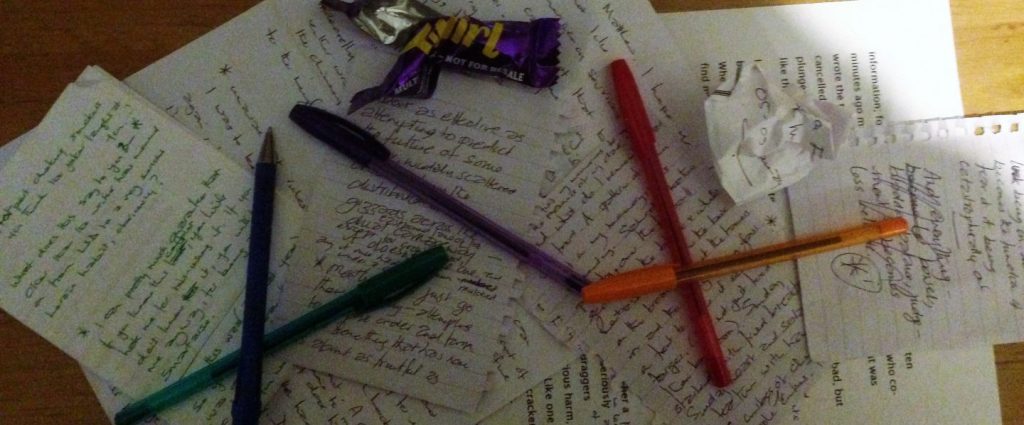
Having not written a usable word for more than a week now, I have decided upon drastic methods to get things going. Not only have I changed my pen, I have also changed the colour of my ink. I know what you’re thinking and, yes, you’re right, I am a man without fear. If pushed into a corner by the Gods of Not Being Able to Tie Down a Single Amusing Thought, I will resort to any method of turning things around. I have faced down the devil, twisted his nose and flicked the lobe of his ear. If he thinks that he can make what is currently flitting around between my ears any more sterile than it already is well, he’s welcome to give it a go. It could only spice up my day. I have grown tired of staring at a blank sheet of paper.
Yes, I did say paper and yes, I have tried staring at a blank laptop screen instead – it didn’t help: it just reminded me that I need my eyes testing. I have tried lined foolscap, plain A4. I have tried both folded into four. I am probably responsible for putting more shit on paper than the inventor of Andrex. I currently have a bin full of the stuff. It is folded in many ways, although some of it is just crumpled up in an almost avant-garde fashion. (Out of interest, I have just popped ‘avant-garde’ into a French to English translator and it apparently translates as ‘avant-garde’.) I am the Jackson Pollock of the wastepaper basket. I am the idiot son of the man who never made it past a yellow belt in Origami. I am currently writing in a school exercise book. I cannot throw the pages away because if I rip them out, another – uncontaminated by my nonsense – falls out at the back. I cannot bear to throw away undesecrated paper.
So, new pen it is: radical I know, but you are looking at a man who once drank red wine with fish. Of course, switching to a blue does not come close to the sheer excitement of pushing down the little levers on one of the 6 variously coloured refills housed within a single pen that people of my age always got for Christmas, but it does make a change from black. As it is, I usually flit between black and red biros. I have black roller-balls, but I really don’t trust them. They are fickle. I use green pens for correcting. Green is the colour of second thoughts. Starting to write with a green pen means that I don’t even trust what is in my head – which gives me an insight into what other people think of me, and I don’t particularly enjoy it. It’s like looking into the house through your own window – something you only ever really do when you are locked out. I write, floridly, in fountain pen occasionally – but these pieces very rarely get transcribed into zero’s and ones. I seem to whine a little too well in India ink. Fountain Pen Me is a character that I rarely allow out in public.
I suppose that the man I would most like you to see when you look at what I write is exemplified by the mug full of pencils that sits on the desk in front of me. They are bright yellow, of uniform length, and each capped with a rubber* to one end. Sadly, upon close inspection you will find that only one or two of them are sharpened. Most are blunt and unusable. In fact, as much as I would like to emulate Hemingway, Steinbeck and Capote in writing in pencil, neatly rubbing out rather than scrawling over mistakes, I can’t. I tend to carry crumpled paperwork around with me during the course of the day and, by evening, pencil scrawlings become indecipherable: a homogenous**, pale grey smudge – too much like my real life.
So, today I am writing in blue ballpoint – simply because I found a hitherto unused pen in a drawer and thought that I would give it a go – and an exercise book that I bought some years ago for my Open University course and never used, (My Uni notes were written in pencil, but were all contained in the margins of the rainbow highlighted text books) so I’m confident that I will eventually find something to tell you. I’m just not sure what yet…
*Probably ‘eraser’ to those of you with an education. **This is correct in English but both reads and sounds odd. In American English ‘an homogenous’, which sounds much better to my own sadly uneducated ears.



 Getting On