The Writer’s Circle #19 – Natalie

Natalie had never been a member of The Circle, but she was known to them all.  She was an ever-present on ‘Club Nights’ in the Lounge Bar of The Steam Hammer, always happy and welcomed to join in the mid-session conversations that took place.  Bright and witty, if at times a little too lugubrious, she was a welcome addition to every discussion.  All the members of The Circle felt that they knew her, but only for this thirty minute spell each week.  When the circle reassembled upstairs she melted away and was never present when they came back into the lounge later in the evening.  She was not known to any one of them in any other circumstance and, consequently, became a bit of a mystery woman, and the only topic of conversation on the rare occasions on which she did not appear.

“…I just asked the barman,” said Frankie, passing a glass to Phil as he rejoined the small knot of members in the corner of the room.  “He says he doesn’t ever see her other than on Circle nights.”
“I always thought she was a regular.”
“Apparently not.  Only ever appears when we’re here.”
“I wonder why she’s never actually joined us upstairs?”
“A bit too far away from the bar, I think.”
A smile filtered its way around the group.  She clearly liked ‘a wee one’ did Natalie.  None of them could ever remember seeing her without the customary gin and lime in her hand: ‘No ice dear – they do something to it under the bar, to make it freeze more easily I think, probably to save money – It gives me a headache.’
“I wonder what she does for the rest of the week?”
“I think we all know what she does, the question is where does she do it?”
“She told me,” started Elizabeth, pausing only to help herself to Frankie’s Cheese & Onion, “that her great grandmother was the baby daughter of Tsar Nicholas and the Empress Alexandra, snuck out of the cellar by a soft-hearted Bolshevik guard and smuggled into Britain on a coal barge.  She said that she is the rightful heir to the Russian throne, but that she can’t go back because she doesn’t like beetroot.  Apparently it is all that stands between her and her birthright.”
“And Putin?”
“Well, yes, and Putin.  Beetroot and Putin.  Plus, she told me, she can’t drink vodka.  It gives her hives – she would show me if I bought her one…  She said that she was once invitied to the Russian Embassy, so she went – to show that there were no ill-feelings – but they plied her with borscht and vodka and she woke up in the park next to a man with a rolled up copy of Pravda under his arm.  She was eventually led to safety by a man from the Salvation Army. ”
“She told me that she was on the run from Mrs Thatcher,” said Billy.
“Ah well, I don’t suppose that’s much of a worry for her now.”
“Well, apparently once you’re on the MI6 hit list, you are never taken off it.  You die on it – one way or another.”
“Isn’t it MI5, the Security Services?  MI6 is foreign spies and all that isn’t it?”
“The CIA according to Natalie.  Apparently Mrs Thatcher took charge of the CIA during one of Ronald Regan’s lost weekends – ‘Nobody knew about them, dear.  They were never made general knowledge.  There are still no official records.  If anyone ever asks you about it, deny all knowledge.  Say you’ve never met me.  It’s for the best.  I have grown used to being persona non grata, even in the Co-op.’ – and she never gave it back.”
“So why was Mrs Thatcher after Natalie then?”
“Poll tax, apparently.  Natalie was the leader of the main organised opposition to it.”
“Really?”
“Only you never saw her face.  She said that she was undercover and always wore a cap in public: she gave up all property ownership in the struggle and she handed in her Tesco Clubcard.  She became a marked woman.  She was ‘Most Wanted’ in every one of the World’s nuclear powers, including Lichtenstein – ‘It’s not common knowledge, dear, so don’t go bandying it about in conversation.’”
“I only met her last week,” said Tom.  “She told me that she was an incognito literary agent keeping tabs on local talent; looking for the next big thing.  I asked her who she was looking at here?”
“What did she say?”
“She said that she couldn’t possibly tell me.  Mind you, if we were to have a quiet chat over a nice double gin and lime I might find out something to my advantage.”
“And did you?”
“I found out never to put ice in a gin and lime, and also that a gentleman always buys a lady peanuts with her drink.”
“I wonder where she is?”
“I wouldn’t worry,” said Deidre, glancing at her watch.  “This isn’t the first time she’s missed a week.  You might remember that the last time she was absent, she reappeared the following week with cuts and bruises all over her, but she wouldn’t tell anyone what had happened; said it was best for our families’ sakes that we never knew.”
“Best not mentioned, dear,” mimicked Phil.  “And ask the bar man for a slice of lime, but watch that he cuts a fresh one.  He fishes them out of other people’s glasses if you don’t watch him.  I always suck mine so he can’t re-use them.”
Even Deidre’s face softened into something approaching a smile.  “I’m sure she’ll be back next week.  Shall we go back upstairs?”
One by one the writers of the Circle drained their glasses and joined the little knot of fellow authors as it made its way up the narrow staircase and into the meeting room, where it stopped as a single entity, host to a collective breathlessness: eleven faces, twenty two eyes turned in a single direction.

There, sitting primly on a chair within the circle, dressed head to toe in ill-fitting tweed, hands folded neatly across her knees was Natalie.  She looked nervous, but she wore a determined smile.  She barely acknowledged the club members as they slowly, silently, made their way back to their seats.  Natalie did not move, although her eyes flitted from person to person, watching them all as they settled.  Nervously they looked from Natalie to Deidre and hoped, for once, that Deidre would take charge of the situation, but she was just as non-plussed as the rest of the group.  Of course they were all happy that Natalie was there; had, presumably, decided to join the meetings on a more formal basis, but they were thrown by the manner in which she had chosen to do it.  So they sat and they waited for Natalie to make the first move.  Silence hung like a pall around her until, with a nervous cough and something that could have been a sigh, Natalie rose to her feet.  She cast her eyes around the circle and then, fleetingly down at the ground, before raising her head and, staring resolutely forward.
“My name is Natalie,” she said “and I am an alcoholic…”

The first story from the Writer’s Club “Penny’s Poem” is here.
Last week’s story “As It Is” is here.
Episode 20 ‘The Lounge Bar at the Steamhammer’ is here.
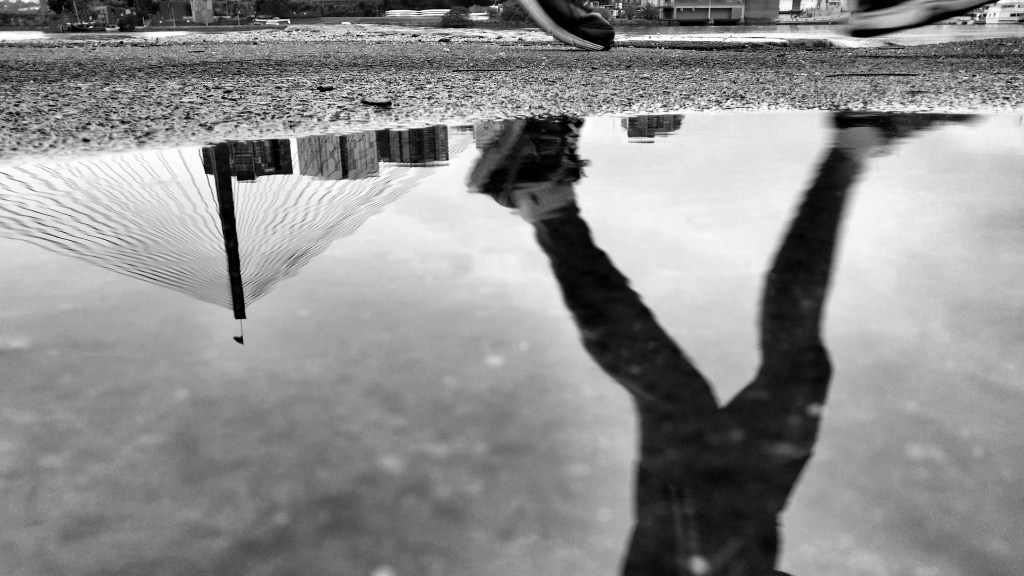
The Running Man – Getting On With It

I started to run during the first Lockdown because I was getting fat, I was getting creaky and, because of the restrictions, I needed an excuse to get out of the house.  I continue to run, but unfortunately, I also continue to be fat and creaky.  I get out of the house, but I am surrounded by a cocoon of music and perspiration which ensures that I interact with no-one, save those kindly souls who enquire about my wellbeing.  I cannot speed up somehow and I cannot run further.  Not even a cycle-borne outrider carrying chocolate could spur me on.  I am at ‘Max’.  It’s not much of a max, but I dare not creep into the red band now.

I am of an age when there is precious little to do other than to worry about the age I am: when I see news stories about amazing, ‘with it’ centurions and think ‘Wow!  That’s incredible,’ before realising that it is only just around the corner for me, and my marbles are already slipping from my enfeebled grasp and rolling under the sofa, just out of reach; when every malady from which I suffer (or believe I suffer) is associated with old age; when my back tightens in direct inverse ratio to my bladder and my feet ache permanently, on the simple basis that they have to prop up the rest of me.  I find myself constantly excusing my inadequacies by saying, ‘Well, I am sixty-two you know.’  I can still do everything I did twenty years ago – only not as well.  My mind remains open to new experiences – it’s just that I forget what they are before I get the chance to try them.

I am fortunate – although I would never admit it: it does not pay to give Fate a target – that my brain still works relatively quickly and my humour is, broadly speaking, still in nappies.  Occasionally I think that I might be developing a mature, sophisticated sense of humour, but then I realise that such a thing does not exist: nobody laughs at ‘clever’.  Sophistication is just an excuse for jokes that fail to make people laugh, despite mentioning Kant.  I can ‘turn a phrase’ from time to time, but I still laugh at the skirt inadvertently tucked into the knickers.

Perhaps if growing older serves any purpose whatsoever it is in allowing you to give yourself a break every now and then.  My expectations have not been lowered, but I realise that I can no longer reach them without a ladder.  My chances of attaining fame, fortune and an illicit liaison with Sandra Bullock are exactly as far away as they have always been, but my ability to cross the divide is now hampered by knees, bladder and a recently developed ‘What the fuck’ attitude which means that I am reappraising the desirability of everything from money to chocolate, love to whisky, and sex on the beach to nine holes on the putting green.  There remains a tiny piece of me that believes I may still be ‘discovered’, but a much larger piece that questions ‘For what?’

What age does bring is the realisation that, outside of a very small number of family members, nobody actually believes that you are in any way ‘special’, nor that the world in general will be in any particular way poorer for your absence from it (although, in my case, there may be a distiller or two in Scotland willing to disagree).  In short, age tells you that what is gone is gone and what is left doesn’t really add up to much, so make the most of it while you can and if that means you have to run about a bit every now and then, well, you might as well just get on with it.

My last ‘Running’ post, ‘…on the Running Man’ is here.
My first ‘Running’ post ‘Couch to 5k’ is here.
The next ‘Running’ post ‘Twelve Months to Become Er…’ is here.

The Running Man on the Running Man

I have still not returned to running.  I will soon, but currently sloth-life pulls too hard on me.  Somehow, since the Lockdown has started to ease and I have returned to employment, my current two days per week appear to leave me less free time than my previous five.  I have neither time nor energy to press the clutch far enough to allow me to get my arse into gear.  In order to address my problems, or at least understand them, I decided that a ‘Why I am not running’ list was in order:

  1. I am a lazy git.  OK, I’ll get this out of the way first.  It is, after all, the ‘Big One’.  I try very hard not to be lazy – well, as hard as being very lazy allows – but God knows it is tempting: it’s blowing a gale outside, scything down with icy rain, turning just dark enough for me to stumble through a heap of freshly deposited horse doo-doo and wind up on my arse on somebody’s front lawn, but just think how much better I will feel if I just get out and do it.  Mind you, just think how much better I will feel if I simply stay exactly where I am, with Columbo on the telly, a giant-squirrel sized bag of dry-roasted peanuts in one hand and a tumbler full of Scotland’s finest in the other.  Also warm and dry.  I may be lazy, but I am not entirely stupid.  If I concentrate hard enough, I can imagine the aches and pains.  Pour a gallon of water over myself and block my airways with a furry doorstop and no-one need ever know that I have not actually ventured outside of the house.
  2. I am not entirely stupid*.  I realise that, at my age, it is imperative that I get exercise.  I just wish that it wasn’t all quite so tiring.  I realise that looking as godawful as I do mid-run is good for the soul.  I realise that thirty minutes a day is not too much to ask of me.  Thirty minutes to exercise heart and limbs, to clear my mind and to put my life into some kind of perspective before diving under the shower and wishing that I had remembered to put the head back on it after clearing the limescale from the tiny little nozzle bits.  Then I think ice cream and coffee, and the world no longer seems so monochrome…
  3. I have many reasons to keep myself well, but…  I am the King of ‘but’.  Everything makes perfect sense, ‘but’…  I know exactly what I need to do ‘but’…  I am also prince of ‘if’ and archduke of ‘except’.  If ever there was a Nobel Prize for dithering, my ‘if only’ would be a shoe-in for the big one.
  4. My age.  The balancing act that inhabits the space between what will enable me to and what will prevent me from reaching my next birthday: another doughnut might just kill me, but if you stand between me and it, death may still occur, although it won’t be mine.  Each action requires balance between its capacity to point me either towards, or away from, death.  A life without risk may not actually be any longer, but it will certainly feel it.  Think of anything you love (I don’t know why I decided to allow free-choice there, as we are all, in fact, thinking of chocolate and wine) and consider the choice: you can live ninety years with it, or ninety one without it.  Maybe if you continue to run, you could push your sinful lifespan up to ninety one as well, but if you don’t, you will be able to fit in so much more chocolate.  How much time is a small pleasure worth?  Put a Mars Bar in the fridge overnight and then eat it carefully layer by layer.  Now tell me that wasn’t worth losing a couple of days for.
  5. My aching limbs.  Even I have started to struggle with this justification for indolence as everything now aches just as much, if not more, when I do not run, although somehow, if I haven’t run then I can’t help but feel that I am not to blame for it: my knees feel as though they have been bent along a plane in which they were never intended to operate, but I haven’t been running, therefore it is not my fault – I can live with that.
  6. D.I.Y.  The jobs I have to do.  The jobs that running prevents me from doing.  ‘No, I haven’t finished the painting, but I have put several centimetres between myself and death.’  ‘No, I haven’t stopped that socket from fusing out the whole neighbourhood each time you attempt to make coffee, but on the other hand, my caffeine intake is well down.’  ‘Yes, I do realise that it is only a thirty minute run and it really shouldn’t absorb half of the day, but just think of how much more healthy I will be for a couple of hours.’  ‘Fix the shelf?  Tomorrow maybe – I’m knackered.’
  7. Lassitude.  A wonderful word that I learned some fifty years ago through the wonderful ‘The Ascent of the Rum-Doodle’** and which has fizzed about whichever part of my brain is responsible for improbable excuses ever since.  I will never admit to being a lazy git***, but suffering from lassitude, I can’t do anything about that, now can I?

In reality, like an errant monk evicted from the monastery on the grounds of uneven tonsure and the failure to adequately decorate the first letter of every diary entry, I will emerge into the real world next week, blinking in the unaccustomed glare of sunshine on May frost and, DIY tasks left firmly behind me – whilst I ponder how I am going to afford somebody to come in and put it all right – I will without doubt, almost certainly, probably, possibly start to run again and you will be able to look forward to settling down to five hundred finely-honed words on ill-fitting trainers or the advisability of supportive undergarments with loose-fitting shorts – unless, of course, you have something – anything – more invigorating to do…

*I am
*‘The Ascent of the Rum Doodle’ by W.E.Bowman.  If you have never read it, I cannot recommend it highly enough.
***Of course I will, and did at the start of this piece – denying it is just too much like hard work.

The running diary started here with ‘Couch to 5k’.
Last week’s Running Man, ‘…on Reasons Why Not’ is here.
Next week’s ‘Getting On With it’ is here.

The Writer’s Circle #17 – New Beginnings

It was towards the end of Elizabeth Walton’s first session at The Circle, having reached the decision that she was going to return, that she realised she would also actually have to start to write… 

…Having downsized from the large detached home she had shared with her husband, to the two-bed apartment in which she had rattled around since his death, she reviewed her options.  They were minimal.  The second bedroom – a little larger than a box room, but only if you used a smaller box – was the obvious choice for her ‘writing room’.  She bought a desk, actually a junk shop kitchen table, and a swivel chair from Argos, which she returned as soon as she realised that she was expected to put it together herself.  In any case, she had by then discovered that she was perfectly comfortable on the slightly more stable of the two dining chairs that had unexpectedly turned up with the table.  She bought cushions, she bought pads of lined paper, reams of printing paper, pens of many hues and a pencil sharpener shaped like a hedgehog (although, strangely, no pencils) which she carefully arranged around her laptop in what she imagined was a writerly manner, and she stared at the screen.  Many days later she was still staring at the screen.

It would seem that her claim to write Family Saga may have been particularly ill-judged.  It had popped into her mind in a moment of Deidre-induced stress and she had not anticipated the hurricane that was to blow in behind those two little words.  She had not, for instance, foreseen the possibility that she would be expected to provide some evidence of her toils at the wordy rock-face – especially not out aloud – nor that she would find the Family Saga novels which she had subsequently picked up as ‘research’ material from the charity shop so overwhelmingly boring.  And long.  No book should be so long.  Before she got half way through, she found that not only was she struggling to remember who, but also how, what, when and why.  Mostly why.  She had toyed with giving up and simply not returning to The Circle, but it represented a new page for her; an empty new page that she was determined to fill.  She considered confessing all to the other members and the idea was very attractive – until she thought of Deidre’s pinched face and she realised that, like a dog, she could never allow Deidre to sense weakness.

She began at first to jot down snatches of conversation both overheard and imagined.  She outlined half a dozen semi-plausible plots before, as she became increasingly familiar with her adopted genre, she found a way of crocheting them all together into the multi-hued bedspread she needed.  She began to see a path from beginning to end and characters began to draw themselves around her.  She filled pages with character descriptions; sat up into the early hours drawing up family trees that overlapped and bound themselves together like Velcro; wrote down a thousand forenames and prowled a dozen graveyards in the search for surnames.  She began to feel that she might be ready to write something that she could read to The Circle.  It did not need to be a beginning, it did not need to have a beginning; just a couple of thousand words that would demonstrate an ability to write at anything above chimpanzee/Olivetti level.  She felt perfectly confident that she could do that.  Well…

What she actually discovered was that a brain buzzing with ideas was simply not what was required for writing.  She had too many ideas: they bounced off the walls, they tripped over one another, wandered off into cul-de-sacs, seduced the vicar.  Each evening she sat down with a neatly assembled cast and watched on helplessly as it collapsed into anarchy before her like an amateur soufflé – full of all of the right ingredients, short of all the required air.  Panic, never deeply buried since the loss of her husband, rose up like porridge in a microwave, threatening to overwhelm the air of calm that she had so intently cultivated.  She returned to the circle, her seventh visit, determined to confess all before riding away, Shane-like, into the sunset.  Oh, if only she’d said that she wrote westerns…

…It was the evening of Phil’s big idea.  They had all drawn genres: Phil had drawn ‘Play’, Billy had drawn ‘Detective’, Penny had drawn ‘Family Saga’ and Elizabeth had drawn ‘Humour’.  Beyond that she could not recall.  In her brain, a number of little cogs had ceased to whirr.  Comedy!  What on earth did she know about comedy?  Well, if she was honest, probably pretty much as much as she knew about Family Saga.  She also knew that it had a much shorter word count.  But she was a widow, for goodness sake!  A relatively recent widow.  What did she have to laugh about?

It was later, much later that evening, in the sleepless darkness that preceded the dawn, that she found herself staring at the wall of her bedroom, taut and confused as the Cinemascopic clarity of her past few months played out on the screen at the back of her mind.  She expected gloom, probably she wanted gloom, but what she got was world-class ineptitude: a woman so ill-equipped for the solitary life that she had fabricated a life as an author in order to find company.  She felt tears begin to well in her eyes, but when, eventually they fell, they did so not in pain but in joy: the joy of seeing herself for what she was – as she was sure others must see her – and not hating herself for it.  The joy of seeing each faltering step she had taken, of witnessing each calamitous event and realising that, in the very midst of it all she had remained standing: like a floral patterned lighthouse in a broiling storm of inconsequential travails, shining the very same light that would illuminate her way – like the Lady of the Lamp, only with a smartphone – and she couldn’t help but smile at the fool she had allowed herself to become.  She saw the world – the world of now – in a new light: like the blinding moment of stepping out into the real world from a cinema matinee, and she realised that she did have something to tell the group about.  It might not be ‘Family Saga’ and it almost certainly would not be ‘Comedy’, but she thought that it might just make them smile and, for now, that was all that she wanted…

‘The Writer’s Circle’ began here with ‘Penny’s Poem’.
The most recent tale from the Circle, ‘The Lure of Summer’ is here.
Episode 18 ‘As It Is’ is here.

The Running Man on Reasons Why Not

I have not been on a single run in the past week.  I have my reasons (or, as I will henceforth refer to them ‘justifications’*) for this malaise.  They are not entirely of my own making…

We need a new carpet for the lounge.  It is possible to see the migrating woodlice through the current one.  My wife has decided that if we are to have a new carpet fitted we should re-decorate before it arrives – ‘Just a lick of paint’ – and has accordingly allowed me ten days (including work days) to get this done before the fitters arrive.  The lounge, I should point out, is three rooms knocked into one and is consequently the kind of shape that you only otherwise see when you are very bad at Tetris.  So far, after a day spent disconnecting TV’s and Hi-Fi’s, and shifting furniture (Why does nothing have castors any more?) I have painted the ceilings and my wife has commenced the glossing.  I have looked at the damaged plaster work that was formerly hidden behind furniture and which I now feel obliged to repair.  I have also investigated a dip in the floor which turns out to be a small collapse where the cavity wall formerly sat between the old house and the old extension.  A builder friend came and channelled out, filled with concrete and left in good order as per, and now I have to learn to apply the leveller between the two surfaces.  I have found my trowel, which was covered in the rock-hard evidence of its last use, and have spent several hours cleaning it off.  I have also spent a number of long, dark hours discovering that I cannot plaster.  Furthermore, I have discovered that I cannot adequately clean trowels, as my newly plastered patches all have deep ravines running across them where the more intransigent lumps of dried-on concrete lingered.  I will repair them just as soon as I have managed to hammer the concrete from my spatula.

I have also spotted a number of small stains on the walls (mostly chocolate and wine if I’m honest) that need to be removed before the new paint is applied, as I know that otherwise they will leach through in seconds.  I have discovered that Sugar Soap is my weapon of choice here.  It does not work, but it is very cheap and every bit as effective as all the expensive preparations that also do not work.  I have removed all door furniture, as requested, with the minimum of injury, and have subsequently spent a forlorn hour staring at all the new electrical sockets and switches that my wife has purchased.  I have added the emergency services to my speed-dial and alerted the National Grid to expect unusual activity within the next few days.  I wouldn’t want them thinking that ET had come back to pick up his bike.  I have taken the batteries out of the smoke alarm.

This evening, having previously moved the TV away from the walls to a position that makes its survival at best ‘of concern’, I agreed to reconnect all the wires so that my wife did not have to stare at the blank screen all evening, pretending to be me after my laptop has updated unexpectedly.  So many wires, so few sockets.  I have absolutely no idea what all these devices do.  I think we are probably hard-wired into Beijing.  Anyway, after a mere few hours, she can now watch TV again, although it does somehow appear that Derek Trotter now speaks in Urdu and Rodney has had a very heavy weight placed upon his head.  Also, according to the guide, she is watching Countryfile.  The remote control flushes the toilet.

Tomorrow I will begin to paint the walls and, given my propensity towards spillage, I must agree that this is best done before the carpet arrives.  I will carefully edge each wall with a single confident stroke that resembles the coastline of Croatia before attempting to apply the paint with a roller that does not appear to be quite the same size as the cage it (almost) fits upon; marvelling at my own ability to produce the kind of striped effect only otherwise witnessed on the lawns at Buckingham Palace and the capacity of formerly flat plaster to assume the rather disturbing silhouette of Dolly Parton behind a net curtain.  It will probably dry out and, if it doesn’t, will provide the perfect position for the photo of our wedding day, which could only benefit from the altered viewing angle.

Following my day spent on the ceilings, my back is currently experiencing the kind of rigor normally associated with the guest stars on ‘Silent Witness’ and I have a twitch in my leg like a pulsar.  Never mind, the human spirit is a wonderful thing and almost as accommodating as the Scotch variety, of which I am about to partake (to safe levels obviously**) in order to treat my cold – should I ever get one.

Anyway, that is the reason I haven’t been running so far this week – and I almost certainly can’t go out tomorrow as it is forecast to rain… a bit… maybe…

*see also ‘excuses’
**I have a theory that if I weighed twice as much as I do, I could safely drink double the amount.  I have taken the batteries out of the scales.

My running diary began with ‘Couch to 5k’ here.
My last actual running thoughts were chronicled here in ‘The Running Man on Extending’.
Next week’s little Running Man jaunt ‘…on the Running Man’ is here.

The Writer’s Circle #16 – The Lure of Summer

Jane Herbert (horror) was the second member of the Circle to face her peers having made an attempt to write in the genre drawn, at Phil’s suggestion, from the pool of those written by every other member.  Romance could not have been more alien to her and she had the added pressure of Deidre analysing her every word but, like Phil who had preceded her, although she found the exercise challenging she also found it rewarding and, as the attention of the group turned towards her, she felt ready to read them what she had written…

“…Frost prickled on the grass, turning each separate blade into a sparkling dagger and fringing the bursting leaves of the overhanging yew trees with a lattice-work of shining, icy lace.  The morning sun reflected and glittered out from every surface, although it yet provided little warmth to the air.  Sparrows fought over the squirming bounty unearthed in newly-turned soil: the desperate comedy of survival cast along the long, long morning shadows; the only other sound the cellophane crackle of bouquet wrappings.

Desmond Demona (Des to his friends, of which there were precious few) sat on the stone-flagged floor in an isolated pool of sunlit warmth, his back against the honeyed limestone of the church tower wall, eyes closed, the black plastic cup gently steaming the scent of stewed milky tea into the air, warming his soil-stained fingers, soothing his senses, calming his soul.  He had the smell of the earth in his nostrils, he could still feel the weathered grain of the spade handle against the skin of his palms.  He was happy in his work, but he took his breaks very seriously – almost religiously.  His timing was meticulous and steady.  In rain or shine, summer heat or winter chill, swaddled in multi-layered clothing or stripped to the waist, his routine remained unvaried: thirty minutes digging followed by ten minutes rest until the job was done.

The job was digging graves and Desmond took great pride in it.  The symmetry of his excavations was revered throughout the diocese.  Even when the unexpected was encountered, in the form of old church outbuildings, clay pipes or illicitly interred beloved pets, he found a way to ensure that the box nestled level, precisely six feet below the sod.

Sometimes he was bothered by the taunts of the local kids as they went to school.  He started his day early, tailored his routine to be as far away from them as possible, but he couldn’t avoid those who chose to loiter around the graveyard during holidays.  He kept his head down and he dug and when they started to pelt him, as they occasionally did, he was always at the bottom of a hole and unable to get out quickly enough to challenge them, so he simply collected the rubbish in a bag (he liked a clean grave) with a view to rubbing their noses in it if ever he caught them.  He never did.  He knew he never would, but the promise of revenge fortified him none-the-less.

The vicar was good to Desmond, managing to find him jobs even when no-one was dying: cutting grass, cleaning headstones, tidying decaying tributes and flowers.  Occasionally he was asked to carry out some menial tasks inside the building; varnishing pews, Hoovering prayer cushions, dusting the surfaces that the vicar could not reach without standing on a chair.  Desmond always did his best – occasionally bringing his own chair from home as it was a little higher than the vicar’s and more stable – but he did not feel suited to ‘inside work’.  He liked to dig.  It was what he was good at.  He liked to feel the sun on his back.  He liked to sit in the shade of the giant yew in the summer as he napped away his thirty minute mid-day break.  For six precious weeks from late May to early July, the sun crested the tower and beat down on his little spot.  Those were his favourite weeks of the year and, although they were still some months away, he sensed them coming in the air and he looked forward to the time when he could rid himself of the cloying cold of the grave by basking in the heat of the noon-time sun.  He loved to feel the heat prickling on his darkening skin, adding definition to a body toned to perfection by a life spent digging.

At least, it was pretty close to perfection as far as the vicar was concerned.  She had been here for five years now and, if anything, she looked forward to the summer months with greater anticipation than Desmond himself.  She had tried to talk to him so many times, to draw him into conversation, but all he ever wanted to hear from her was where to dig and, if there really was no digging to do, he would hold her with his doleful eyes until she found him some tasks, preferably outside, with which to pass his day.  There were times when she had to find him jobs to do around the church itself – when people were just not dying or when the bloody kids just wouldn’t leave him alone – but she could tell that he was not happy there.  She devoted every moment she could at such times in attempting to draw some conversation from him, but she always knew that, for both their sakes, she would very soon have to find him work outside in the fresh air, where he felt able to remove his shirt – where she was able to surreptitiously observe him doing so.

But today, she watched him through the frost speckled windows of the vestry as he screwed the cup back on top of his flask and rose, fully-clothed to his feet.  He moved, she thought, like a cat.  What went on inside his head?  She realised that the paraphernalia of vicarhood hung around her like an invisible cage.  Few men ever think about vicars as suitable girl-friend material but then, truth be told, few vicars ever think about a withdrawn gravedigger as being the man to lead them up the aisle, and she was almost certain that even fewer ever see themselves quite so vividly breaking so many commandments simultaneously.  Slowly she raised the cassock above her knees and sighed contentedly as the heat of the tiny electric heater slowly caressed her legs.  For her, the summer just couldn’t come soon enough…”

The Writer’s Circle started with ‘Penny’s Poem’, here.
Last week’s Writer’s Circle ‘The Mud, the Blood and the Beer’ is here.
Episode 17 ‘New Beginnings’ is here.

The Running Man on Extending

Our back garden as viewed from my office window.  Note our own extension in the bottom left, the clothes dryer that would have had to have been moved if my wife knew that I was taking the photo, and the pink shell sandpit that the kids carefully emptied out onto the patio during their last visit.

As I run around the village these days I find that almost every other house is clad in scaffolding.  The whole place looks like a series of giant Meccano sets, constructed and curated by a strutting illustrated man clad in denim overalls talking like he’s permanently attached to an invisible megaphone, somehow managing to laugh and snarl at the same time.  Half the world is extending whilst the other half is winter frog-like – in a state of stasis, like a jelly fish in the freezer.  Unmodified homes are betrayed by their lack of gunmetal grey windows and buff-coloured rendering; naked housebrick standing out like the uncouth uncle at a family gathering: the man in the green checked shirt, blue striped suit and purple nylon wig.   It can only be a matter of time until the children are warned to keep away.

I am a creature of habit and my running routes seldom vary, so I see these changes taking place.  I witness the houses evolve in my own cataractal time-lapse eye and although it is very rare to lope past a finished job thinking that it shouldn’t have been done at all, I could obviously point you at one or two that look like they’ve had a shed velcroed onto the side of the kitchen.  I never dreamt that this volume of builders even existed – the breaker’s yards by now must be completely devoid of all decrepit white vans.  Where will they all go when the lockdown finishes and people no longer want to re-sculpt the homes in which they have been trapped?  Does Brigadoon require knocking through?  Most of the houses – presumably no longer homes – are put up for sale the moment the work stops.  There must be a psychological explanation for this, but I’m buggered if I can find it – unless people find that they just cannot live without dust and noise, Absolute 90’s on the radio, a Portaloo on the front lawn and tea stains on every conceivable surface.  The houses, when finished, look great – except that they all have the forlorn appearance of ‘property for sale’ hanging, shroud-like over them.  I picture a kind of merry-go-round of upsizing and downsizing in progress with the clockwise half of the local population constantly tripping over the anti-clockwise balance.

Such homes that are not having internal walls removed and external walls skimmed are having the gardens done.  Landscape gardeners have proliferated like Cane Toads in the Australian Outback.  No garden is finished until it has been designed on a computer.  ‘Hard Landscaping’ is the horticultural mode: remove as much green as possible and cover it with shingle, bricks and the kind of wooden structures that, around here, will succumb to woodworm before the autumn.  Monty Don must be spinning in his cold-frame.  The garden has become an ersatz house extension and the flowers have paid the price.  My lawns are not great, but they are two of very few left in the village.  Most of the green oases that pepper the streets now are of the ‘astro’ variety – lawns that are swept rather than cut – but do at least add a varied palette of green shades to the surroundings that would never be seen in nature. 

I am no gardener, but I know that gardens are important, both for nature and for human well-being.  Each spring I watch the green shoots begin to forge their way through my own small patch of winter-wizened soil and debate long and hard over which to leave and which to dig up, in the certain knowledge that I will get it wrong.  Each summer I spend one of the two balmy evenings we are apt to get per year, sitting out amongst the flowers, cradling something warming in a glass.  Each autumn I chop it all down and ram it into the compost bin, whence it forms a foul-smelling brown slime that I have to sluice away in the summer.  This is the circle of life and I am sad to see it broken by grey slate and plastic lawns.  My run is becoming more monochrome by the day as the town is moved into the country – a vista of white van and black Range Rover – and my glimpses of nature (outside of strategically placed dog-turds in bio-degradable bags) rarer. 

Oh well, I’m sure that when the summer comes it will all look better.  Who knows, I might just have an extension built to watch it from…

In England we can now have up to six people, or two households, meeting in the garden.  Guests can even use the toilet!  (I must tell next-door’s cats.)  Accordingly, this week’s running diary is brought to you courtesy of a very elderly gazebo and a newly purchased patio heater.

This whole running shenanigans started here with ‘Couch to 5k’.
Last week’s Running Man ‘…on Setting Off’ is here.
You can find the next Running Man ‘…on Reasons Why Not’ here.

The Writer’s Circle #15 – The Mud, the Blood and the Beer

Penelope (Penny) Farthing had been named by her father just a matter of weeks before he walked out of the family home, never to return.  He wasn’t missing, just gone – at least that’s what her mother always said.  His absence was seldom discussed and Penny had never really felt the desire to try to find the man who had given her her name.  Whenever anybody spoke of meeting him, she always thought of ‘A Boy Named Sue’* and how unsuited she was to kicking and gouging in the mud, the blood and the beer.  Also, she always suspected that her mother knew much more than she was prepared to tell.  Penny felt, instinctively, that she had been involved in some way with his disappearance – maybe she had killed him – but she had never dared to ask.  It was her mother’s claim that she had been too timid to object when her father had registered her name, but Penny had serious doubts: her mother was many things, but never timid.

Why her father should play such a trick on his own child – a child he had never really got to know, a child he was planning to leave – Penny could never quite understand.  Certainly her mother’s late-night, post-sherry taunts that “Nobody expected you to still be single at your age,” led her to believe that her role in the whole elaborate prank was far greater than she wanted her daughter to know.  If Penny retained any desire at all to meet her father, it was so she could ask him that one thing.  “Did the old witch know what you were doing?  Was she a part of it?”  She would never be able to do so now.  The only thing that bound her to him – outside of DNA – was her mother, she held all the clues and she was no longer able to focus long enough to remember anything that she did not choose to.  An almost selective form of dementia – so typical of the bloody woman to retain all of her defences whilst rationality abandoned her.  To lose the facility to recall her own daughter’s face, but not the contempt in which she held it, it took a certain kind of mother.  It is not an easy thing, to feel nothing for your own mother, not good for your soul, but it was all Penny had left since she had spat compassion back at her.

Everyone at The Circle had noticed the change in Penny over the last few weeks.  She was just that little bit more assertive, more spiky somehow; still the little mouse, but more inclined to nip if cornered.  The unexpected appearance and subsequent disappearance of Charlie had preyed on her mind.  His failure to return, to explain, had somehow brought her father to mind with a presence that she had not felt in many years.  She would not in any way compare Charlie with her father; Charlie was a good man, she had missed him while he had been away and his return had kindled some kind of hope inside her, but both he and her father had disappeared from her life and the disappearance of the man she missed had, once again, made her curious about the man she did not.  What if he had been a good man?  She had only her mother’s word that he had not.  What if it wasn’t him that had given her that hated name at all?  Again she had only the unreliable word of the hollow woman that she visited daily, religiously, in the home.  She cursed herself for not doubting her sooner, for not pressing her for answers whilst she still had them, but she had trusted her mother, just like she had trusted Charlie when he said he was coming back, that he was getting better, and she didn’t fully understand herself, why she felt it such betrayal.  Except…  Charlie was a member of The Circle, a good man, whom she felt had, in some indefinable way had let her down.  The Circle was the closest thing that she had to a family now and, like a family, nobody else ever seemed to notice if you weren’t at your best.  Nobody noticed if you were just that inch or two out of your depth…

The consoling arm on Penny’s shoulder took her by surprise.  She opened her mouth to speak but, as hot tears swelled unheralded into her eyes, Terry put a finger to concerned lips and silently handed her a tissue.  “Wipe your eyes,” he whispered, “and as long as you don’t tell, neither shall I.”  He winked.  “After all, where would The Circle be without a little feud to keep it going?”  Penny took the tissue and smiled weakly at Terry as he retreated slowly, back to his customary place on the periphery.  “That,” thought Penny “is the problem with families: you never quite know where you are with them…”

*‘A Boy Named Sue’ by Johnny Cash

The Writer’s Circle stories started her with ‘Penny’s Poem’ here.
The previous Writer’s Circle story ‘Funeral Songs’ is here.
Episode 16 ‘The Lure of Summer’ is here.

The Running Man on Setting Off

I was very pin-toed as a child and my mother was told that it was very unlikely that I would ever walk properly, let alone run.  (They were wrong, of course.  I realise that you know I wouldn’t have mentioned it otherwise.)  I do have a slightly unusual gait to my walk – picture a slightly camp giraffe on ice – but, although not quickly, I do run and I have played sport all of my life, even if most of my ‘upright’ time is spent in a stance that can best described as ‘a teeter’.  (I caught sight of myself in a mirror once whilst playing squash and it reminded me of ‘modern ballet’ – the kind of dance that is accompanied by music that exists only in the notes that never quite made it into formal notation; where you witness a move and wonder whether it could possibly have been intentional.  The image was so shocking that I paused for a second and wound up with a bruise the size of a fried egg on my forehead.)  At any speed above ‘dawdle’ I always give the impression of a man on a tightrope.

Since I began to run, a year ago, I have never done so without wearing supports on both knees.  It is likely that my pin-toes are to blame for the weakness in my knees, although I always blame a lifetime of playing sport, because it sounds so much more glamorous.  In fact I have a distinct memory of inadvertently attempting to fly as a child, across a space where a stone staircase should have been and crash-landing on my knees, leading to what the doctor described as ‘water on the knees’, which he treated with crepe bandages wound so tightly that my feet turned blue and my eyes bulged in my head like balloons in a microwave.  Whatever the cause, my knees operate on a basis of more or less permanent ache which, against all expectations, is lessened by running.  Early on in ‘my running journey’ I was troubled by hip pain, but I learned some stretching exercises and now the only time I get pain in my hips is after a couple of days without running.  It is my body’s way of telling me to get my arse into gear.

The start is always the hardest.  If I get up in the night – ‘if’?  who do I think I am kidding? – my stagger along the landing is a joy to behold as neither hips nor knees are prepared to bend without a substantial period of notice.  The imperative to reach the bathroom combined with the intransigence of my joints means that the midnight walk is more of a controlled fall forward.  In fact, that is the only way that I can set off on a run.  I slowly tip forward until I reach a point where the gyroscope in my head (obviously sub-standard since fitting) tells me that either I start to move my feet or ditch on my snitch.  The state of the paths around here means that either result is equally plausible.  In my head I am a cool runner, but in the eyes of the world I am an old man fighting a futile battle against gravity; I am a pin-toed Rowan Atkinson attempting to catch a crowded train as it pulls out of the station.  In reality, of course, the train has long-since left and I’ve no chance of ever getting back on board.  Just as well really, it would almost certainly be heading for the wrong station…

As always, I would refer you to the start of this running around business in ‘Couch to 5k’, here.
Should you want to know what happened last week, you can join me running ‘…on a Bicycle’, here.

N.B. At the end of a recent Running Man, I included a little footnote about my coloured pen ‘editing’ process which drew a little comment.  I think I should clarify that this is not some kind of ‘professional’ methodical process, but a desolate routine that almost invariably follows the same pattern:
1. Write piece in pen on paper.
2. Transpose onto computer and print.
3. Read through and despair.
4. Take red pen and add jokes.
5. Read through and despair.
6. Take green pen and attempt to make some sense of it.
7. Read through and despair.
8. Take black pen and correct grammar, syntax and opinion.
9. Read through and despair.
10. Feed into shredder and revert to original.

So now you know…

My running diary started with ‘Couch to 5k’ here.
Last week’s little tarradiddle ‘The Running Man on a Bicycle’ is here.
Next week’s run out ‘The Running Man on Extending’ is here.

The Writer’s Circle #14 – Funeral Songs

“…I’d like loads of fuss: anguished wailing, gnashing of teeth; the whole nine yards…”  It was a typical mid-session conversation at The Circle, this time sparked by Frankie’s passing mention of having ‘Don’t Fear the Reaper’ as his funeral song and Phil, as usual, was having his say, although what was coming out of his mouth bore little relation to what was going on in his head.  “Can you still get those horses with big white plumes on their heads?  I’d like those.  White horses, of course.  Nothing tacky…”
“Well,” interjected Deidre, the venom in her voice just about concealed by the syrup in her smile, “I’m sure we all look await the occasion with bated breath.”
“What is bated breath?” asked Elizabeth.  “I mean, why is it ‘bated’?”
“I think,” said Billy, “it’s ‘abated’ shortened, so kind of postponed.  Your man Shakespeare again, I think.”
“Right, so if we all bate our breath whilst waiting for Phil’s funeral, it’s very likely that we’ll all get there before him.”
“I used to work for a man who loved funerals,” volunteered Louise.  “He used to go from church to church, sitting at the back, singing hymns.  He loved to sing.”
“I hate funerals,” ventured Penny.
“They certainly don’t have much to recommend them,” said Terry.
Penny stared at him hard.  “Some might,” she whispered.
“My grandad was the same,” offered Frankie, picking up the stitch that Louise had dropped.  “He loved a good funeral did my grandad – although he did, at least,  restrict himself to people he knew.  Broke his heart when he couldn’t go to my grandma’s funeral.”
“Why couldn’t he go?” asked Deidre.
“Because she wouldn’t die.”
“Ta-da!” said Phil who, unlike Deidre, had seen it coming.
“It’s weird though, isn’t it,” started Elizabeth as the laughter subsided, conscious that Deidre was about to say something that would almost certainly dampen the mood, ‘how all that tension in the church dissipates the second the first sherry is served.”
“And why sherry?” asked Jane.  “Does anybody drink sherry other than at funerals?”
“Great aunts on Christmas Eve” suggested Vanessa.
“Well, that’s a given,” said Jane.
“I had a great aunt who drank nothing but Milk Stout,” Said Billy.  “It killed her in the end.”
“Don’t tell me,” laughed Frankie.  “She was knocked over by the delivery truck.”
“No,” said Billy.  “She had cirrhosis.  As I said, she drank nothing but Milk Stout.”
“Always one of the first signs that Christmas was on its way,” said Terry “the adverts for British Sherry.”
“I prefer mine dry,” said Penny, which brought a smile to Terry’s lips.
“When I was a kid, my mum used to send me to the local offy with a pound and an empty milk bottle for a pint of draught sherry.”
“Didn’t it make your tea taste funny, Bill?” quipped Frankie, who never learned.
“It was always snowballs in our house at Christmas,” said Deidre.  “Instead of sherry, I mean.  A snowball.  Although we never had lime in it, or a cherry come to that.  Just advocaat and lemonade.  Oh, what was it called?”
“Warninks,” answered Billy.  “‘Eveninks and morninks, we all drink Warninks…’”
“I think we had Bols.”
“I bet that took some swallowing.”  Frankie was in his element.
“Yes, thank you very much for that, Francis.”  Deidre was not.
“I never knew my mum or dad to visit the pub,” Terry said.  “When my dad died – I was very young – but I remember mum put a fiver behind the bar to buy all the drinks.  The landlord ended up footing the bill, because he didn’t like to tell her it was nothing like enough.  As we left, she told him to keep any change there was.  I really didn’t like the way she winked at me…”
“I wonder why we make the association between funerals and Christmas?” asked Vanessa.
“And alcohol,” added Phil.
Vanessa nodded.  “And alcohol…  Forced bonhomie and conversations with people with whom we would rather not spend our time…”
“Family gatherings,” said Billy.  “Like carbuncles: hard to endure, but when they’ve gone, the relief is immense.”
“So what’s you funeral song then Bill?” asked Phil.
“I don’t think I’ve got one,” he answered, just a beat too quickly.
“You have,” said Phil.  “I know you have.  You must have.  Everybody has.”
“Well, my dad had ‘My Way’ and my uncle Derek had ‘Always Look on the Bright Side of Life’…”
“A bit clichéd, don’t you think?”
“Exactly my point,” said Billy.  You either go for something ridiculously clichéd or totally bonkers.”
“I like a song by Judie Tzuke called ‘Joan of Arc’,” said Penny.  “I think I’d have that.”
“I’ll make a note,” said Frankie.
“You’ll be gone long before me,” Penny laughed, despite herself.
“Mm,” Frankie stroked his chin, “I suppose I am probably the eldest here,” he chuckled.  “Together with Deidre, of course.”
Deidre groaned, as if shot, but not wanting to ‘protest too much’, she smiled wanly.
“Would any of you come to my funeral, I wonder?” asked Terry.  “Other than Penny of course, who can’t wait to dance on my grave.”
“Well, not ‘dance’ exactly,” said Penny.
“Shame,” said Terry, “because I was thinking of having ‘I’m in the Mood for Dancing’ by The Nolans.”
“I hate that song,” said Penny.
“Me too,” laughed Terry, “but fortunately I won’t have to hear it.”
“I’d have ‘Magnificent’ by Elbow,” said Jane.
“That’s a great song.”
“I know, I’ll be sad to miss it.”

Sitting at the end of the bar, just on the fringes of the group, cradling his half-pint, Tom Bagshot listened intently, but did not interject: it was, after all, his first meeting and, truth be told, although it was far less intimidating than he had feared, he would be pleased if he could make it through without having to provide any input.  He nodded from time to time, laughed when everybody else laughed and quietly attempted to assemble in his mind a map of where everybody fitted in.  And then, fleetingly, he caught Frankie’s eye…
“What about you, er?…”
“Tom…”
“What about you, Tom, sherry or snowball?”
“Sherry, I think, but dry like…”
“Penny…”
“Like Penny.”
“And what about your funeral song?” asked Phil.
“Maybe ‘One World’ by John Martyn, although I do think ‘Magnificent’ is a great shout.”  He smiled at Jane and Deidre glanced at her watch.  “Well everyone,” she said, “as hard as it will be to drag ourselves away from ‘The Joy of Funerals’ I think it is time that we went back upstairs to hear what Penelope has got for us this week.”  Tom, along with the rest of the group, rose to his feet and Deidre smiled at Penny.  “Is it about birds again, dear?” she asked…

If you enjoyed this week’s Writer’s Circle meeting, it all started here with ‘Penny’s Poem‘.
Last week’s Writer’s Circle, ‘Charlie’s Diary’ is here.
Episode 15 ‘The Mud, the Blood and the Beer’ is here.